



Every Parameter But the Number
Rehden, in Lower Saxony, is Germany’s largest gas storage facility. Its operator puts its working gas capacity at around four billion cubic metres, close to a fifth of all German storage. On the gas day of 9 September the larger of the two AGSI records covering it, 35.7 TWh of working gas, was 9.3% full.
German law requires each named facility to reach a level of its own, and for Rehden that level is 45% on 1 November. The requirement quoted in winter previews is 90%. That one is also in force and also applies to Germany, as directly applicable EU law. The two have coexisted since May 2025, and I have not found a public document that reconciles them.
One caution before any of it. The legal floor attaches to the facility; the public data reports marketed products. Rehden’s second record is pooled with another site, so its stock cannot be separated out, and nothing below establishes where the facility Rehden stands against its 45%. Every Rehden number in this piece is the larger record’s.
Two instruments
The EU obligation sits in Article 6a of Regulation (EU) 2017/1938 as amended last year. It requires each Member State to reach 90% of the aggregated capacity of the underground storage facilities “located on their territory”, at any point between 1 October and 1 December. The unit of obligation is the Member State. The EU aggregate figure, 67.50% on 9 September, is a security-of-supply indicator and not the legal test of anything.
The German instrument is the Gasspeicherfüllstandsverordnung of 5 May 2025, made by the economics ministry under § 35b(3) of the Energiewirtschaftsgesetz and expiring on 31 March 2027. It sets no national figure at all. It requires that “in each of the named storage facilities” a level be held, expressed as a share of that facility’s own working gas volume, at two dates:
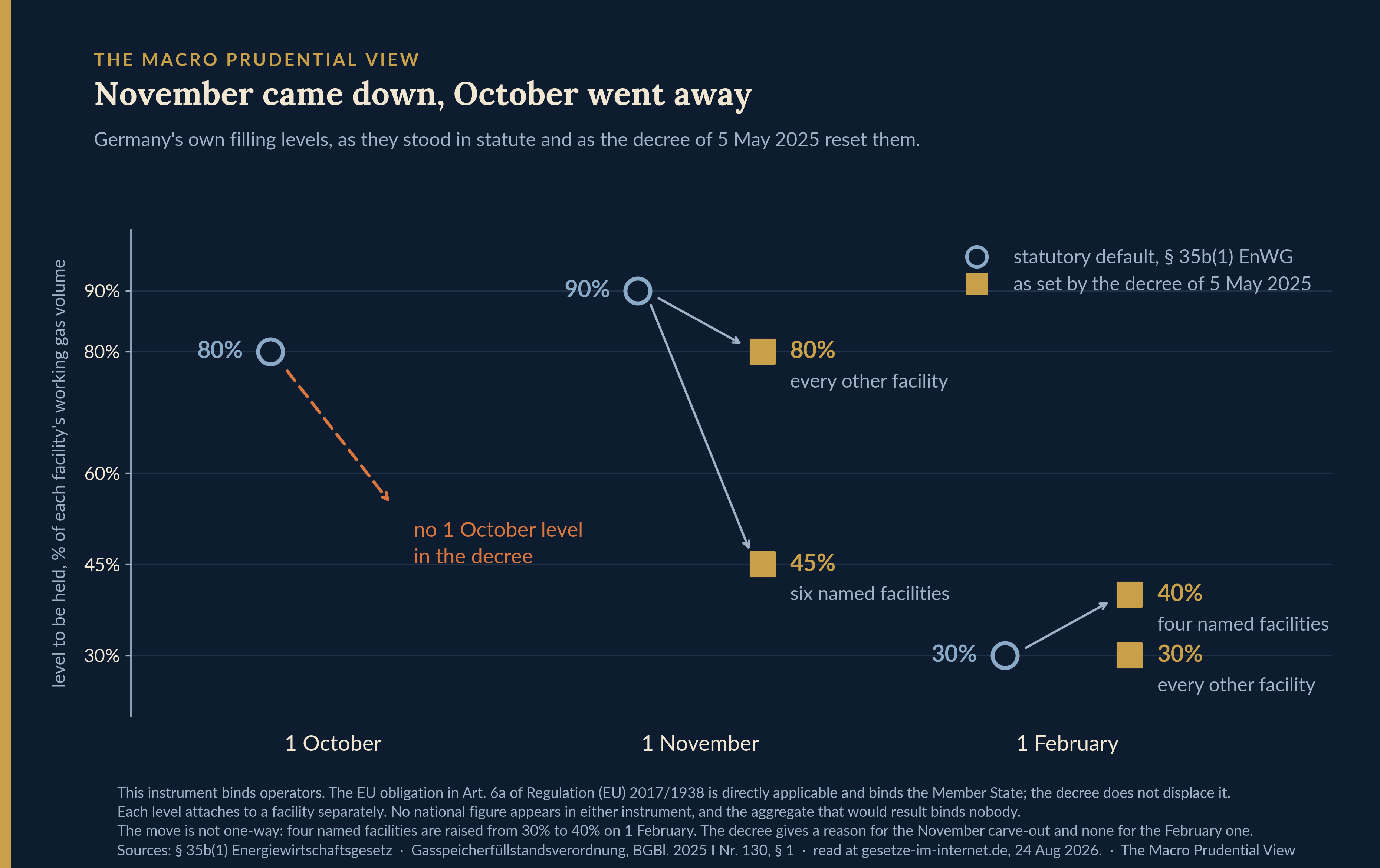
On 1 November, 80% at every facility except six — Bad Lauchstädt, Frankenthal, Hähnlein, Rehden, Stockstadt and Uelsen — which owe 45%. On 1 February, 30% everywhere except Bierwang, Breitbrunn, Inzenham-West and Wolfersberg, which owe 40%. The six at 45% are carved out, in the regulation’s own words, on account of “their markedly reduced injection and withdrawal rates and their geographic location”. The four at 40% are given no reason at all.
Set that against what the statute itself says and the shape of the change appears. Section 35b(1) puts Germany’s own levels at 80% on 1 October, 90% on 1 November and 30% on 1 February — the November figure being the EU figure. The decree deviates from all of it, and not in one direction: November comes down, October disappears, and February goes up for four sites.
Reporting converts this into a German national target of about 70%. No such number exists in the instrument, and the conversion is not innocuous. Each facility owes its own floor, so a full site does not discharge an empty one, and the weighted average binds nobody. I can bracket it between 68% and 73%, depending on how two pooled AGSI records divide between named and unnamed facilities, but I cannot reproduce a point estimate, and neither, as far as I can tell, has anyone who has published one.
The two instruments do not conflict, because they bind different people. The EU obligation sits on the Member State. The German one runs through § 35b of the Energiewirtschaftsgesetz, which puts the duty on the operator of each facility — but the duty is to write contract terms creating the conditions for the level to be reached, and the facilities “should” reach it. Working gas is held by storage users, not by the operator, so the obvious question is what an operator does when its users have not delivered.
The statute answers it. Under § 35b(5), where the levels cannot be reached because a user is not using working gas volume it has firmly booked, the operator must hand those unused capacities to the market area manager, pro rata to the extent of non-use, along with a proportional share of injection and withdrawal capacity. The user goes on paying for the capacity it booked, minus the variable injection charges. That is the plumbing connecting a facility floor to a state buyer, and it is what stops the German floors being a mere exhortation.
Read § 35b(1) before any of this and the sequence sharpens. The default German levels are 80% on 1 October, 90% on 1 November and 30% on 1 February. The 1 November figure is the EU figure. The Gasspeicherfüllstandsverordnung deviates from all of it: 80% on 1 November, 45% at the six named sites, and no 1 October checkpoint at all.
What EU law permits
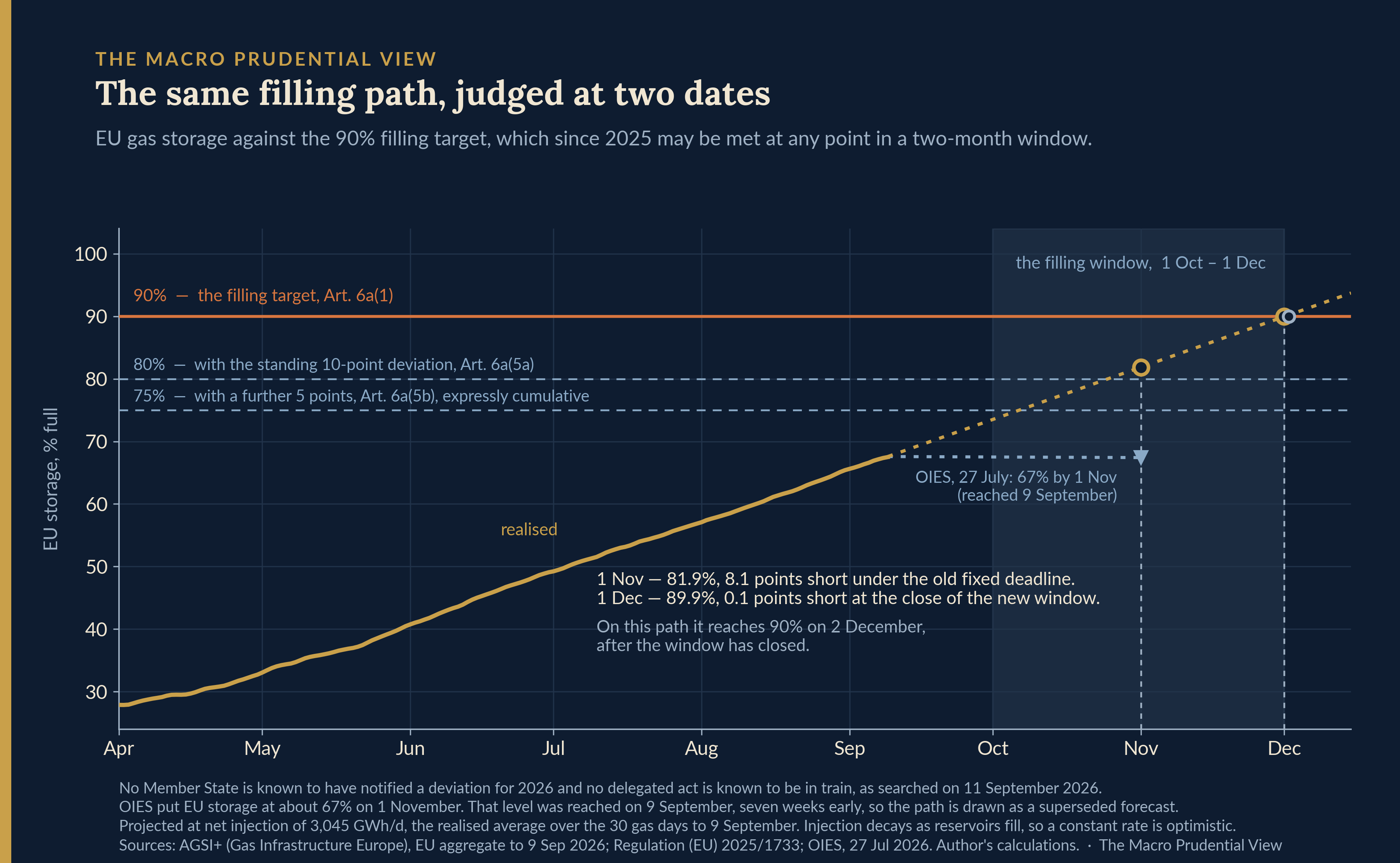
Two things moved in 2025 before any derogation is reached. The target may now be met at any point between 1 October and 1 December rather than by a fixed 1 November. And the filling trajectories that functioned as intermediate checkpoints became “a series of indicative intermediate targets” that Member States “strive to follow”, with no binding obligation at EU level.
The first is not a technicality this year. Hold the realised EU injection rate flat and the same physical path is 8.1 points short of 90% on the old fixed date and 0.1 points short at the close of the new window. On this year’s numbers the window is not a technicality at all: it is the difference between a Member State that plainly misses and one that arrives within a rounding error, having done nothing differently.
That 0.1 is a floor rather than a forecast. Holding a September rate through November is generous in a way the calendar makes obvious: injection slows as reservoirs fill, and in most years the last weeks before December add little or turn negative. The gap between the two dates is real; its size on any particular path is not.
Then the derogations. The terms matter here, because they are routinely summarised wrong.
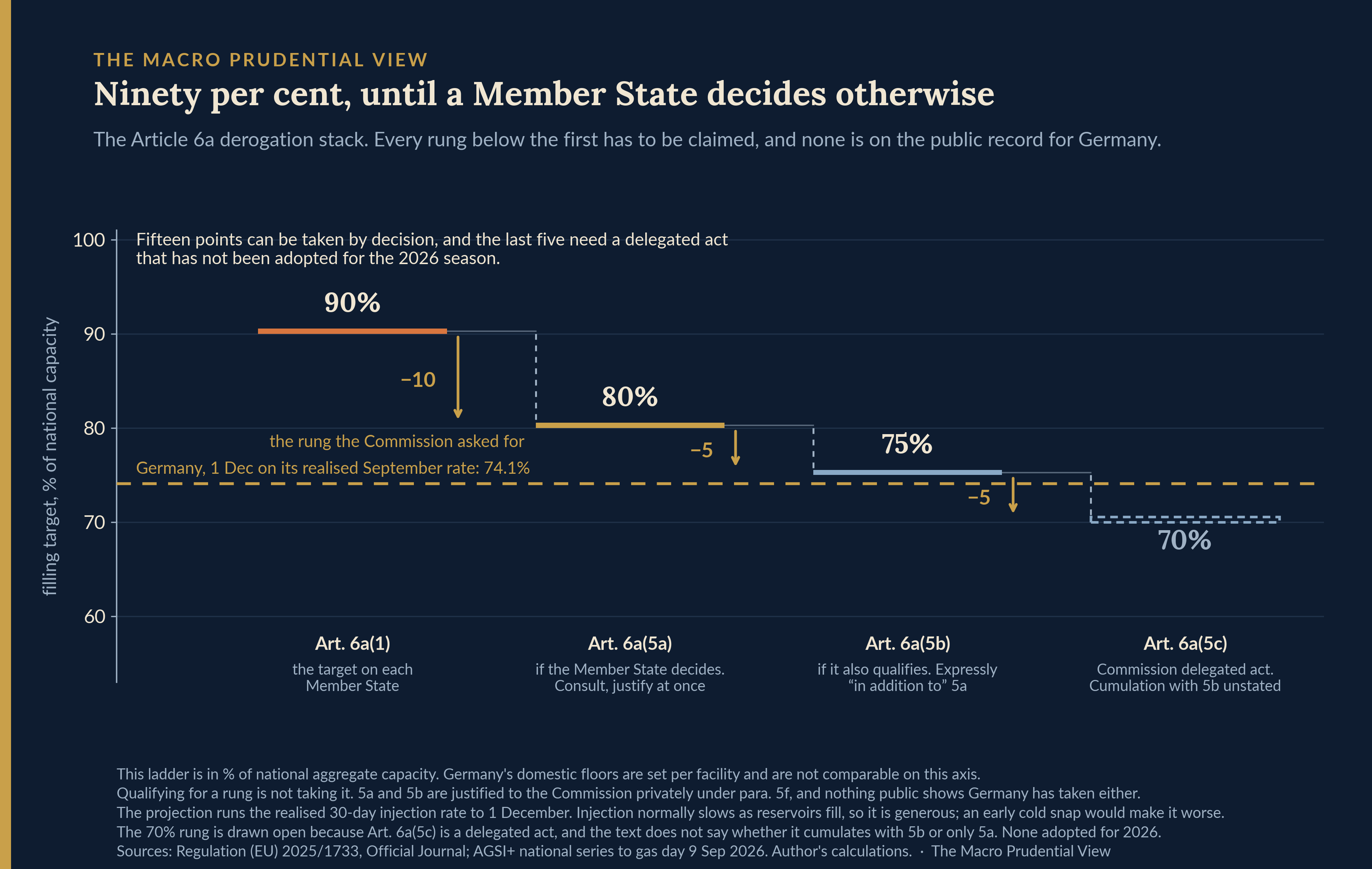
Paragraph 5a lets a Member State decide to deviate by up to ten percentage points where “difficult conditions” limit its ability to fill. The European Parliament, describing its own text, put the trigger as difficult market conditions with “indications of speculation hindering cost-effective storage filling”. Paragraph 5b adds five more and says expressly that it applies “in addition to” 5a, so those cumulate to fifteen. It is available where national production exceeds consumption, or where “specific technical characteristics of an individual underground storage facility with technical capacity above 40 TWh” require an injection period beyond 115 days. Paragraph 5c adds a final five, granted by the Commission for a single filling season by delegated act. No such act has been adopted for 2026.
None of that is automatic. The target remains 90% unless a Member State decides to deviate and justifies the decision to the Commission, and 5c requires the Commission to legislate. The floor a Member State can reach if it takes every step available this season is 75%. The floor that applies until it does is 90%.
Nor does 90% mean the same thing everywhere. Article 6a(2) reduces the target, for Member States whose storage is large relative to their demand, to a volume worth 35% of average annual gas consumption over the preceding five years. The Netherlands is the obvious candidate in this region, and on that reading it owes a volume rather than a percentage, which converts to something below 90% of its capacity. I have not reproduced the five-year series the article specifies, so I am not putting a number on it. What survives without one: two Member States under a single headline figure, owing different fractions of their own storage before either has injected anything.
Note where 5b’s second limb points. It needs two things of the same site: technical capacity above 40 TWh, and a slow injection rate producing a period beyond 115 days. Rehden appears to clear both, though not from any single source. Its operator puts the facility at around four billion cubic metres of working gas, about 44 TWh. On the injection side, AGSI’s own declared figure for the larger Rehden record is 282 GWh/d against 35.7 TWh of working gas, which is 127 days to fill it from empty.
That second calculation is mine, not the operator’s, and “injection period” is not defined in the article. But the capacity limb is a problem for anyone reading the public data. AGSI reports Rehden as two marketed products, the larger 35.7 TWh, and neither crosses 40 on its own. The German carve-out and the EU derogation rest on the same physical fact about the same asset, and the public data reports that asset in pieces.
Paragraph 5f requires a Member State taking 5a or 5b to consult the Commission and justify itself immediately, so visibility across the stack runs from a private justification to a published delegated act. Nothing in the public record shows that Germany has taken either. The Commission invited Member States to use the flexibility, and an invitation is not evidence that anyone accepted it. The loosening that has demonstrably happened sits outside this ladder altogether.
The Commission asked
Three weeks after the Middle East disruption began, the flexibility stopped being theoretical. The Commission announced on 23 March 2026 that Commissioner Jørgensen had written to EU energy ministers. Its Gas Coordination Group note of 26 March records the ask: the letter invited “EU countries to make use of the flexibility provisions in the Gas Storage Regulation and to consider reducing their filling target to 80% as early as possible in the filling season”, to “provide certainty and reassurance to market participants”. The April note refers to refilling “to a minimum of 80% by 1 November depending on LNG supply availability”. The letter itself has not been published.
A mandatory buyer with a published target is a buyer the market can position against, and softening the target early reduces the size of a forecastable bid. That is the argument for releasing a countercyclical buffer at the onset of stress rather than waiting to see whether the stress binds. It is often right, and it is always available.
Where Germany actually is
German storage was 55.16% full on 9 September, and the country is injecting about 566 GWh/d, measured as the change in stock over the preceding thirty days. Hold that rate and Germany reaches 67.3% on 1 November and 74.1% on 1 December.
That leaves it 15.9 percentage points short of the EU’s 90% at the close of the window. Getting to 90% by 1 December means covering 34.8 points from where it stood on 9 September, which over those 83 days is 184% of the rate it is managing now. Uniper’s chief executive, speaking on 11 August, put it in commercial terms: “We can still get there, but we do have to see the market prices move to incentivize the filling of the storage.”
On 20 August the economics ministry said reserves at 60% to 70% would be sufficient for winter, conditional on extra imports. That is a further number for the same winter, from the department that wrote the facility list.
I would not defend the decimal places. A thirty-day August rate extrapolated forward is crude, injection slows as reservoirs fill, and a cold snap before the window closes would make it worse. What follows does not depend on the extrapolation.
What the aggregate hides
Because each German facility owes its own floor, the quantity that binds is the sum of the individual shortfalls. Gas held above the floor at one site does not discharge the obligation at another — it could physically be withdrawn and re-injected elsewhere at a cost, but it does not count where it sits, and the arithmetic of a national percentage silently assumes it does.
Take the 44 facilities whose floor is unambiguous — 209.8 TWh of working gas, 85% of German capacity, leaving aside two AGSI records that pool a named 45% facility with unnamed others. From 9 September to the 1 November date:
30 of the 44 sit below their own floor
the shortfalls sum to 42.8 TWh
facilities above their floor hold 4.4 TWh more than they need
a national percentage reports the difference, 38.4 TWh
The aggregate understates the requirement by 4.4 TWh, about 12%. The bias is structural and always runs the same way, because a percentage lets a full site pay for an empty one and the law does not. It has doubled since late August, and for the reason you would expect: as the country fills, more sites rise above their own floor, and every tonne of that surplus is netted off a requirement it cannot discharge.
The Rehden record alone accounts for 12.8 TWh of the 42.8, thirty per cent of the shortfall across this sample. The sample is 84.8% of German working gas volume rather than all of it, so that share is not a national figure — but it is close to a third of the measured requirement sitting in one record, and that record has a lower floor than any unnamed facility in Germany precisely because it fills slowly. Its share has risen since August, because the rest of the country has been filling and it has not.
The distribution behind the 55.16% is stark, and has grown starker. The four cleanly identifiable facilities on the 45% floor hold 48.9 TWh of working gas between them and were 19.7% full on 9 September. Everything else was 63.8% full. Frankenthal was still at zero. Over the three weeks to 9 September the rest of German storage gained five points and this group gained under two, so the sites given the lower requirement are not merely the empty ones — they are falling further behind.
Four facilities that would have to beat their own declared rate
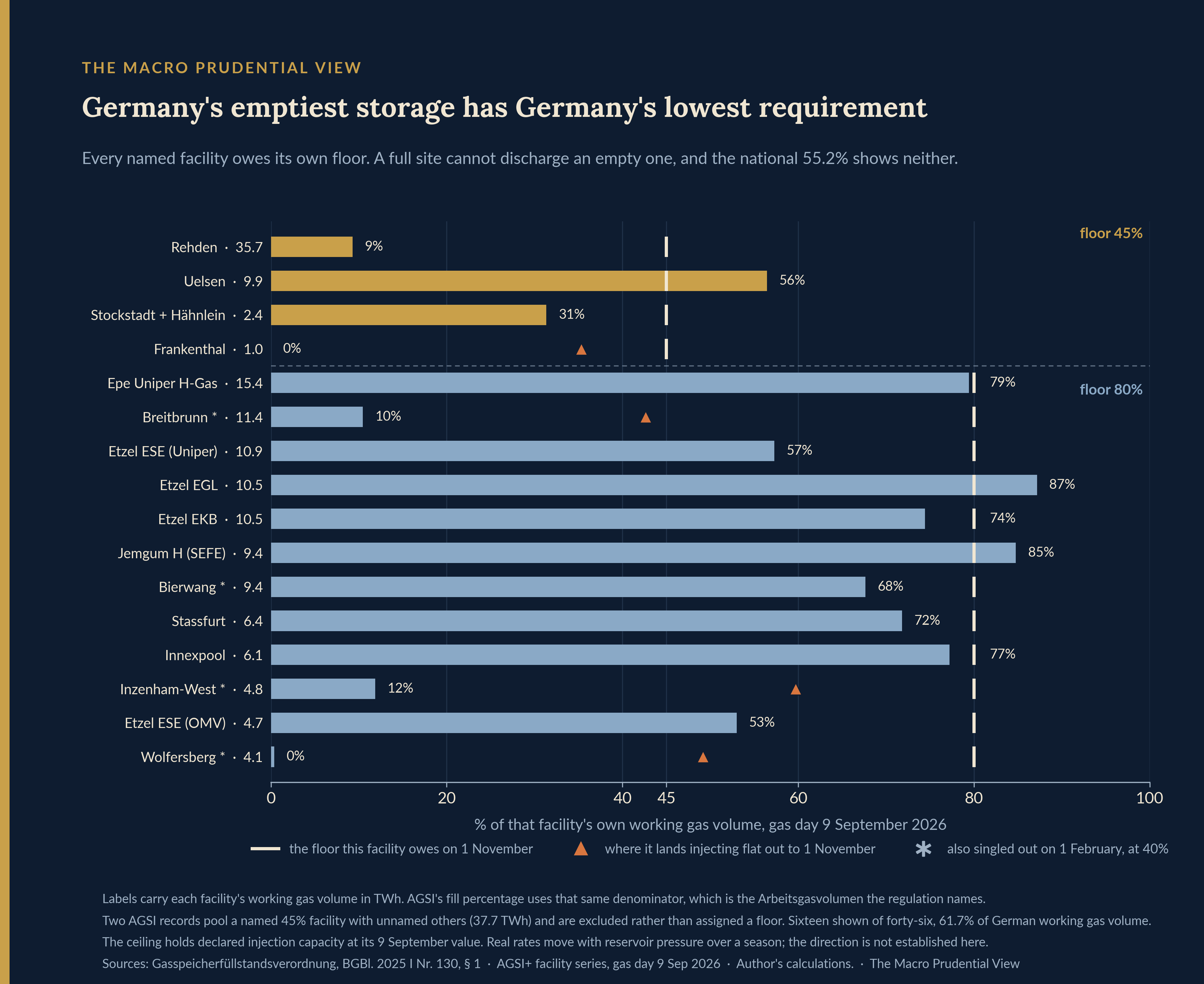
Run each German facility at the injection capacity it declared on 9 September, every day until 1 November, and four of them still fall short of their floor.
Breitbrunn was 10.5% full and tops out at 42.6%, thirty-seven points below its line. Wolfersberg was at 0.4% and reaches 49.2%. Inzenham-West was at 11.9% and reaches 59.7%. Those three owe 80%. Frankenthal, which owes 45%, was at zero and reaches 35.3%.
Three weeks ago the same calculation caught three sites and put their ceilings eleven to seventeen points higher. Nothing about the facilities changed. The calendar did: there are eighteen fewer days left to inject in.
The assumption carries the result, so it belongs in the open. Declared injection capacity is held at its 9 September value for fifty-three days, and real rates move with reservoir pressure over a season in a direction I have not established. Read as arithmetic on a declared rate, this holds. Read as a claim that these sites cannot physically comply, it does not, and I am not making that claim.
The facility view answers a question the aggregate cannot. Germany’s installed injection capacity is 4,294 GWh/d and the country is using 566, an eighth. Across only the facilities that are short, the required rate is 808 GWh/d against 2,705 installed, which is 30%. Nationally there is slack. At these four sites there is none at the rate they are declaring. Both are true, and only the facility data distinguishes them.
Three of the four sit among the Bavarian facilities that the regulation singles out in February, granting them a higher floor than everyone else, 40% against 30%. It is tempting to read that as the instrument recognising a constraint at one date and forgetting it at the other. The regulation gives no reason for the February carve-out — unlike the November one, which it justifies expressly — and a higher end-of-winter floor for a regional cluster has an obvious reading as a withdrawal-season standard. The coincidence is real and it will not carry an inference.
If not capacity, then price
Jack Sharples and Ricky Hill, writing for the Oxford Institute for Energy Studies on 27 July, report seasonal spreads “consistently negative” through 2026, against 1.50 to 2.00 EUR/MWh from May to August 2025. They do not name the contract months, so neither will I. The trade that fills European storage, buying summer gas to sell in winter, has been booking a loss on entry all summer.
The cross-year record is at least suggestive, and less so than it was a month ago. In 2021 EU storage entered the same thirty-day window at 60.6% full and took 3,457 GWh/d. In 2026 it entered at 59.6% and took 3,045, about an eighth slower from an almost identical starting point. On the equivalent window ending in August the gap was a quarter, so it has been closing.
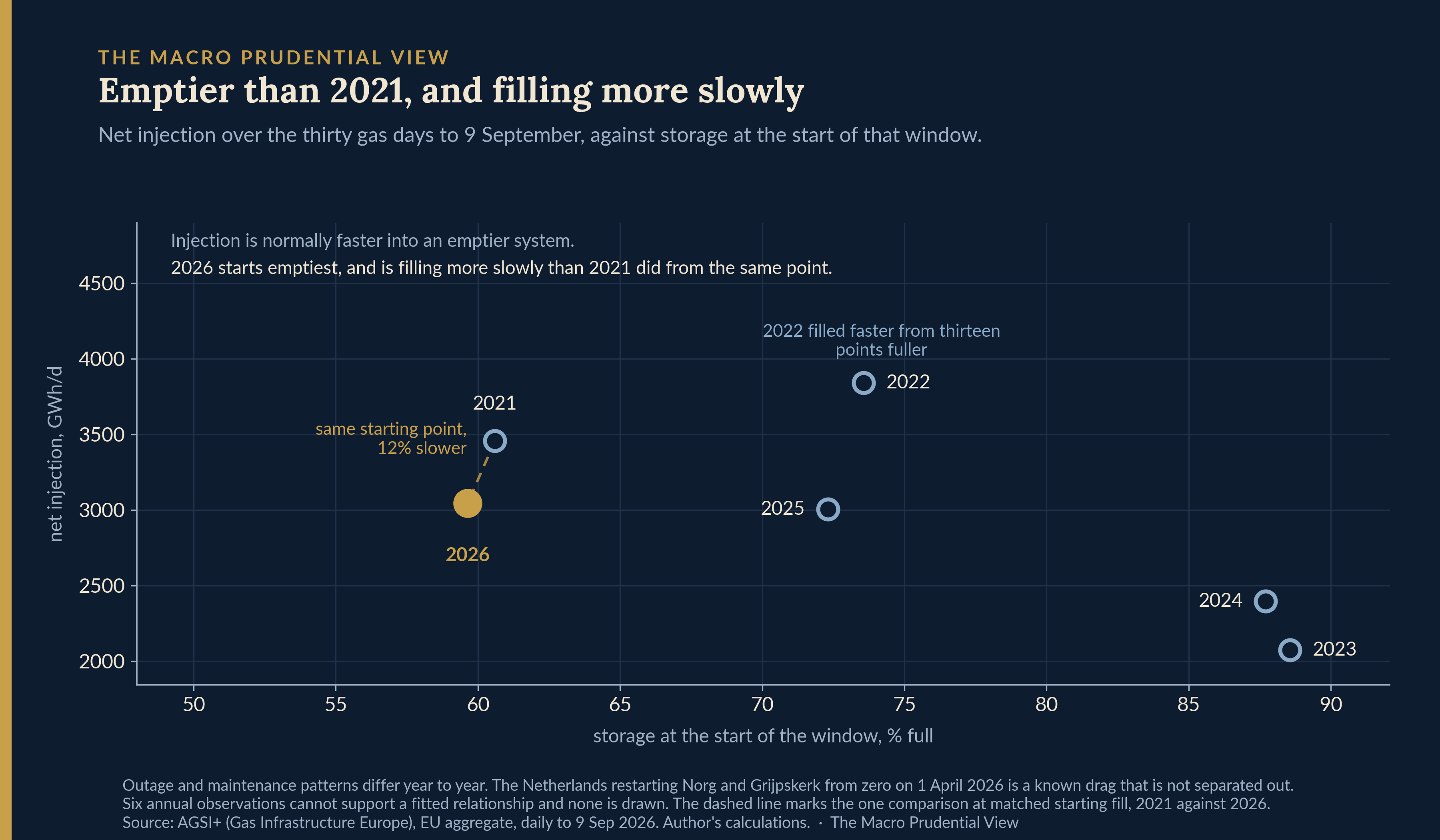
One matched pair is not a control, and I should not dress it as one. Storage fees, capacity bookings, financing costs and fuel losses all sit between a headline spread and a filled tank; outage patterns and country composition differ year to year; and an EU aggregate fill percentage conceals the facility distribution behind it, which is this piece’s own complaint turned against its own evidence.
It is also a claim with a shelf life, and some of it has expired. Through August Europe was filling an unusually empty system no faster than it had filled nearly full ones in 2023 and 2024. Through early September it is filling faster than either, and faster than 2025. Whatever was binding in high summer has loosened. What remains is narrower: the emptiest system in the record is still being refilled more slowly than 2021 managed from the same point, and a persistently negative spread is the most obvious candidate for why.
A common claim is that only about 76% of German storage capacity is commercially booked, and that this caps what can be filled. It caps what the market fills. Section 35c(2) of the Energiewirtschaftsgesetz, in force until March 2027, lets the market area manager book the capacity it needs at a formula-set fee. The booking rate is a constraint on traders, not on the Member State.
How Germany filled its tanks last time
In 2022 Europe went into the filling season facing the loss of Russian pipeline gas at prices several times today’s, and filled anyway — Germany reached about 95% by 1 November. It is tempting to read that as proof that price never stops a determined buyer.
What it shows is narrower. Most of that gas was bought by the market; the part that closed the gap was not. Trading Hub Europe, the market area manager, was tasked by the federal government with buying close to 50 TWh of gas for around €9 billion, mostly on the spot market at record prices, on volume the market had not booked. Fifty terawatt hours against a national working gas volume of 247 is a fifth of the country’s storage, procured by the state. The cost was recovered through the Gasspeicherumlage, a levy on consumers that began at €0.59/MWh and reached €1.86/MWh by January 2024.
Both halves of that arrangement were changed in 2025, and in opposite directions. The purchasing power survives: section 35c(2) of the Energiewirtschaftsgesetz, in force until 31 March 2027, still empowers the market area manager, with ministry approval, to undertake “the acquisition of physical gas and its injection” where the market’s own filling falls short. The financing does not. Section 35e now runs only to the end of 2025, and since 1 August 2025 it excludes from the levy any cost beyond the manager’s own material, staff, advisory and financing costs — which is to say, the cost of the gas itself.
So Germany still has the power it used in 2022, and the particular route it used to pay for it has been closed. Whether another exists — an appropriation, a guarantee, borrowing — I have not established, and the question has not been put in public. That change and the facility floors arrived in the same year, both before the disruption that made either matter. The Gasspeicherfüllstandsverordnung is dated 5 May 2025; the Commission wrote to energy ministers in March 2026; the ministry’s remark about 60% to 70% came last week. The instruments were in place before the winter they now govern.
So the two episodes compare on something firmer than price. In 2022 Germany bought a fifth of its storage and socialised the bill. By 2026 it had lowered the floor its operators owe and closed the account the 2022 purchase was charged to. Both are defensible responses to a changed supply picture. Neither shows up in the headline target, and only one of them shows up in a fill percentage.
The reading in which nothing has gone wrong
There is a version of these facts in which this is all sensible, and it deserves more than a caveat.
On that reading, 90% was calibrated in 2022 against the abrupt loss of Russian pipeline gas, where storage was the only buffer between Europe and a supply cliff. The risk now is different. LNG is the marginal supply, it arrives on ships that can be redirected, and a persistently negative summer-winter spread is the market’s forecast that winter gas will be available and affordable. Filling to 90% then buys expensive insurance against a contingency the market has already priced away, and the Commission’s 80% invitation is a rational recalibration to a different supply regime. Its April language points the same way, conditioning 80% on “LNG supply availability”, which is a supply-contingent standard rather than a fixed one.
The German facility carve-outs have the strongest version of this behind them. The regulation says the six sites at 45% cycle slowly, the ceiling arithmetic above is consistent with that, and a rule that ignores injection physics is a worse rule than one that accommodates it.
Two things stop me settling on it. If this is a recalibration, it has never been stated as one: no impact assessment lowers the 90%, no delegated act has been published, and the headline figure is unchanged. And a forward curve prices what the market expects, which is not the same as what a buffer is for. Storage is held against the case the curve does not contain. A negative spread is evidence that the market does not expect to need it; the target exists because expecting not to need it has never been the test.
The parameter that gets reported
Count the numbers now attached to one requirement for one winter. Ninety in the EU regulation. Eighty if a Member State takes the ordinary derogation, and the level the Commission asked for. Seventy-five if it also qualifies for the structural one. Seventy-three for the Netherlands under the consumption cap. Eighty in Germany for most facilities, forty-five at six of them. Sixty to seventy as sufficient, per the German ministry on 20 August. Thirty in Germany on 1 February, and forty at four Bavarian sites.
The first is the one that travels.
The reason is not conspiratorial. Lowering a stated requirement is a public act with an identifiable constituency against it. Widening a window, softening a trajectory to indicative status, legislating a derogation exercised on a private justification, or setting facility-level floors in a ministerial regulation are governance acts of a different order, and they attract less scrutiny for a comparable effect on the buffer that actually exists.
None of it was concealed. The EU flexibilities were legislated in the ordinary way and presented as measures that would bring prices down; the German regulation was published in the Bundesgesetzblatt; every fact here came from a public document. A requirement can be adjusted in the open, repeatedly, and still leave the published comparisons unchanged, because those comparisons track the parameter that did not move.
The macroprudential parallel is close, and I want it stated narrowly. Article 136(5) of the Capital Requirements Directive sets the timing of increases in the countercyclical buffer rate: institutions must apply an increase no later than twelve months after it is announced, and a shorter deadline than that has to be justified by exceptional circumstances. Nothing imposes an equivalent lag on reductions; 136(6) asks only that an authority reducing the rate indicate a period during which no increase is expected, and says that indication does not bind it. The asymmetry is deliberate and defensible. It also means an announced increase can sit a year away from applying, which a comparison reporting the currently applicable rate does not show, and which a comparison carrying the announced rate and its effective date would.
For anyone building resilience metrics, the German case makes a sharper point than “headline rates are incomplete”. Aggregating facility-level floors into one percentage understates the requirement structurally, in the direction of comfort, and the understatement grows as the system fills — 6% in late August, 12% three weeks later, because every site that rises above its own floor adds surplus the law will not let it spend. The aggregate also says nothing about which sites are furthest from what they owe, which is the part that decides whether the shortfall is recoverable.
What happens next
Europe will spend the autumn quoting 90%. Whether Germany meets anything turns on a window widened in 2025, derogations that may or may not be exercised, a delegated act that has not been adopted, a facility list that expires in March 2027, a purchasing power whose financing was withdrawn in the same year it was last needed, and whether the seasonal spread turns before October.
Not one of those was decided this winter, and every one of them is decided before this winter is scored. On its present national trajectory Germany misses the EU number, and thirty of the forty-four facilities I can measure sit below the floor their own regulation sets. Whether they close it is a question about forty-four separate injection paths, which is exactly the question the published figure is not built to answer.
Paweł Fiedor — The Macro Prudential View
The views expressed are the author’s own and do not necessarily reflect those of any institution with which the author is or has been affiliated.
Sources: Regulation (EU) 2017/1938 as amended by Regulation (EU) 2025/1733, Official Journal — https://eur-lex.europa.eu/legal-content/EN/TXT/HTML/?uri=CELEX:32025R1733; Regulation (EU) 2022/1032, for the Article 6a(2) five-year consumption basis — https://eur-lex.europa.eu/legal-content/EN/TXT/HTML/?uri=CELEX:32022R1032; Gasspeicherfüllstandsverordnung of 5 May 2025, BGBl. 2025 I Nr. 130 — https://www.gesetze-im-internet.de/gasspf_llstv_2025/BJNR0820A0025.html; Energiewirtschaftsgesetz §§ 35b, 35c and 35e — https://www.gesetze-im-internet.de/enwg_2005/__35b.html, https://www.gesetze-im-internet.de/enwg_2005/__35c.html and https://www.gesetze-im-internet.de/enwg_2005/__35e.html; Directive 2013/36/EU, Article 136 — https://eur-lex.europa.eu/legal-content/EN/TXT/HTML/?uri=CELEX:32013L0036; European Commission, gas storage — https://energy.ec.europa.eu/topics/energy-security/gas-storage_en, and the Gas Coordination Group notes of 26 March and April 2026; Jack Sharples and Ricky Hill, European Storage Refill in Summer 2026: Key Countries, Their Stocks, and Replenishment Mechanisms, Oxford Institute for Energy Studies, 27 July 2026 — https://www.oxfordenergy.org/publications/european-storage-refill-in-summer-2026-key-countries-their-stocks-and-replenishment-mechanisms/; SEFE Storage GmbH, Rehden facility — https://www.sefe-storage.de/en/storage-locations/rehden-storage-facility. Storage data: AGSI+ (Gas Infrastructure Europe) — https://agsi.gie.eu — EU aggregate to gas day 9 September 2026, the German national series to the same day, and the German facility-level series for gas day 9 September. Author's calculations throughout.