



On 29 May 2026 the finance ministers of Germany, France, Italy, Spain, the Netherlands and Poland agreed to back more centralised supervision of EU capital markets. The industry answer was already on record: for EFAMA, turning ESMA into an extra supervisor for asset managers is “unwarranted, a major distraction, and runs contrary to the EU competitiveness and simplification agendas” — and the version in the Parliament’s draft report is worse than the Commission’s. Since then, the public argument has mostly run on those rails: cost and competitiveness on one, institutional design on the other.
Read the legislative texts, though, and the divide that matters most for the system-wide risk monitor sits elsewhere: in whether the powers to act on fund-sector systemic risk move together with the supervisor. The texts do not carry equal weight. The Commission’s December proposal has initiative status; the rapporteur’s June draft report for the Parliament’s economic affairs committee is one pole of an amendment process, not yet voted in committee and not a Parliament position; the Council had adopted no position at the time of writing; and the ECB supports integration while calibrating, for asset managers specifically, short of what the rapporteur proposes. This piece maps what each text does to the macroprudential machinery and where the open questions sit. It takes no position on what should be adopted.
What the texts do
The Commission’s Market Integration and Supervision Package (4 December 2025) does not centralise the supervision of asset managers. It creates a recurring review (new Articles 47a and 47b of the AIFMD and 110b and 110c of the UCITS Directive): ESMA, in cooperation with home authorities, would review at least annually each EU group of management companies and AIFMs with aggregate EU-wide net asset values above €300 billion and a multi-Member-State footprint, with escalation powers running as far as suspending a group’s cross-border activity. AIFMD Article 25 — the provision under which national authorities impose leverage limits and other restrictions on fund managers — is left untouched.
The rapporteur’s draft report for ECON (Eero Heinäluoma, 12 June 2026) restructures this into two tiers. The annual review would apply to groups between €50 and €150 billion. Above €150 billion, with cross-border operations, ESMA would designate a group significant and, in the words of the inserted Article 44a of the AIFMD, “assume the supervisory tasks and duties assigned under this Directive to the competent authority of the home Member State, including for their authorisation and supervision.” The review article confirms the tiering: it applies to groups “that do not fall under the direct supervision of ESMA pursuant to Article 44a.”
The macroprudential part of the draft sits next door. New Articles 25a and 25b would write a toolkit into the AIFMD itself: powers to require notice periods, holding periods and redemption-frequency limits for open-ended AIFs, applicable to whole categories of funds where systemic risk is identified; and leverage limits at fund or category level, with real-estate funds calibrated on total debt to total assets — the design the Central Bank of Ireland used in 2022, generalised. ESMA would draft the technical standards for both, jointly with the ESRB on leverage. The draft also puts depositaries under direct ESMA supervision, mirrored across both directives (new Articles 101a of the UCITS Directive and 54a of the AIFMD) — with a duty to coordinate with the banking supervisors, since the large fund depositaries are credit institutions supervised under the SSM or nationally. It is a measure of how far beyond the Commission text the draft reaches. The rapporteur’s explanatory statement is explicit about the logic: a more integrated supervisory framework for funds should be accompanied, as the ECB has argued, by amendments to the macroprudential framework.
Two design questions sit in the texts themselves. The first is the perimeter. Both thresholds are group aggregates: they add up the net assets of the management companies and AIFMs inside a group, which measures how much a manager runs, not the footprint its funds have in markets. A group can sit under the line while managing funds whose gross exposure is a multiple of their net assets — the profile behind most leverage-driven fund episodes. The drafting compounds it: Article 44a sets the threshold in net asset values while its definition paragraph speaks of assets under management, and for leveraged managers the two differ by multiples. That mismatch is in the legislative text, and technical standards cannot repair it.
The second question is timing. The rapporteur frames Articles 25a and 25b as ex-ante instruments, but the text does not confine them to calm conditions, and a category-wide notice period announced into stress sharpens the first-mover incentive that liquidity tools exist to dampen. Fund-level gates carry the same anticipation problem in miniature; scaling them to whole categories scales it too. That one is a calibration question, and it does land on the technical standards.
The layer that does not move
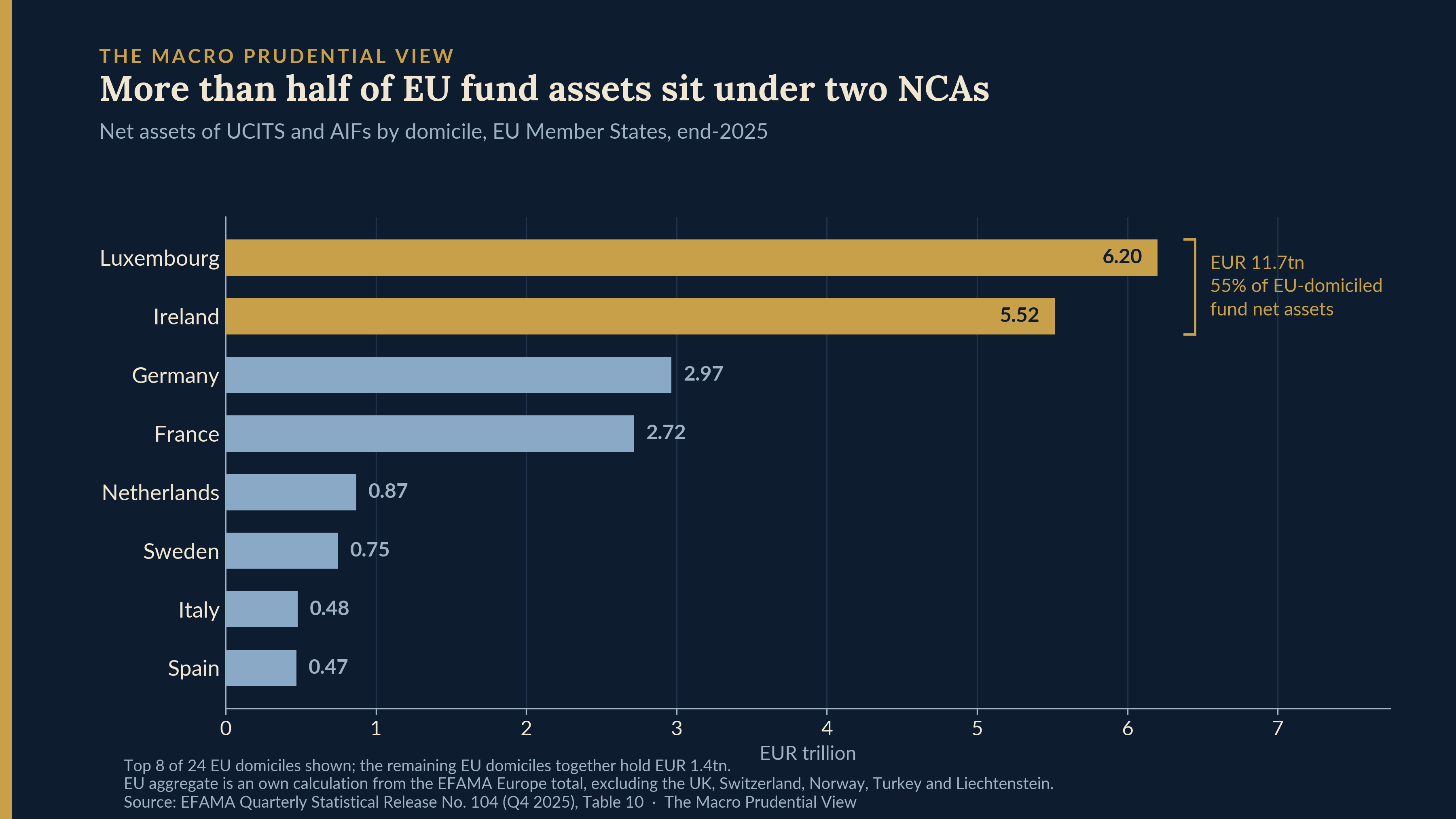
Every text on the table leaves the fund layer national. Authorisation of UCITS and AIFs, product supervision, day-to-day oversight and enforcement in national courts stay with the domicile authority under the Commission review and under the rapporteur’s direct-supervision tier alike. That layer is where the concentration sits: Luxembourg and Ireland domiciled €11.7 trillion of fund net assets at end-2025, 55% of the EU total. The management-company population is concentrated in the same places, though not universally — several large groups anchor their EU management companies elsewhere — which is why the chart is evidence about the fund layer, and only that. The cross-border character of the sector is structural either way: funds sold outside their domicile have grown from 49% of European fund assets in 2015 to 55% in 2025 — on EFAMA’s European aggregate, a wider perimeter than the EU figure above, which is an own calculation excluding the UK, Switzerland and the other non-EU domiciles. Any move at group level, under either proposal, would sit on top of a product and enforcement layer that is organised nationally and concentrated where the chart shows.
The same four questions
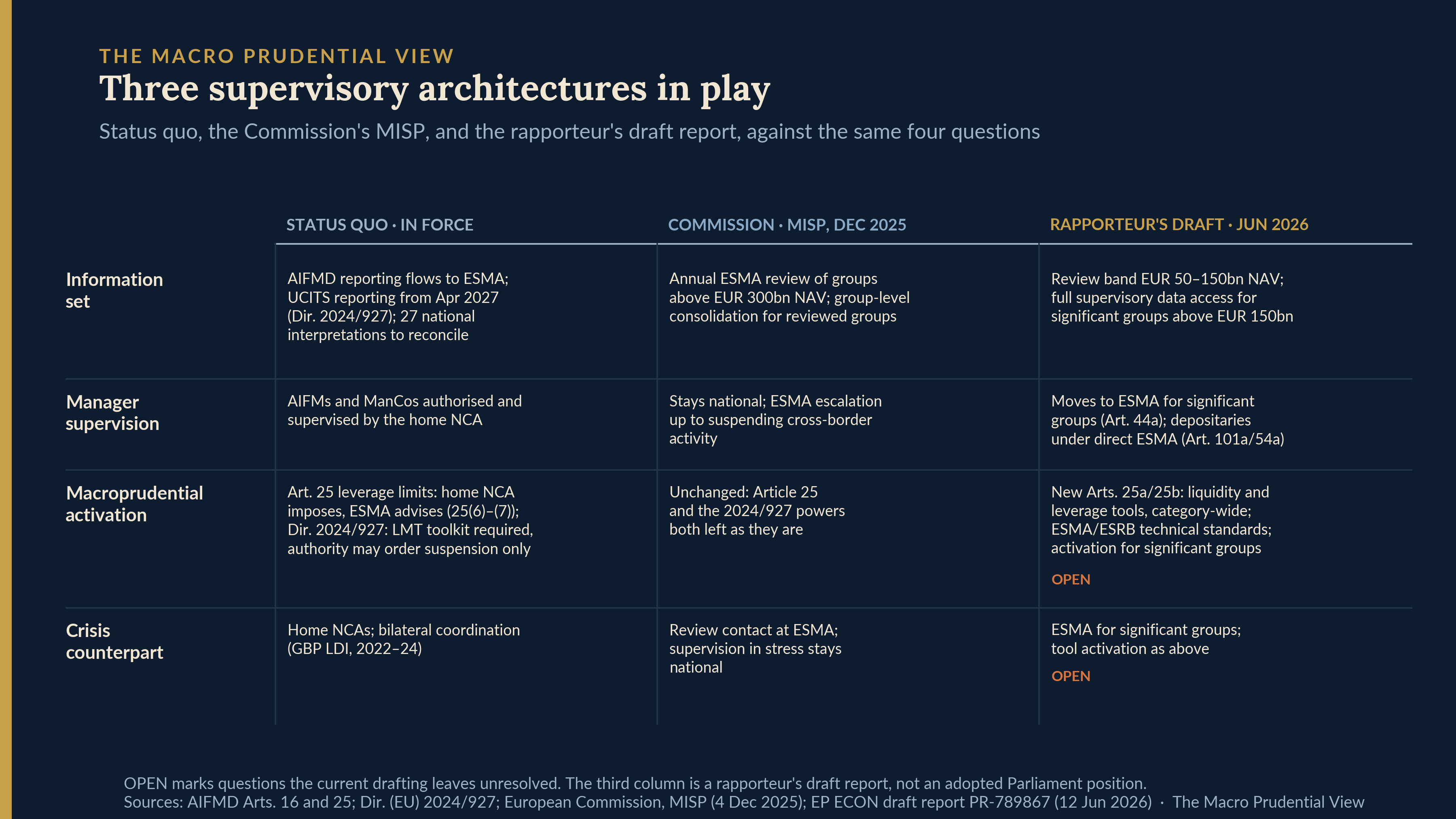
The honest way to compare the three architectures — the one in force, the Commission’s, the rapporteur’s — is to hold four questions constant: what information improves, which decision rights move, who leads when a large manager is under stress, and where the power to activate macroprudential tools sits. “Leads” means the authority a supervisor, a counterparty or a finance ministry calls first, which is a different thing from the authority that can impose a limit. The matrix carries the full cells; the prose here stays on the points where the columns diverge.
Information is the narrow difference. AIFMD reporting already flows to ESMA, UCITS reporting follows from April 2027 under Directive 2024/927, and the real gaps are group-level consolidation and the comparability of filings made under twenty-seven national interpretations. The Commission’s review forces consolidation for the groups above its threshold; the rapporteur’s significant-group tier converts that into full supervisory access.
The Commission has priced the difference, and the numbers are worth sitting with. Its impact assessment budgets ESMA 10 to 20 additional staff, €2–4 million a year, to coordinate supervision of around 10 to 15 large cross-border asset management groups. For comparison, in the same document, directly supervising the trading venues belonging to 8 to 11 groups is costed at 90 to 105 staff; five to eight CCPs at 30 to 50; ten to thirteen CSDs at 30 to 40. The gap between coordinating a review of a dozen groups and supervising a dozen entities is roughly a factor of five in people, on the Commission’s own estimates — which is one way of seeing how much lighter the review is than the word ‘supervision’ suggests, and what the rapporteur’s tier would be asking ESMA to build.
Decision rights are the wide difference, though not a clean one. The Commission’s review does move a decision right: escalation running as far as suspending a group’s cross-border activity is a power to act, not a power to look. What it leaves untouched is macroprudential activation — authorisation, supervision and Article 25 all stay national.
The rapporteur’s draft goes at the anchor itself, and here the drafting matters more than the intent. Article 44a would have ESMA assume the home authority’s tasks and duties, and Article 25(3) assigns the imposition power to exactly that authority. But the AIFMD defines competent authorities as the national authorities of the Member States, and the draft does not amend that definition — so whether ESMA could exercise powers the directive addresses to a category it does not belong to is an open legal question rather than a plain reading. The matrix marks two further cells open. The first is horizontal: 25a and 25b allow measures across whole categories of funds, a power addressed to “competent authorities” at large, which does not map onto the home-authority assignment the transfer clause uses. The second runs along the UCITS side: the significant-group definition counts UCITS management companies and AIFMs together, and the draft mirrors its depositary powers across both directives, but the transfer clause for significant groups sits in the AIFMD; without a UCITS counterpart, a designated group would answer to ESMA for its alternative-fund business and to its home authority for its UCITS business. A plain reading is not an operational answer, and the distance between the two is where the trilogues will spend their time.
Even on the reading where everything transfers, ESMA would be imposing entity-level measures on funds that remain authorised and governed under national law. How such a measure would be decided, challenged and enforced — through ESMA’s own decision and appeal machinery, through national procedure, or through both — the drafting does not trace. The measures in force show what that means: the property-fund limit bites an Irish market under Irish fund law; the yield buffer was built around the plumbing of funds in two jurisdictions. A limit calibrated in an ESMA technical standard would still have to bind, and be enforced against, specific funds in specific legal systems. This is the double layer EFAMA warns about, relocated to the macroprudential level; it cuts both ways, because that layer is where enforcement power and supervisory expertise both live. The Parliament’s own scrutiny unit reaches the same point from the other direction, and puts it more precisely: supervision in asset management is organised around the nexus between a management company and the funds it runs, since judgements about a fund rest on what the authority knows about the manager’s governance and risk arrangements. Splitting the two, on that reading, risks fragmenting layers that are operationally intertwined rather than resolving anything.
One part of the in-force baseline is easy to miss, and it sets the bar the new tools would have to clear. Directive 2024/927, applicable since 16 April 2026, already requires open-ended AIFs and UCITS to select and maintain liquidity management tools from a defined list. The power it gives authorities, though, is narrower than the toolkit it mandates: under the amended Article 46(2)(j) of the AIFMD, a home authority may require a manager to activate or deactivate suspension of subscriptions and redemptions — Annex V, point 1, and only that one — in exceptional circumstances, after consulting the manager, where risks to investor protection or financial stability warrant it. Notice periods, holding periods and redemption-frequency limits are tools the manager chooses and operates; no authority can order them today.
That is what Articles 25a and 25b would change, and in two directions at once: from the on-off switch to the calibrated instruments, and from a case-by-case direction to standing terms set across a category in advance. The Commission’s text leaves both the Article 25 powers and the 2024/927 powers as they are.
The UCITS side carries a home-host detail that bears on all of this. A host authority may ask the home authority to exercise its supervisory powers, informing ESMA and, where the stability of the financial system is in question, the ESRB — but the request mechanism excludes the very point covering activation of suspension. The tool that bites hardest in a run is the one a host authority cannot ask for.
The 2022 episode shows what the open cells would have required the texts to answer in real time: UK pension schemes, running liability-driven strategies through funds domiciled in Ireland and Luxembourg, selling into a falling gilt market. Under the architecture in force, the response ran through two national authorities coordinating bilaterally, with ESMA advising. Under the Commission’s review, ESMA’s information would plausibly have been better consolidated; the activation mechanics would have been identical. Under the rapporteur’s tier, if the managers involved had crossed the designation threshold and the funds were AIFs rather than UCITS, ESMA would have been the group supervisor — adding a Paris counterpart for the Bank of England alongside Dublin and Luxembourg rather than replacing them, since the product layer stays national under every text here. That dialogue ran on bilateral supervisory relationships, including memoranda of understanding with the UK authorities, and how they would map onto an additional EU-level counterpart the drafting does not settle. None of this says how the episode would have ended; it says which questions would have needed answers in the middle of a run.
The strongest institutional case for moving in this direction sits with the ECB, and even it stops short of the draft report. In its formal opinion on the package, the ECB welcomes the annual review of large groups as proportionate, warns that centralising functions within a group must not create supervisory blind spots or single points of failure, and states the condition the rapporteur later picked up: more integrated supervision of funds and managers should be “accompanied by a review of the Union macroprudential framework through targeted amendments to the UCITS and AIFM Directives”. Its Occasional Paper “One market, one supervision?” judges direct supervision of asset managers unlikely in the short term, proposing a stronger convergence role for the ten to fifteen largest cross-border groups. The Eurosystem argued in the same direction in the 2024 NBFI consultation, and the ESRB asked for European oversight of systemic cross-border actors — oversight and monitoring, which is not the same instrument as the direct supervisory mandate Article 44a would create. All of it was said before the draft report appeared, and neither institution has published a view on its specific articles. On the positions of record, the rapporteur’s text goes further than anything the official sector has proposed.
EFAMA’s October 2025 report carries the case against: ESMA would need supervisory capacity that some national authorities have accumulated over decades; splitting management-company supervision from product supervision creates a double layer; and collective decision-making is slower than a single authority in the moments that matter. The first and third are claims about institutional performance that the record cannot settle. The second is structural, and it survives every variant on the table.
A proportionality argument runs alongside it, and it does not come from the industry. The Parliament’s scrutiny unit notes that the sector has not historically produced the distress patterns seen elsewhere in finance, that UCITS in particular operate under binding constraints on leverage, liquidity and diversification, and that an added supervisory layer might therefore be questioned against the risks actually identified — while allowing that the Commission’s approach can be read as forward-looking, addressing coordination problems that past episodes have not yet surfaced. Whether that history is a guide or a lagging indicator is close to the whole disagreement.
The record, then the reach
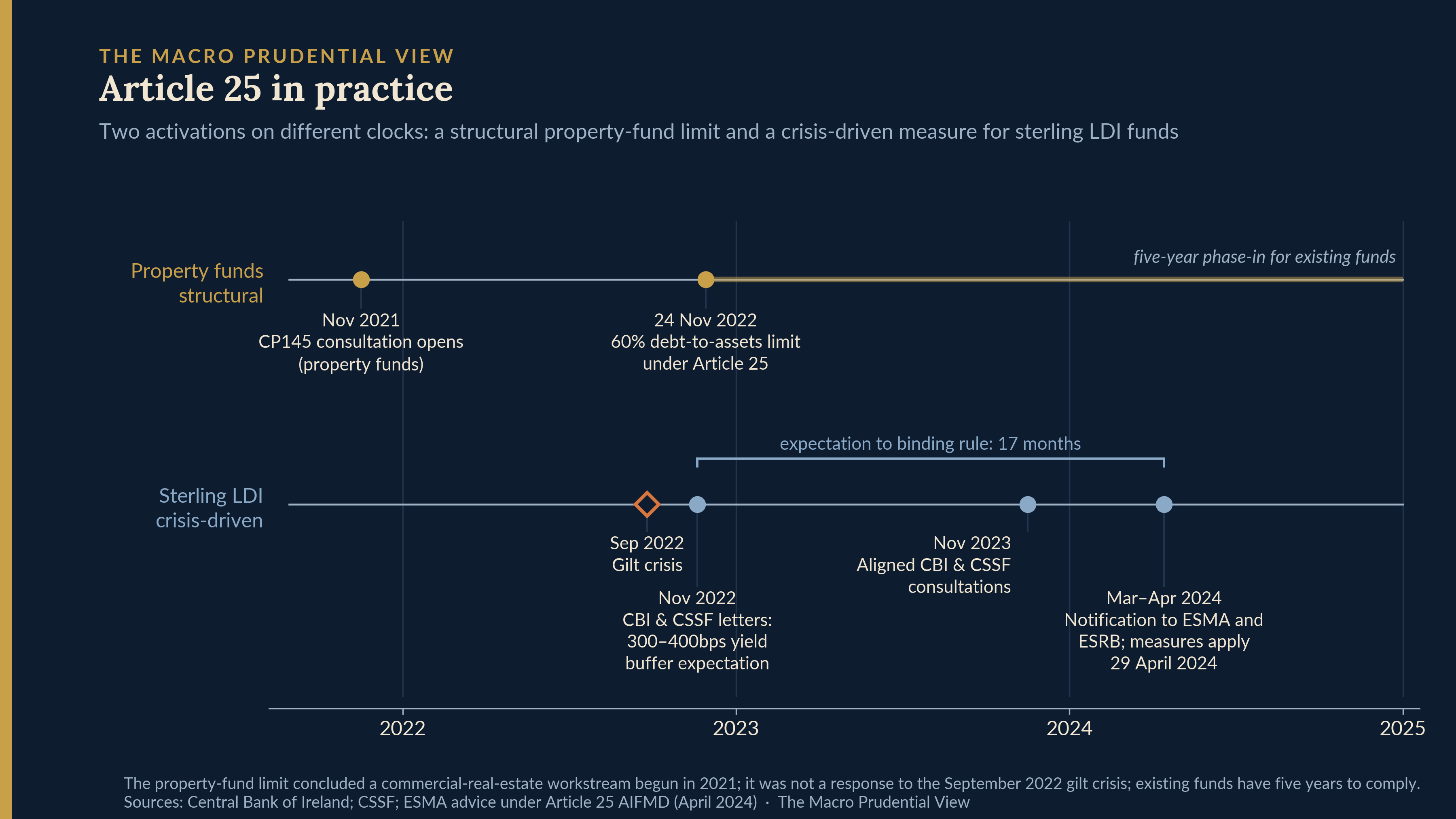
The one body of codified fund-level practice is Article 25 itself, used in two episodes — three measures, counting authorities — on clocks that have nothing to do with each other. The structural case is the Irish property funds: a consultation opened in November 2021, the 60% debt-to-assets limit followed in November 2022, and existing funds were given five years to comply, with full phase-in due in 2027. That measure addressed domestic commercial real estate and had been in preparation for a year before the gilt market moved.
The crisis case is sterling LDI. Within two months of September 2022, the Central Bank of Ireland and the CSSF had set a 300–400 basis point yield-buffer expectation by industry letter. Converting that expectation into a binding rule took seventeen months more: aligned national consultations in November 2023, notification to ESMA and the ESRB in March 2024, supportive advice, measures applying from 29 April 2024. Part of that is consultation and notification procedure an EU-level activator would face too. Part — two aligned national consultations to bind funds in two legal systems, having acted through letters while the codified route caught up — is specific to the current design, and it is the part centralisers cite. Between them, the two cases show the current architecture running a measure in both modes, and what each one costs.
What the record cannot show is reach, and reach is where the geography matters.
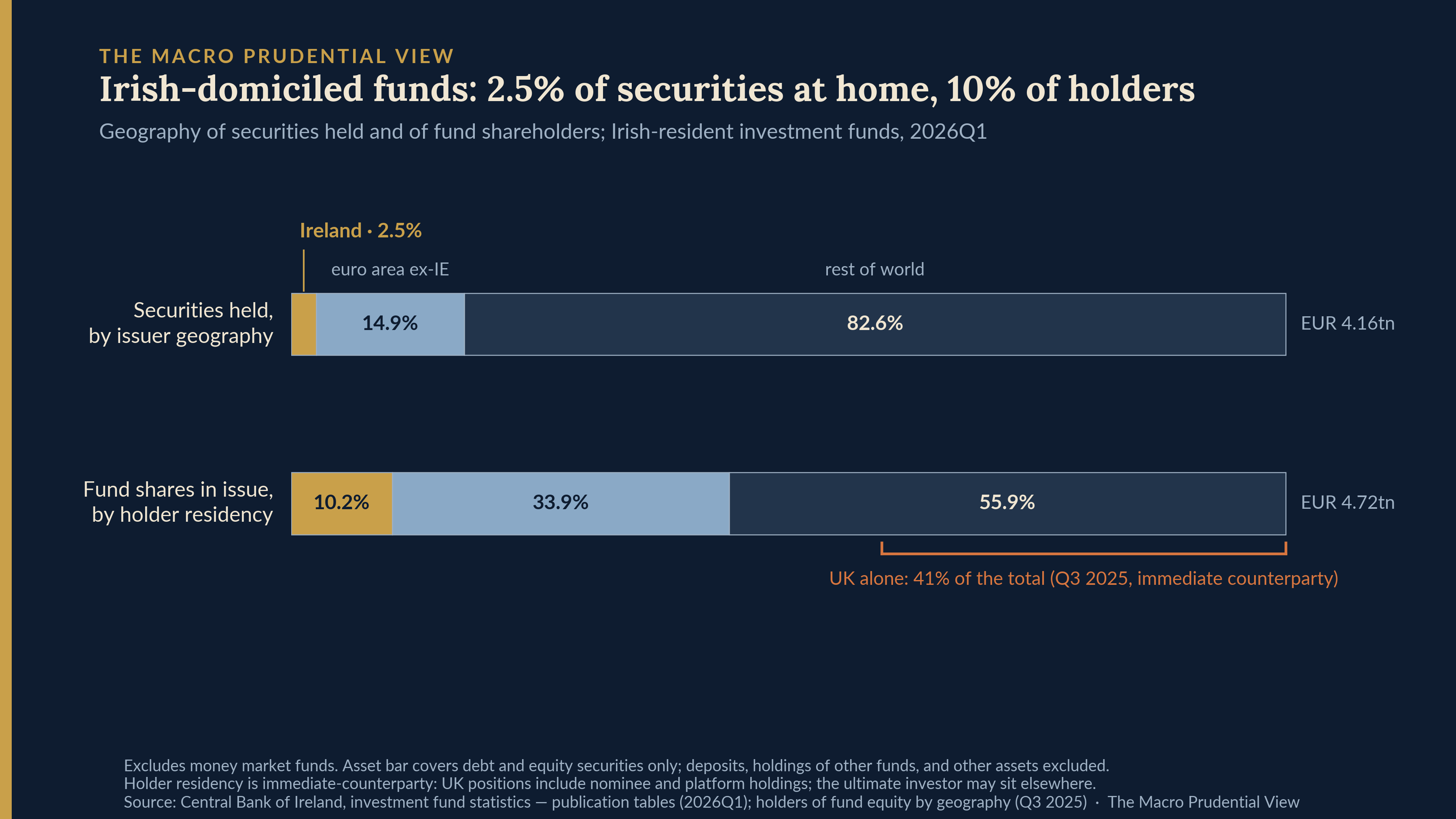
Take Irish-domiciled funds — the second-largest EU domicile after Luxembourg, and the one that publishes this split — and read the chart in order. Holdings first: 2.5% of the securities Irish funds hold are Irish-issued, or 9.6% on the broadest cut, counting deposits, holdings of other funds and all other assets. Holders second: 10.2% of the fund shares in issue are held by Irish residents; the ECB’s own securities-holdings work puts the foreign share of the investor base in Irish and Luxembourg funds at roughly 90%. Booking chain third: 41% of the total is recorded against UK-resident holders. That figure identifies where holdings are registered, not who ultimately owns them — much of it is nominee and platform intermediation — which is why it matters operationally: the registered chain is the one a redemption instruction travels down. Portfolio management, meanwhile, is routinely delegated to London and New York. That boundary is operational, not only geographic: an Article 25 measure addresses the EU manager, while the execution it forces — the unwinding, the margining, the sales — runs through delegates, desks and market infrastructure regulated elsewhere, which the measure does not reach directly. However the Union allocates supervisory competence internally, the registered holder chain and much of the day-to-day risk-taking sit outside it. Every column of the matrix operates inside that boundary.
Scale, and who answers
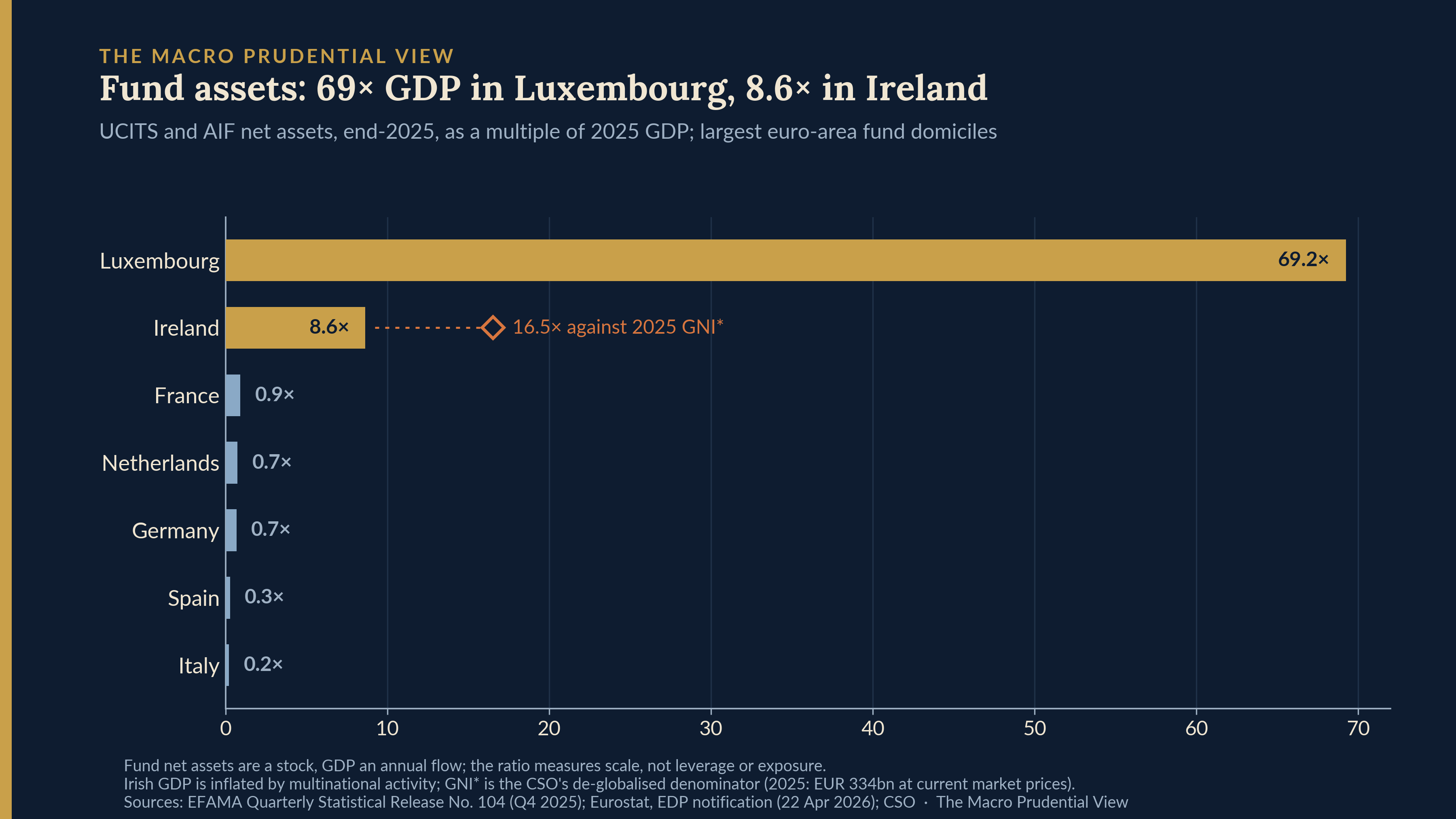
Fund net assets stand at 69 times GDP in Luxembourg and 8.6 times in Ireland. France, the next-largest fund domicile, sits at 0.9; no other domicile in the chart exceeds one. The chart measures scale, not leverage or exposure. Ireland gets a second denominator because its GDP is a measured distortion: against 2025 GNI*, the CSO’s de-globalised benchmark, the ratio is 16.5 times — and no other country in the chart has an official alternative denominator, which is why no other country gets one.
The chart belongs in a supervision debate because of accountability. ESMA’s founding regulation places financial stability in its headline objective — “contributing to the short, medium and long-term stability and effectiveness of the financial system” — and instructs it to pay particular attention to systemic risk. The gap is not in the statute; it is in the architecture around it. Today, ESMA’s macroprudential instrument for funds is advice under Article 25(6) and (7), backed by comply-or-explain under 25(8); the ESRB warns and recommends; the binding tools are national. The rapporteur’s draft would change that materially, through the 25a and 25b technical standards and the 44a transfer. At that point, the question of who answers for error becomes concrete — and it is an accountability question, not a bailout question. Losses from a miscalibrated measure would fall on fund investors, who are mostly non-resident, and the market effects would land where the funds invest, which the geography above shows is mostly not the domicile either. What the domicile carries is the industry: the employment, the fees, the tax base built on them — and, for the funds that do hold domestic assets, the local market too, which is what the 2022 property-fund limit was about. The calibration would be made at Union level — though ESMA’s Board of Supervisors is composed of the heads of the national authorities, so the change is one of decision procedure rather than of who sits in the room: the domicile keeps its seat and can be outvoted. What it would not keep is the ability to set the number itself. The same chart is the centralisers’ exhibit on the distance between where decisions would sit and where consequences land, and the decentralisers’ exhibit on why supervisory expertise accumulated where it did.
What the precedent does and does not license
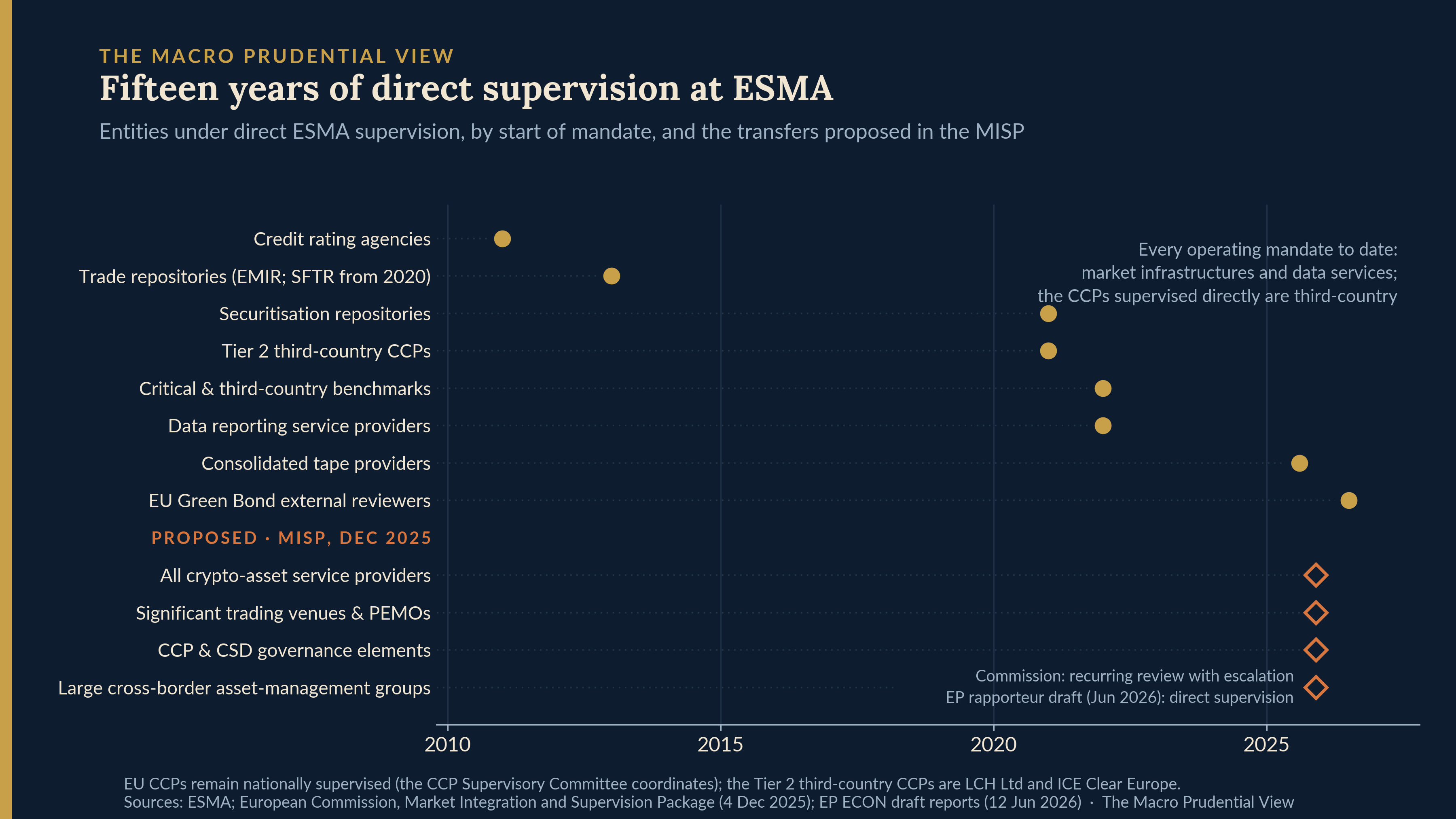
The debate keeps reaching for precedent, so the record deserves precision. ESMA directly supervises credit rating agencies (since 2011), trade repositories (2013), securitisation repositories and Tier 2 third-country CCPs (2021), critical and third-country benchmark administrators and data reporting service providers (2022), consolidated tape providers as they are authorised, and EU Green Bond external reviewers from June 2026. EU CCPs are not on the list: they remain nationally supervised, with ESMA’s CCP Supervisory Committee coordinating. Fifteen years of direct supervision, in other words, covers market infrastructure and data services, plus systemically important CCPs from outside the Union.
A large asset-management group would be the first supervised population whose dominant failure mode is redemption-driven market transmission and leverage dynamics at scale, rather than the operational integrity of a utility. The record licenses one inference: ESMA can build supervisory capacity in bounded, rule-dense domains, and has. It licenses no inference, in either direction, about supervising market-facing redemption risk in the fund sector — and the failure-mode contrast above is a hypothesis about that population, not an established finding. Anyone claiming the precedent settles the question — for or against — is claiming more than fifteen years of evidence contains.
What to watch
Three things from this mapping are worth carrying into the autumn. The variants on the table differ most substantively on macroprudential architecture, and the difference is visible in the texts themselves. Centralising group-level scrutiny and relocating the power to act on systemic risk are separable choices: the Commission’s text takes the first without the second, while the rapporteur’s draft creates the tools and moves the supervisor, and leaves the join between them unresolved. And wherever the powers land, part of the sector’s geography — its delegation chains, its booking chains — sits beyond any intra-EU allocation.
The perimeter is narrower than the debate’s temperature suggests: the Commission’s impact assessment puts the population at around 10 to 15 large cross-border groups, and the ECB proposed a convergence role for the ten to fifteen largest. What the rapporteur’s €50bn and €150bn thresholds would capture, and what share of EU fund assets that is, nobody has published. The questions for the remaining parliamentary and Council process, and for any trilogue that follows, come straight off the mapping: whether Articles 25a and 25b survive Council scrutiny, are stripped out, or migrate into the Commission’s separate macroprudential work on non-bank finance; who the “competent authority” of a significant group is for activation purposes; how the technical standards treat leverage that a NAV threshold does not see; and how an EU-level measure would be executed through national legal systems and third-country delegation chains. The timetable is set: the “One Europe, One Market” roadmap of April 2026 targets agreement on the package by the end of this year. The positions on record give the questions their shape. The direct-supervision tier has one institutional sponsor so far: the rapporteur who drafted it, whose report still has to survive committee and plenary before it becomes anything Parliament negotiates on. The macroprudential strengthening has more company — the ECB, the Eurosystem and the ESRB have all argued for it, which is support in principle for the direction, not for these articles as drafted. The Commission consulted on macroprudential policy for non-bank finance in 2024 and proposed no legislation after its March 2025 summary report. The rapporteur’s draft is, in practice, the first legislative text to move on it.
Paweł Fiedor - The Macro Prudential View
Positions described are as at 17 August 2026.
The author works at the Central Bank of Ireland and in the ESRB Secretariat. This piece is written in a personal capacity; views are the author’s own and should not be attributed to the Central Bank of Ireland, the ESRB, or the Eurosystem. It draws exclusively on publicly available sources and takes no position on whether the proposals should be adopted.
Sources: European Commission, Market Integration and Supervision Package — the Communication “Further development of capital market integration and supervision within the Union” (COM(2025) 940 final) and the legislative proposals (COM(2025) 941, 942 and 943 final), 4 December 2025 — https://finance.ec.europa.eu; European Parliament, ECON draft report by rapporteur Eero Heinäluoma, ECON-PR-789867, 12 June 2026 — https://www.europarl.europa.eu/doceo/document/ECON-PR-789867_EN.pdf; Directive 2011/61/EU (AIFMD), Articles 16, 25 and 46(2)(j) and Annex V, and Directive 2009/65/EC (UCITS), Article 98(3) and (4), as amended by Directive (EU) 2024/927 of 13 March 2024 (OJ 26 March 2024; applicable from 16 April 2026, reporting provisions from 16 April 2027) — https://eur-lex.europa.eu; Regulation (EU) No 1095/2010 (ESMA Regulation), Article 1(5) — https://eur-lex.europa.eu; joint statement and letter of the finance ministers of Germany, France, Italy, Spain, the Netherlands and Poland on the MISP and centralised capital markets supervision, 29 May 2026 — https://www.gov.pl/attachment/60b5fb71-a937-4d3a-8883-c8ec86d7700b (statement), https://www.gov.pl/attachment/56f1ed87-e749-4331-9347-271d491be331 (letter); Opinion of the European Central Bank of 9 April 2026 (CON/2026/13) — https://eur-lex.europa.eu/eli/C/2026/2837/oj; Carmassi, Dumora Lemaire, Evrard, Gati, Milea, Parisi, Rouveyrol and Spolaore, “One market, one supervision”, ECB Occasional Paper No 383 (2026), and ECB Blog posts of 13 February and 30 March 2026 — https://www.ecb.europa.eu; European Commission targeted consultation on macroprudential policies for non-bank financial intermediation (May 2024) and summary report (March 2025), with the Eurosystem response (November 2024) and the ESRB response — https://finance.ec.europa.eu, https://www.esrb.europa.eu; European Parliament, Economic Governance and EMU Scrutiny Unit, "MISP: A review of selected technical issues", PE 784.036, April 2026 —https://www.europarl.europa.eu; EFAMA, “Asset management supervision: why passporting remains the best supervisory model for Europe” (October 2025) and response to the Parliament draft report (2026) — https://www.efama.org; Central Bank of Ireland, macroprudential measures for Irish property funds (November 2022) and for GBP-denominated liability-driven investment funds (April 2024), with the CSSF’s parallel measures and ESMA’s advice under Article 25 AIFMD (April 2024) — https://www.centralbank.ie, https://www.cssf.lu, https://www.esma.europa.eu; ESMA, Supervision — https://www.esma.europa.eu; EFAMA Quarterly Statistical Release No. 104 (Q4 2025); Eurostat, EDP first notification, 22 April 2026; CSO, Annual National Accounts 2025 (modified GNI, 2 July 2026); Central Bank of Ireland, investment fund statistics, publication tables (2026Q1) and holders of investment fund equity by geography (Q3 2025). Chart data as cited in each figure.