



The mandate
In December 2023 the US Securities and Exchange Commission adopted a rule that will push much of the US Treasury market — both cash and repo — into central clearing through the Fixed Income Clearing Corporation (FICC), the only clearing house that does this work. After an extension granted in February 2025, the compliance dates now fall at the end of 2026 for cash and 30 June 2027 for repo. Neither is fully settled: the Investment Company Institute has asked for repo to slip to 2028, and in April 2026 Acting Chairman Uyeda floated relief for inter-affiliate transactions. Treat the timeline as directional rather than fixed.
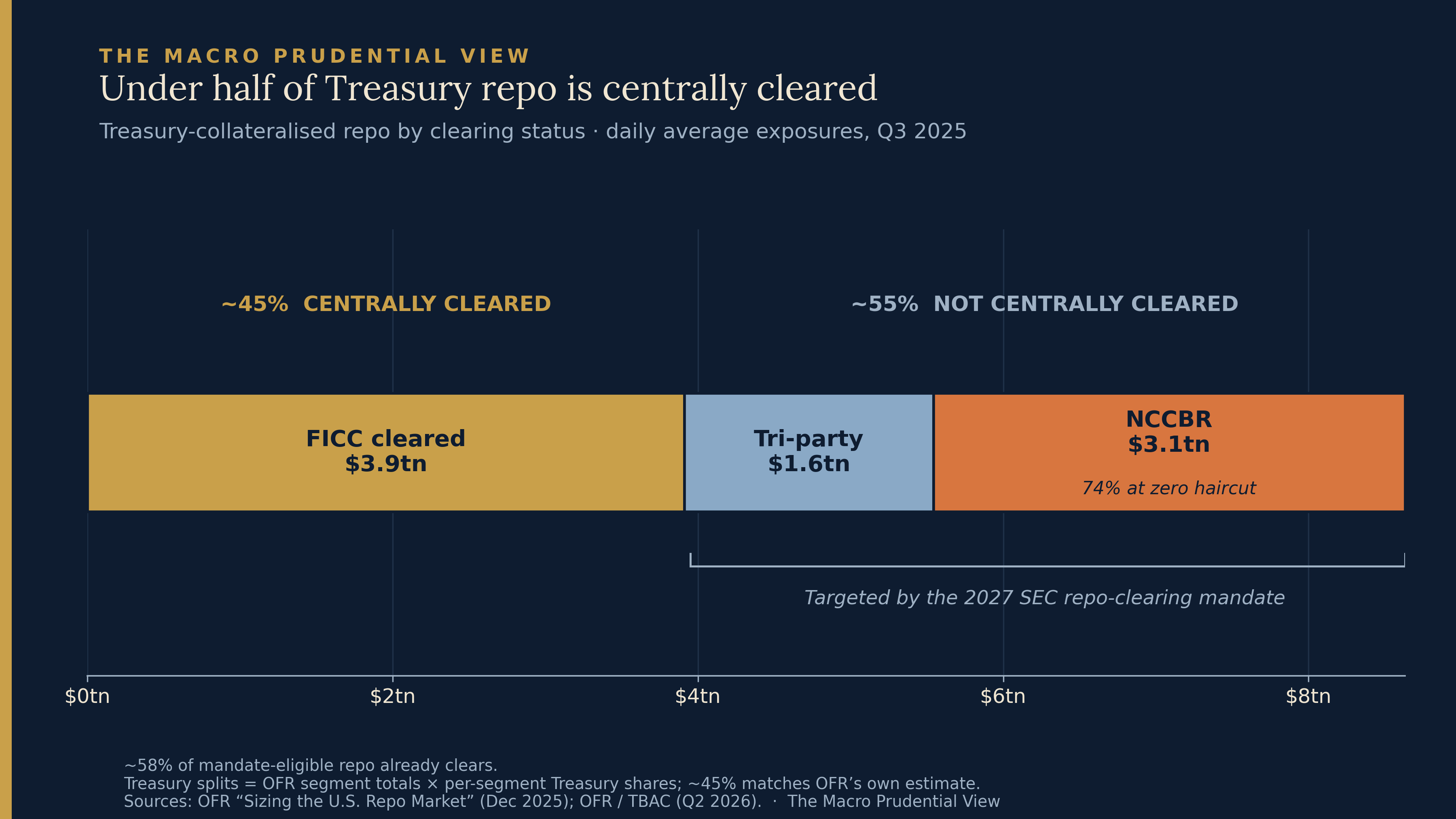
The direction is what matters. The mandate takes a market that is a little under half-cleared today and removes, for most of the rest, the option not to clear. The case for doing so is the standard post-2009 case for central clearing, and it is largely correct: multilateral netting shrinks gross exposures, a central default-management process replaces a scramble of bilateral close-outs, and the clearing house sees positions the bilateral market does not.
This piece is about what the framework does around that move — how it prices the resulting exposures, where it ranks them in a failure, and what it asks of their holders in a stress — and about a misalignment that sharpens as more of the market passes through one counterparty.
Two privileges
Cleared and collateralised claims enjoy two distinct forms of favourable treatment, worth keeping separate because they come from different parts of the rulebook and bind on different activities.
The first is capital, and which part of the capital framework bites depends on the trade. For cleared derivatives, the headline is the risk weight: a bank’s trade exposure to a qualifying central counterparty carries a 2% risk weight under Article 306(1)(a) of the EU’s Capital Requirements Regulation, mirroring the Basel standard (CRE54), against at least 20% for the bilateral equivalent — a reduction of more than 90% on the trade-exposure leg. For Treasury repo, the risk weight was never the binding constraint; repo against government collateral carries little of it to begin with. What binds there is the leverage ratio, which is risk-blind and therefore bites hardest on low-risk, balance-sheet-intensive business. It was amended in 2019 to recognise client-cleared collateral, lowering the leverage cost of clearing, and it is now being relaxed further (below). So the right reading is not “derivatives are capital-light”: the standardised approach to counterparty credit risk (SA-CCR), live in the EU since June 2021 and in the US and UK since January 2022, raised capital on many bilateral books. It is that cleared exposures are treated more cheaply relative to bilateral ones, on whichever constraint actually binds. The framework steers traffic toward the clearing house, on purpose.
It helps to separate the exposures this produces, because they are often run together: the trade exposure to the CCP (risk-weighted at 2% for a QCCP), the default-fund contribution (a mutualised, loss-absorbing claim with its own, much higher charge), the leverage exposure (the balance-sheet footprint), and the liquidity cost (the cash needed to keep the position margined). The first three are priced. The fourth, at the level that matters here, is not.
The second privilege is priority. In a dealer or bank failure, cleared and collateralised claims do not wait in the ordinary creditor queue. Repo and derivative counterparties can net their positions and enforce their collateral outside the automatic stay — the US Bankruptcy Code’s safe harbours, the EU’s Financial Collateral Directive — so they are satisfied largely outside the insolvency estate rather than ranked within it. The clearing house sits one step further out: FICC’s margin, held on a bankruptcy-remote basis and doubling as its default fund, is carved out even of the resolution stay. The US and EU have converged here. Both impose a short stay on close-out in resolution — until 5pm the next business day under the US regimes, until the end of the next business day under Article 71 of the EU’s Bank Recovery and Resolution Directive — and both carve CCP margin out of it. None of this is new, and the mandate does not create it. What the mandate does is enlarge the population of claims that enjoy it.
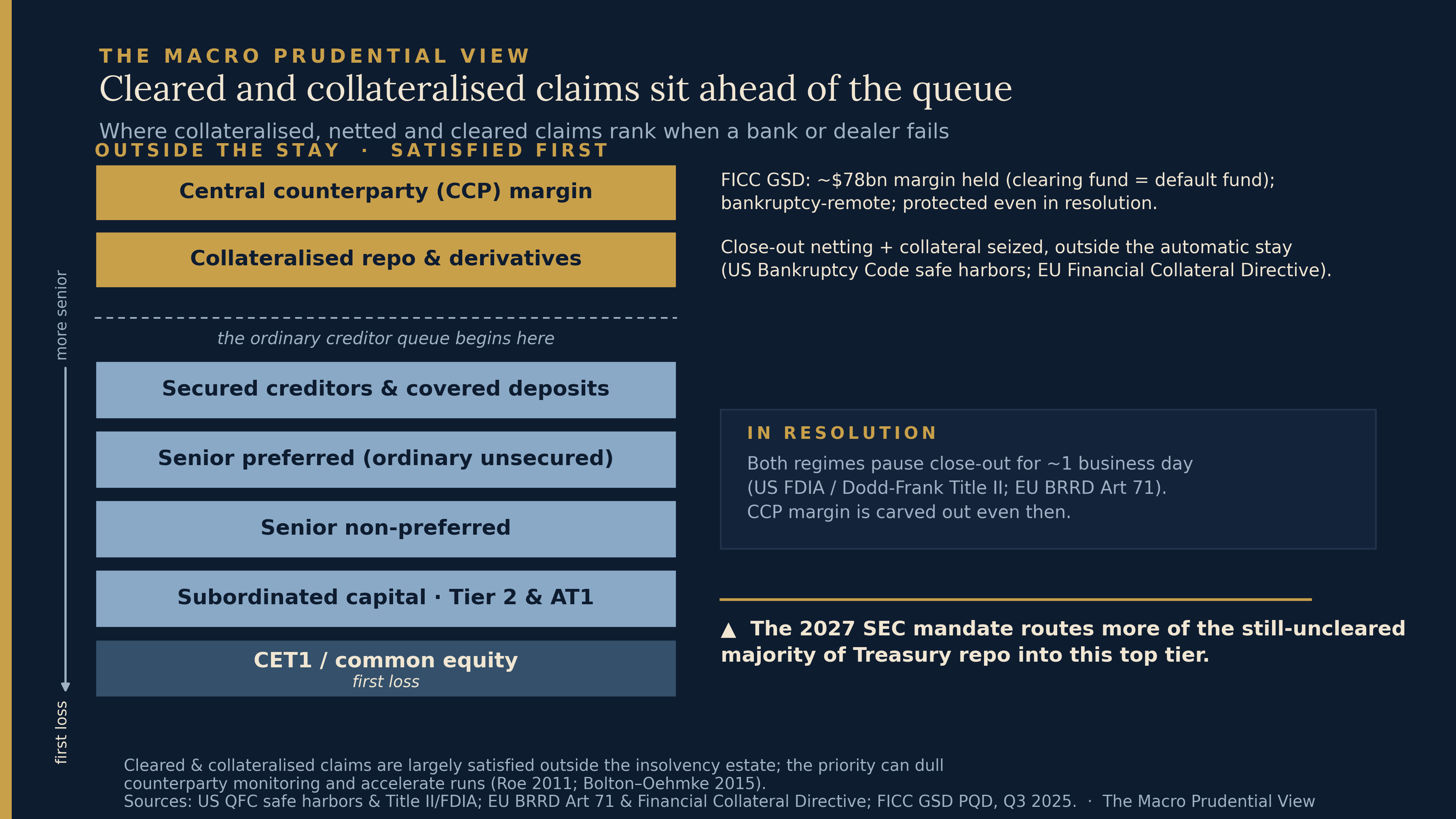
The capital treatment is sometimes called a subsidy. That is the wrong frame, and the one a critic would most enjoy taking apart. The low risk weight reflects a real reduction in counterparty credit risk: the clearing house interposes itself, margins the position daily, and mutualises the tail. On counterparty credit risk, the framework is pricing about right.
Nor is it true that the framework ignores liquidity. The Liquidity Coverage Ratio and Net Stable Funding Ratio price liquidity risk directly — banks hold high-quality liquid assets against potential repo and derivative outflows, and the LCR treats cleared repo comparatively favourably. What those rules price is each institution’s own liquidity position: its own outflows, its own buffer. They do not price the liquidity demand that daily margining imposes on the system when the same call arrives everywhere at once. The exposures the framework treats as safest to hold and most senior to be paid are also the ones that generate the largest correlated demand for cash, exactly when cash is dear — and that correlated demand sits outside what any of these instruments is sized against.
The channel is already filling
Two facts about the market the mandate is enlarging, and a word on who actually bears the call.
First, the denominators, because two of them are easy to confuse. As of the third quarter of 2025, central clearing accounts for about 45% of Treasury repo on the OFR’s measure — a little under half. But the mandate does not target all of the uncleared remainder: once the carve-outs are applied, the Treasury Borrowing Advisory Committee reckons around 58% of the volume actually subject to the mandate already clears. So: ~45% of the whole Treasury repo market, ~58% of the mandate-eligible subset. The slice the rule actually forces in is therefore at most the remaining ~42% of that eligible set, and less once the carve-outs apply — a real enlargement of the cleared population, but not the doubling that “half the market is uncleared” might suggest.
Second, the buy-side leg has been growing on its own economics, and mostly before the rule could have caused it. FICC’s sponsored service — the route through which hedge funds and money funds reach clearing — expanded from roughly $1.1 trillion of combined borrowing and lending at the end of 2023 to about $2.9 trillion at the end of 2025, more than 150% on the end-of-period measure. The steepest growth is concurrent with mandate preparation, but the trade driving it predates the mandate and would exist without it: the borrowing leg is leveraged investors funding the cash–futures basis trade, the lending leg is money market funds placing cash. The mandate is not what built this channel. What it does is make the cleared share near-universal, mandatory and permanent, and close the bilateral route that today still carries the other half.
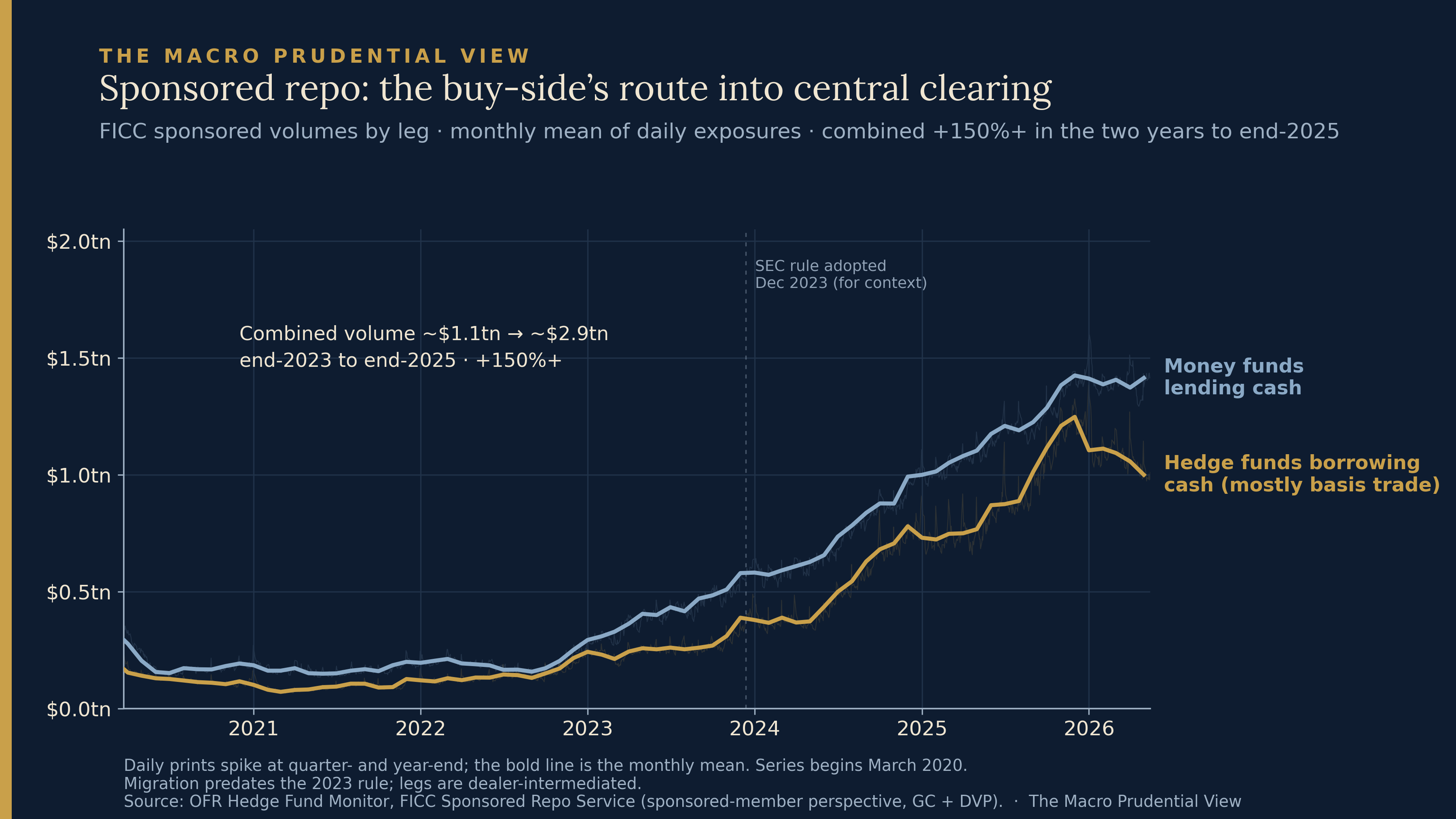
The plumbing decides who is actually called in a stress, and it is also why dealers use the service. Two distinct benefits meet at the dealer, and they should not be run together. The first is an accounting benefit, available only because the trade is cleared: novating matching sponsored repo and reverse-repo legs to FICC lets a dealer net them on its balance sheet under US GAAP (ASC 210-20-45, the former FIN 41), which shrinks the reported leverage exposure of the activity. The second is the regulatory leverage relief discussed below, which is a separate change, applies more broadly than cleared repo, and operates on leverage capital rather than reported exposure. The accounting netting is what has driven the growth in the chart above — DTCC puts the balance-sheet capacity freed at well over a trillion dollars on peak days — not the regulatory relief alone. But netting the balance sheet is not the same as shedding the risk. The dealer-sponsor still guarantees the sponsored member’s performance to FICC, still posts FICC’s value-at-risk margin, and still carries a clearing-fund and contingent-liquidity obligation against the position. Clearing transforms the dealer’s exposure rather than retiring it, which makes the dealer-sponsor the load-bearing node: when margin is called, the binding questions are whether the hedge fund can fund it, whether the money fund will keep rolling, and whether the dealer can carry the position while it does.
The synchronised call
Margin is procyclical whoever holds it. Variation margin tracks mark-to-market moves; initial-margin models re-estimate risk upward as volatility rises; a single shock raises both at once. This is not special to clearing. Bilateral repo has variation margin, discretionary haircuts and collateral calls that tighten in stress too — and being discretionary, they can tighten harder and faster, with no anti-procyclicality requirement on them at all. A regulated CCP, by contrast, runs a transparent, rule-bound margin model subject to explicit anti-procyclicality rules. Per dollar of exposure, it is not obvious that cleared margin is more procyclical than the bilateral arrangement it replaces; it may well be less.
What clearing changes is not the timing of the calls — a severe shock synchronises bilateral calls too; panic moves every desk at once — but their character. A bilateral market applies many margin schedules, many haircut conventions, and discretion: a dealer can delay or soften a call to a valued client to keep it from dumping collateral into a falling market. A central counterparty applies one model and one parameter set to everyone, marked at fixed times, with no discretion to grant. It replaces a heterogeneous, partly negotiable set of calls with a single uniform, mechanical, non-negotiable one — and the mandate pushes the share of the market inside that one call toward near-universal. The distinctive feature is not the synchronisation of the clock; it is the uniformity of the model and the absence of forbearance at the moment forbearance is what would arrest a fire sale.
That cuts both ways. Discretionary forbearance is exactly what post-2008 reform set out to remove: the bilateral discretion that can soften a call is also the discretion that conceals losses, delays recognition, favours some clients over others, and amplifies the run when it finally comes. Mechanical uniformity strips out the stabilising forbearance and the loss-concealing kind together, and that uniformity was a deliberate regulatory objective, not an accident. The net effect on fire-sale risk is therefore ambiguous in theory. The concern here is narrower than “discretion is good”: it is that removing the release valve, while concentrating the population inside one model, removes a margin of adjustment exactly where the system has least slack.
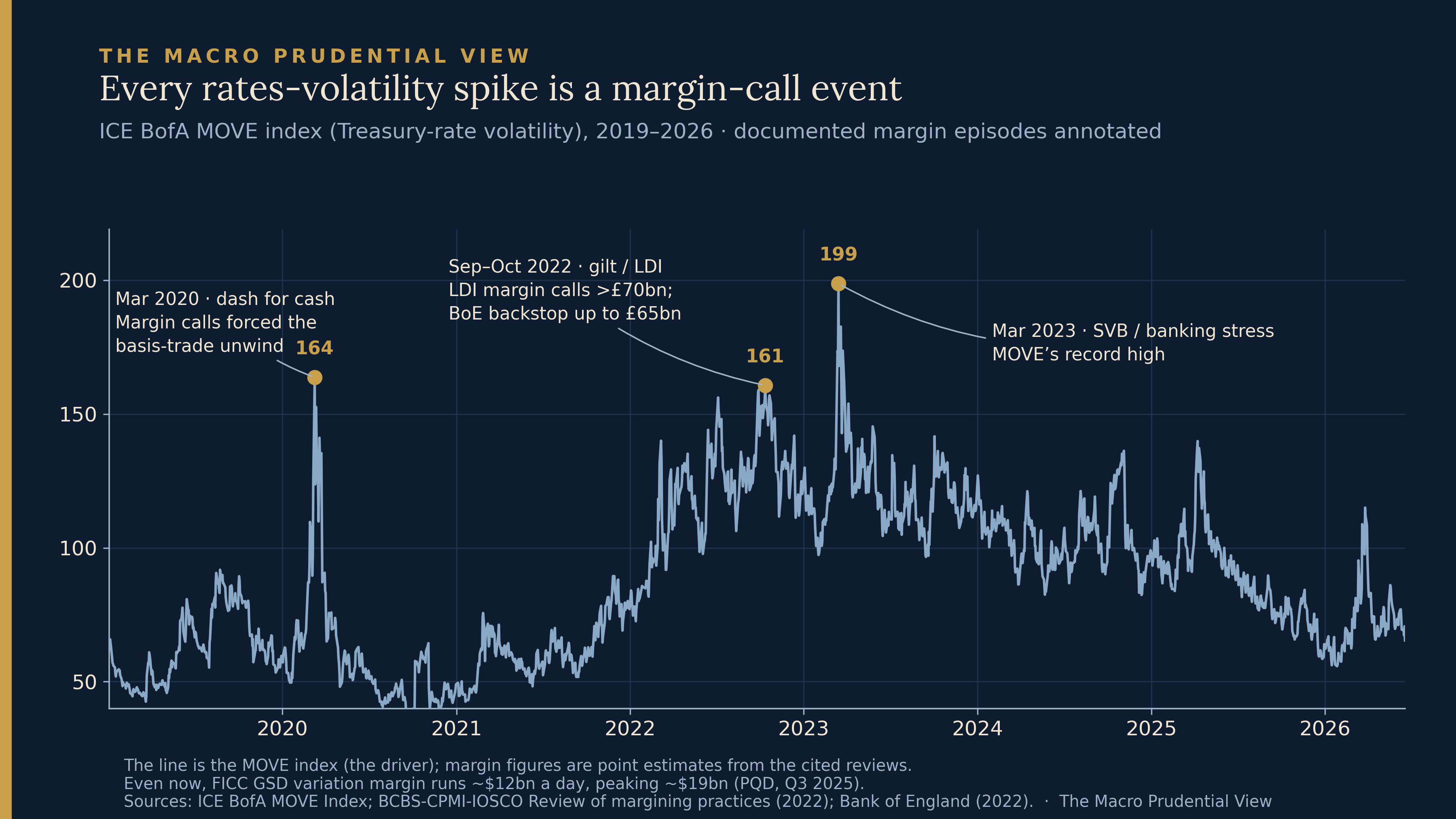
The Treasury-specific evidence sits in March 2020. As the dash-for-cash took hold, leveraged funds running the cash–futures basis trade — the same trade now being routed into FICC — were forced to unwind, and their selling of Treasuries to meet margin and funding pressure fed the dysfunction in the world’s deepest sovereign market. That is the transmission this piece is about, observed before the mandate concentrated the trade any further. The cleared figures themselves are not, in calm times, large in proportion: FICC’s Government Securities Division held on the order of $78 billion of initial margin in late 2025 and runs about $12 billion of variation margin a day, peaking near $19 billion — small against roughly $4.4 trillion of cleared Treasury repo. The industry makes that point: the World Federation of Exchanges has argued that peak crisis margin calls were 2.5% or less of participants’ liquidity resources. On average, true. But averages are not where this risk lives.
The mechanism that takes it into the tail is specific to the basis trade, and worth stating precisely, because the obvious analogy understates it. The 2022 UK gilt episode is the existence proof: liability-driven investment funds faced margin and collateral calls Bank of England staff put in excess of £70 billion, concentrated on a specific, liquidity-poor set of holders, and those calls forced fire sales — against which the Bank stood up a backstop of up to £65 billion. But LDI was a directional trade, hurt by a parallel move in rates; its margin call was roughly linear in the size of the rate move. The Treasury basis trade is a relative-value trade — long the cash bond, short the future — and a parallel shift in the curve does not break it; a widening of the spread between cash and futures does. The cleared-Treasury failure mode runs through that spread: a mechanical margin call on the futures leg forces deleveraging of the cash leg, the forced selling widens the cash–futures basis, the wider basis raises the margin again, and the loop feeds itself. That is the negative-convexity tail the averages do not see, and it lands on the most leveraged holders in the market.
Put the increment honestly, because the argument does not need to overstate it. With ~58% of mandate-eligible repo already cleared, the volume the rule actually forces in is at most the remaining ~42% of that eligible set, less after carve-outs. The case does not rest on that number being large; it rests on where it lands — on the most leveraged segment of the market, intermediated through dealers whose leverage capacity is being freed at the same time, with the bilateral escape valve closed. How much additional same-day margin that marginal volume would generate under a given volatility shock is not something public data lets anyone estimate, and this piece does not pretend to a figure. It is a design argument about where the rule concentrates risk, not a forecast of the size of the next call.
This is the fallacy of composition, in the sense Mark Roe (2011) and Patrick Bolton and Martin Oehmke (2015) gave it for derivative and repo priority — but the clearing house changes the argument, and the change has to be conceded. Roe and Bolton-Oehmke were writing about bilateral super-priority in opaque markets, where the safe-harbour claim weakens each creditor’s incentive to monitor and accelerates a race to the collateral. A CCP mutualises default, runs a disciplined waterfall, and is transparent to its regulator; it dampens precisely those bilateral dynamics. Where the frame still bites is one level up: each participant’s decision to hold the senior, collateralised, capital-cheap, centrally cleared claim is individually rational and individually risk-reducing, and the aggregate of those decisions is a market whose demand for collateral and cash is uniform and synchronised by construction. Privately optimal; in aggregate, something else.
What the optimists are right about
Four counterarguments deserve to be met rather than waved past.
The first is that clearing reduces systemic risk on net. It does. Netting genuinely shrinks gross exposures; a disciplined default waterfall genuinely beats a bilateral scramble; and cleared margin is not obviously more procyclical per dollar than what it replaces. The claim here is narrower: that concentrating these exposures into one uniform call raises a liquidity demand the framework does not price, and that the bill falls due in exactly the states of the world where it is hardest to pay. The net sign — more netting and central default management against a more uniform, less forgiving liquidity call — is genuinely uncertain, and I am not claiming it is negative. I am claiming one side of it is unpriced.
The second is that the Federal Reserve has built the backstop. The Standing Repo Facility, made permanent in 2021, exists to cap repo rates in a dash-for-cash, and the FIMA repo facility extends the logic to foreign official holders. This is the strongest objection, and it is largely right. Lending cash against pristine collateral at an administered rate is textbook Bagehot, not a giveaway, and a credible backstop does blunt the procyclical spiral. The point that survives is about ex-ante incentives: a backstop that is standing and anticipated, rather than an emergency improvisation, is priced in by participants in advance, and that shifts behaviour toward the structure it protects. It also makes the central bank the residual liquidity provider for a structure the prudential framework treats as private and safe.
The third is that FICC already prices this. It runs a Capped Contingency Liquidity Facility — a rules-based, pre-committed facility under which each member’s cap is set by the liquidity its own activity generates, attested annually by two of its officers and carried in its liquidity plan. It is, very much, a line item, and a real one. But what the CCLF prices is the liquidity FICC needs to settle the obligations of a defaulting member — a single-name event — not the correlated, market-wide variation-margin call that lands on everyone at once with no one in default. And its own mechanism is a synchronised draw: in a CCLF Event the surviving members must repo cash to FICC up to their caps, supplying liquidity precisely when they are scrambling for their own. The one committed facility turns a member default into a mutualised liquidity demand on the survivors; it sits inside the synchronisation rather than outside it. FICC itself expects the mandate to raise these obligations — it told the SEC so when it added a $10 billion commercial-paper programme in 2026 to diversify its default liquidity — which makes the adequacy of the post-mandate sizing an open question, not a settled one.
The fourth is that the tools already exist more broadly. CCPs have recovery and resolution regimes; EMIR sets anti-procyclicality requirements for margin models; the BCBS-CPMI-IOSCO follow-up work in 2025 pushed on initial-margin responsiveness and liquidity preparedness. These are real, and also discretionary, partial, and largely untested at the scale the mandate implies. They applied to the pre-mandate world too; the mandate is what scales the population they have to work on.
Loosening the leverage ratio
In the same window in which it is mandating clearing, the US is loosening the leverage ratio — the capital constraint that bears most directly on balance-sheet-intensive Treasury activity. The enhanced supplementary leverage ratio was finalised in November 2025 and took effect on 1 April 2026 (banks could adopt it from 1 January); it is now in force.
The agencies’ case is not frivolous. The leverage ratio is risk-blind, and a risk-blind constraint bites hardest on the lowest-risk, most balance-sheet-intensive business — which is exactly Treasury intermediation and repo. The FDIC put the rationale plainly: the relief is meant to give banks more capacity “to engage in low-risk activities, such as U.S. Treasury market intermediation and repo financing.” And an unconstrained dealer balance sheet is also the shock absorber — the capacity that takes Treasuries off forced sellers when the call lands. There is a coherent and serious view in which loosening the eSLR is what a larger cleared market needs: more balance sheet to intermediate it, and more to absorb the fire sales the uniform call can trigger. I do not dismiss it.
What complicates that view is where the relief lands. The rule’s own dissenting governor made the point: about 28% — roughly $219 billion — of the tier-1 reduction falls at the GSIBs’ depository-institution subsidiaries, and only 1.4% (around $13 billion) at the holding-company level, while Treasury-market intermediation happens mainly at the broker-dealer. Barr was, in his words, “skeptical that it will achieve the stated objective of improving the resiliency of the Treasury market.” If the relief does not reach the intermediating broker-dealer, then the agencies’ stated purpose — more capacity to intermediate Treasuries and finance repo — is not met, while group-level leverage discipline is loosened anyway. And if it does reach the dealer, then the one quantity constraint on the leveraged build-up is being eased as the build-up is required. There is no comfortable reading: either the relief misses the entity it was sold to help, or it removes the brake on the very activity the mandate concentrates. Under both, a quantity constraint on leverage is loosened, and no liquidity-specific tool is tightened in its place.
Europe is contemplating the same move
This is not only a US story, and the European version has a twist worth sitting with.
The EU has no Treasury-repo clearing mandate. But its own macroprudential authority is pointing the same way. In November 2024 the European Systemic Risk Board published A system-wide approach to macroprudential policy, its response to the European Commission’s targeted consultation on macroprudential policy for non-bank financial intermediation. It singles out clearing as one of three priority activities — alongside asset management and lending — and, on government-bond cash and repo, says it “sees merit in incentivising the central clearing” of those markets, together with margin requirements on the bilaterally cleared remainder. The ESRB, in other words, sees merit in incentivising the migration the US is mandating. The same report reaches for the same frame this piece does: in a footnote it invokes the fallacy of composition as it works through the system-wide approach. The body most alert to the aggregation problem is also the one encouraging the activity that creates it.
Then nothing moved: the Commission published a summary of the consultation responses in March 2025, and there is no legislative package. So Europe sits where the US sits, with a clear direction of travel, a clear set of cautions, and no settled framework reconciling them.
The market structure differs in a way that changes the risk rather than removing it, and the difference runs on two axes that point in opposite directions. The US clears Treasury repo through a single counterparty: FICC is a monopoly, which means extreme concentration but one model and one resolution regime. Europe clears government-bond repo across several CCPs — LCH SA in Paris, Eurex Clearing in Frankfurt, Euronext Clearing in Milan, BME in Madrid, LCH Ltd in London — over heterogeneous sovereigns, with roughly half of euro repo already cleared. On the uniformity axis, that fragmentation cuts against the US problem: multiple CCPs running different models make the cleared euro market less perfectly uniform than a single-FICC market, which blunts the one-model-for-everyone effect. But on the netting axis it cuts the other way, and harder: positions held long at one CCP and short at another do not net, so a dealer pays gross margin to both, and collateral posted at one cannot be redeployed to meet a call at another. Fragmentation across multiple CCPs therefore raises the aggregate, gross demand for margin per unit of exposure, and adds cross-CCP and cross-border coordination and resolution risk that a single regime is spared — with a London CCP still central to euro repo after Brexit. The EU does not inherit the same call. It replaces one form of synchronisation risk with a different and largely untested set: less single-model uniformity, more gross collateral demand and more coordination fragility. EMIR 3.0’s active-account requirement nudges derivative clearing into the EU but does not touch repo; the Bank of England, for its part, opened a discussion of gilt-repo resilience and clearing in September 2025.
The gap
The framework does one thing well and leaves another unpriced. It prices the counterparty credit risk of cleared exposures correctly, and ranks them where their collateralisation and netting earn them. It prices each institution’s own liquidity through the LCR and NSFR, and it prices FICC’s single-member-default liquidity through the clearing fund, the CCLF and the new commercial-paper programme. What none of these prices is the system-wide demand for cash when one uniform margin call lands on the whole cleared population at once. Stated narrowly, so that it is hard to rebut: no instrument prices or constrains the combination this piece has traced — a uniform, model-driven margin demand from the most leveraged segment of the repo market, holding super-senior cleared claims, intermediated through dealers whose main quantity constraint is being eased at the same moment — and the closest committed facility, the CCLF, is itself a synchronised draw on the survivors.
None of this is an argument against central clearing, and none of it forecasts that the next dash-for-cash breaks the Treasury market. It is a structural argument about incentive design, not an empirical claim that the mandate is the dominant source of the next stress. The backstops may hold; the dates may slip; the margin tools may mature. The narrower point is harder to dismiss: the framework treats these exposures as safe one at a time, and the macroprudential question is what happens to all of them at once. The body that comes closest to owning that question, the ESRB, is also the one encouraging the activity that makes it sharper.
Paweł Fiedor - The Macro Prudential View
The views expressed are the author’s own and do not necessarily reflect those of any institution with which the author is or has been affiliated.
All figures from public sources (OFR, TBAC, FICC GSD Public Quantitative Disclosures and SEC rule filings, BCBS-CPMI-IOSCO, Bank of England, FDIC and Federal Reserve, ESRB, ICMA, CRR/Basel framework). Nothing here draws on non-public data, and forward-looking characterisations of ESRB and Commission intent are attributed to the cited public documents.