



On 4 March 2025, Germany’s incoming coalition announced that it would loosen the constitutional debt brake and stand up a large infrastructure and defence fund. The bond market did not wait for the legislation. Within the week the ten-year Bund yield rose by around 43 basis points, the sharpest weekly move since the 1990s, and French and Italian yields moved almost exactly in step. Spreads between the member states held roughly steady, so the repricing landed on the common benchmark rather than on the gaps between sovereigns: a parallel lift in the level of the curve that anchors euro-area pricing, set off by a fiscal decision taken in one capital and transmitted across the bloc in days. The Bundestag and Bundesrat ratified the change a fortnight later, on 18 and 21 March. By then the market had long since moved.
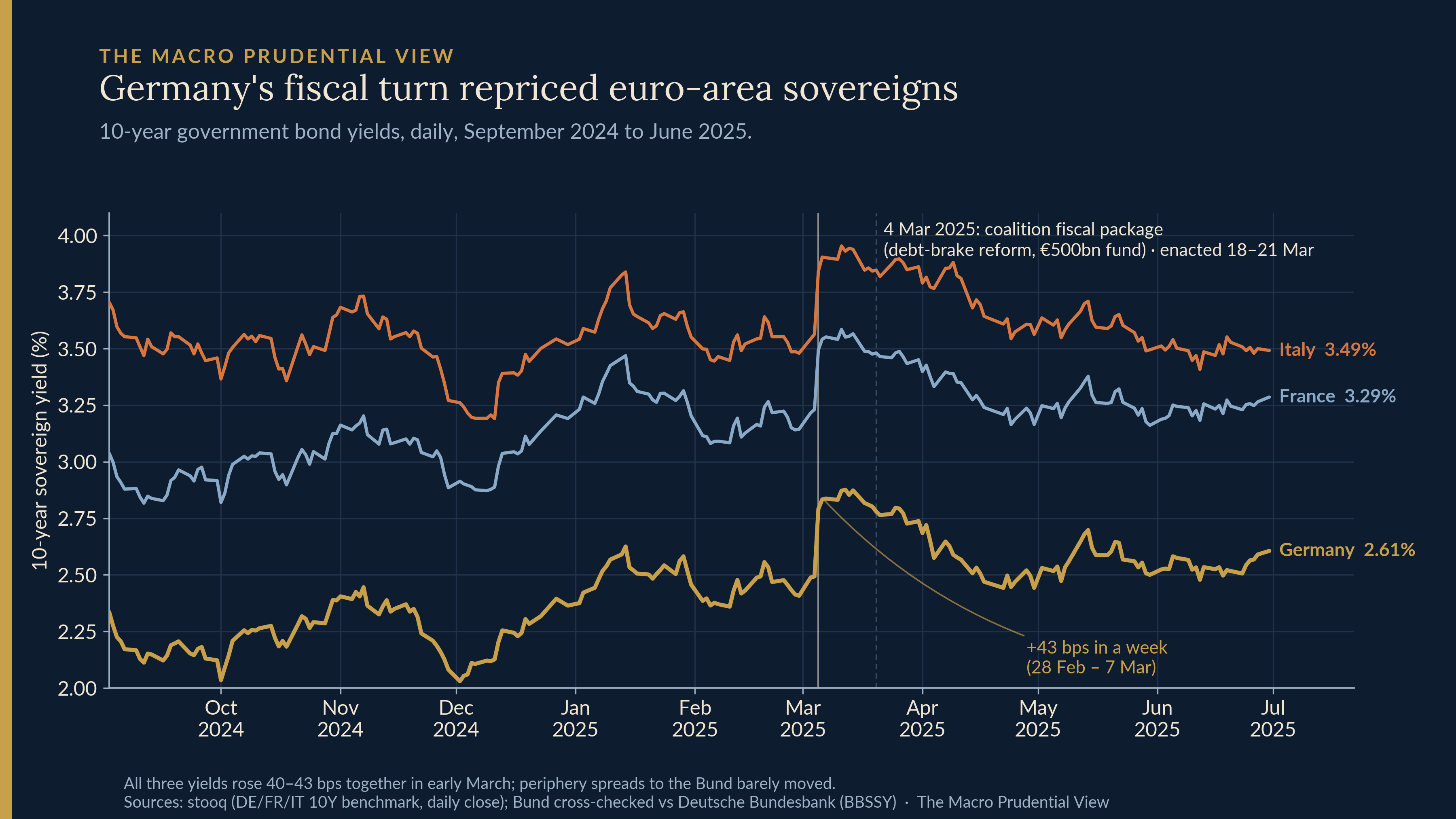
The episode is a clean window onto a fact that is easy to state and easy to lose sight of: the conditions macroprudential policy is asked to manage are set, to a first approximation, by others. Sovereign supply, the path of policy rates, the term premium, the willingness of a central bank to stand behind a market in stress — that is the terrain. Macroprudential policy operates on top of it. It does not grade it.
The residual claimant
It is worth being precise about that subordination, because the strong version of the claim is wrong and the defensible version is narrower.
Macroprudential policy operates downstream. Its mandate is the residual financial-stability risk that monetary and fiscal policy leave behind, and the influence runs both ways: bank buffers change loss-absorbing capacity, and a well-capitalised system gives monetary policy more room to ease in a downturn without fearing for stability. So the claim is not that the policy is powerless or merely passive.
The defensible claim is narrower. Macroprudential policy is the arm of stabilisation most exposed to conditions it does not set. It is also the least able to make its own countercyclical instrument credible before it is tested. Three constraints sit behind that, each demonstrable on its own. It does not set the monetary-fiscal mix that drives the cycle it has to contain; the March repricing is one view of that. It does not control the public backstop the system leans on when stress crystallises, which I come to below. And it struggles to make its ex-ante countercyclical buffer bind through anticipation. The first two constraints are structural and largely uncontested. The third is where the argument has to do work, because it is the one place where the policy is acting on an instrument it genuinely owns.
A jurisdictional edge runs through all of this. The core toolkit — bank capital buffers — covers the regulated banking core. A growing share of the risk it is meant to contain has moved outside that perimeter. That is why the third constraint matters as much as it does, and it is where the rest of the piece begins.
Even its own tool sat idle
Start with the revealed preference, which is more informative than any account of what macroprudential authorities can in principle do. The countercyclical capital buffer is the one instrument built to lean directly against the financial cycle: to rise in the expansion, accumulating releasable capital, and to be cut in the downturn. Across the euro area, through the last expansion, it did neither.
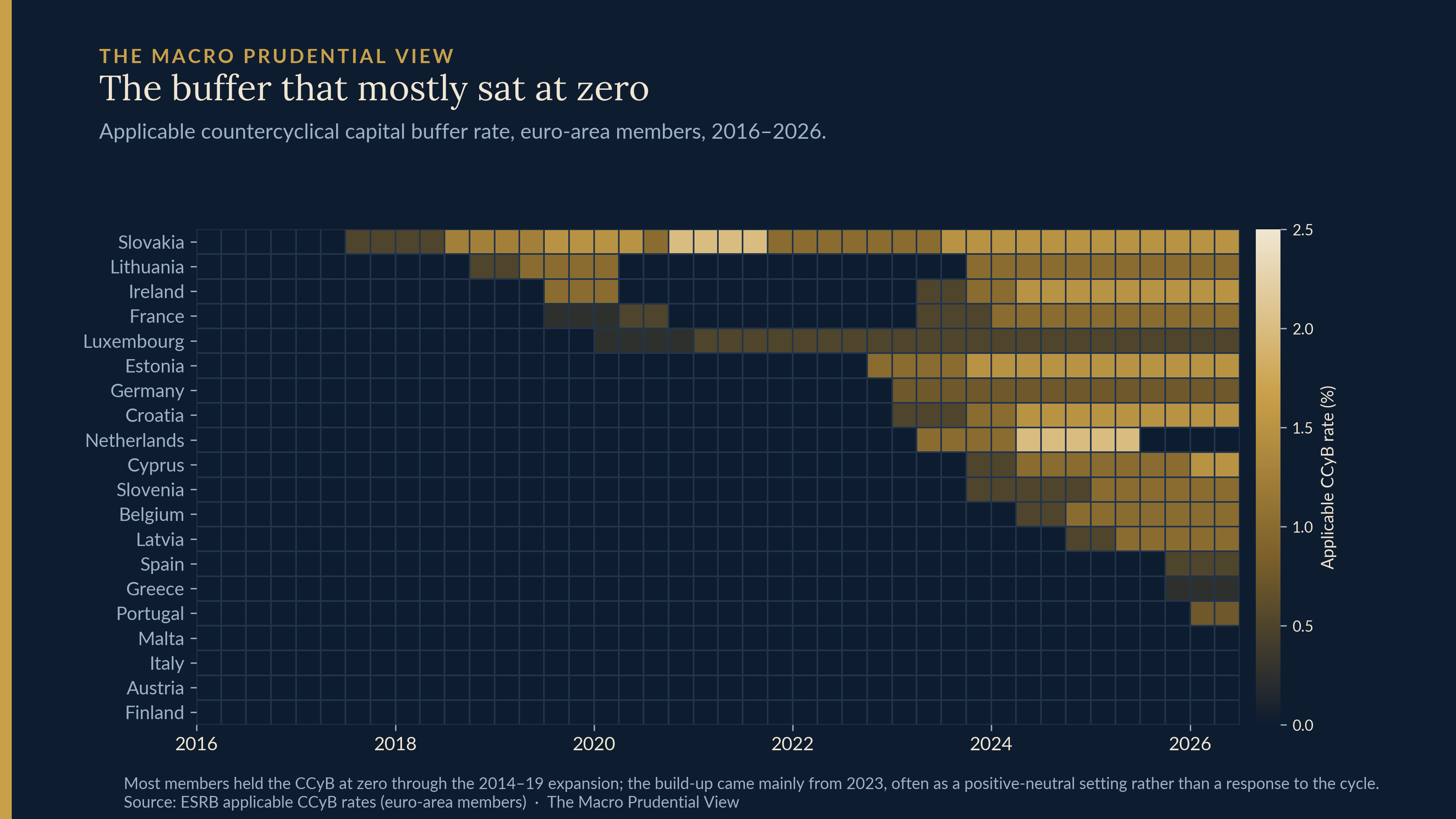
Most members held the buffer at zero through the upswing; as late as 2019, only four euro-area countries had set a positive rate at all, and the handful that had built anything released it in 2020. There was little to release. The European Central Bank’s own post-pandemic review is blunt about the arithmetic: of the capital relief the banking system drew on, only a small slice came from releasable macroprudential buffers, because so little had been accumulated beforehand. Authorities, in its phrase, had “little ammunition.”
The reasons were layered. The standardised guide meant to flag the build-up phase — the credit-to-GDP gap — rarely flashed in a decade of low growth and low rates, and raising capital requirements into an expansion is in any case costly to announce and easy to defer. The point is not that supervisors were negligent; it is that the cyclical instrument, as designed and as governed, did not build the releasable resilience it was meant to. The move from 2023 toward a “positive neutral” buffer — a positive rate set in normal times rather than waiting for a gap to open — is best read as the system’s own recognition of that limitation.
That dormancy matters more than a quiet decade suggests, because the risk the buffer was built to cushion was in the meantime migrating outside the perimeter the buffer can reach, while private intermediation capacity was being capped on purpose.
The sector outgrew the core
The migration is not subtle. Non-bank financial intermediation — investment funds, money-market funds, insurers and pension vehicles, the broad universe the Financial Stability Board tracks — has grown into the larger half of the euro-area financial system.
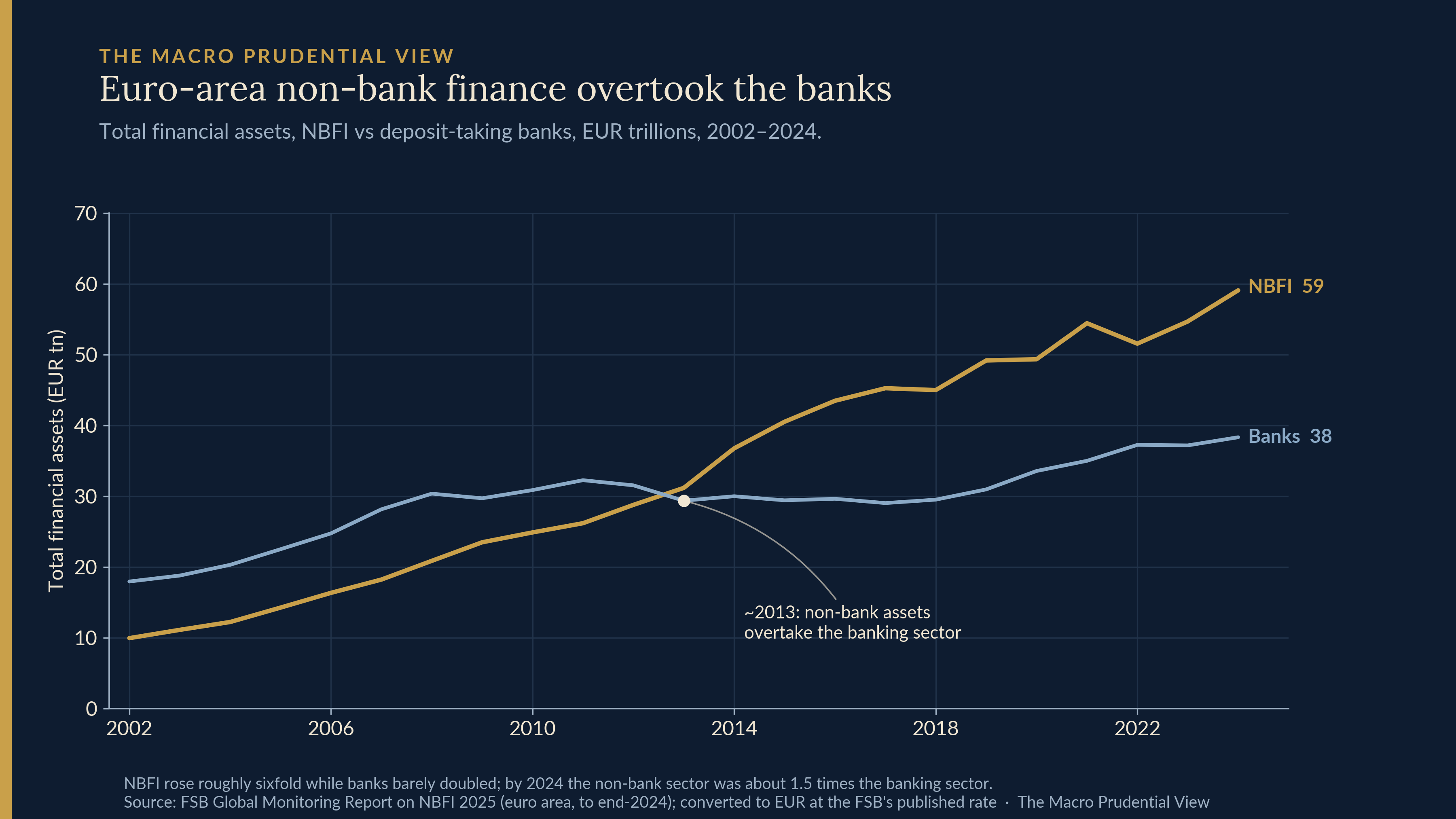
On the FSB’s measure, euro-area non-bank assets crossed above the banking sector around 2013 and now stand at roughly €59 trillion against the banks’ €38 trillion, about one and a half times the regulated core, up from barely half its size two decades ago. The non-bank share of euro-area financial assets has risen from around 15 to 22 per cent over the period.
A buffer binds on the entities it is written for. The countercyclical buffer sits on banks; it does not sit on the open-ended fund running a liquidity mismatch, the insurer reaching for yield, or the leveraged fund crowded into the same trades as its peers. As intermediation has moved beyond the banking perimeter, the buffer’s direct reach has narrowed to a shrinking share of the system. That reach is not nil: banks still fund, warehouse for, lend to, clear for, and run prime brokerage against the non-bank sector, so a capital tool on the core still bites the perimeter indirectly, through the price and availability of bank balance sheet. But indirect and incomplete reach is a weaker thing than a buffer that sits where the transformation happens — and it is one reason the credibility of the bank buffer still matters even after the risk has moved, a point the mechanism section returns to.
Capacity capped by design
The other half of the migration story is who absorbs the stress when it arrives. Here the cleanest evidence is American, and I want to be careful about what it does and does not establish.
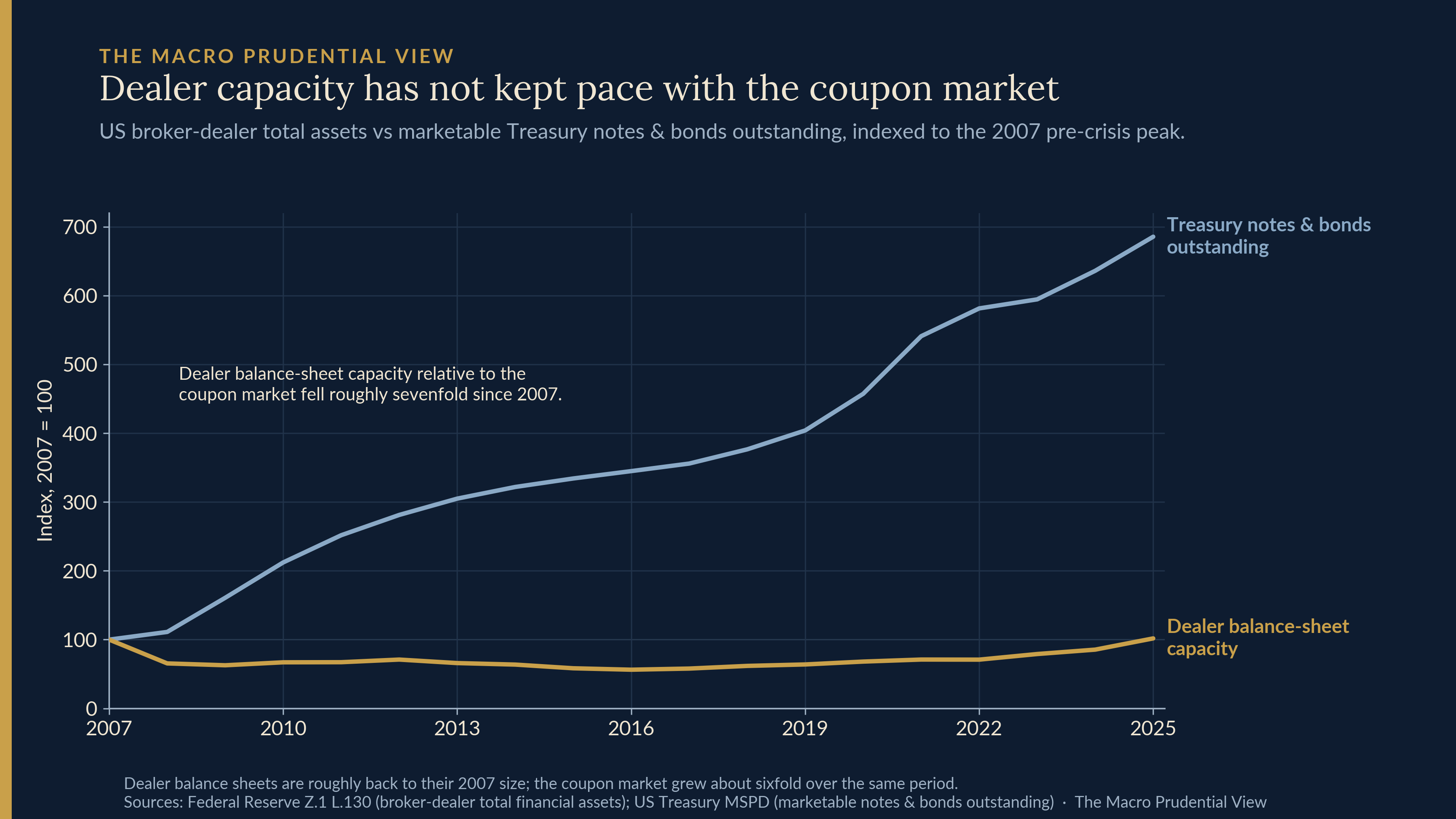
Indexed to the pre-crisis peak, the US Treasury coupon market is around six times larger than it was in 2007, while the balance-sheet capacity of the dealers meant to intermediate it has, in aggregate, round-tripped to roughly where it began. Dealer capacity relative to the market it must absorb has fallen roughly sevenfold. The shape of that gap is not an accident or a loss of nerve. It is, in large part, the intended consequence of post-crisis bank regulation — the leverage ratio and the capital rules that made banks safer by making it more expensive for them to warehouse large inventories of even low-risk assets. The capacity was capped on purpose.
The chart is US data and the euro-area market is built differently, so this is an analogy for a general constraint rather than direct evidence for the bloc. The point worth importing is narrow: post-crisis balance-sheet rules have made private intermediation capacity more state-contingent relative to the size of the markets it clears. The United States leans on standalone and non-bank primary dealers; euro-area sovereign market-making runs overwhelmingly through banks, so the binding constraint here is the optimisation those bank-dealers perform under the Capital Requirements Regulation — the leverage ratio, risk-weighted-asset targets, and internal liquidity transfer pricing that together govern how much sovereign inventory a desk will carry and how fast it steps back when balance sheet turns expensive.
There is an awkwardness worth owning. The leverage ratio that caps that capacity is itself a prudential rule, set within the regulatory family macroprudential policy belongs to, so this stretch of the terrain is not external weather in the way the monetary-fiscal mix is. But it is a microprudential safety choice whose systemic side-effect — thinner market-making in stress — lands on the macroprudential authority without that authority having set the rule. The downstream pattern holds even here: macroprudential policy is left managing a constraint calibrated for other ends.
The public balance sheet fills the gap
When a market that has outgrown its private intermediation capacity comes under stress, something has to absorb the imbalance. Repeatedly, across jurisdictions, that something has been the public balance sheet.
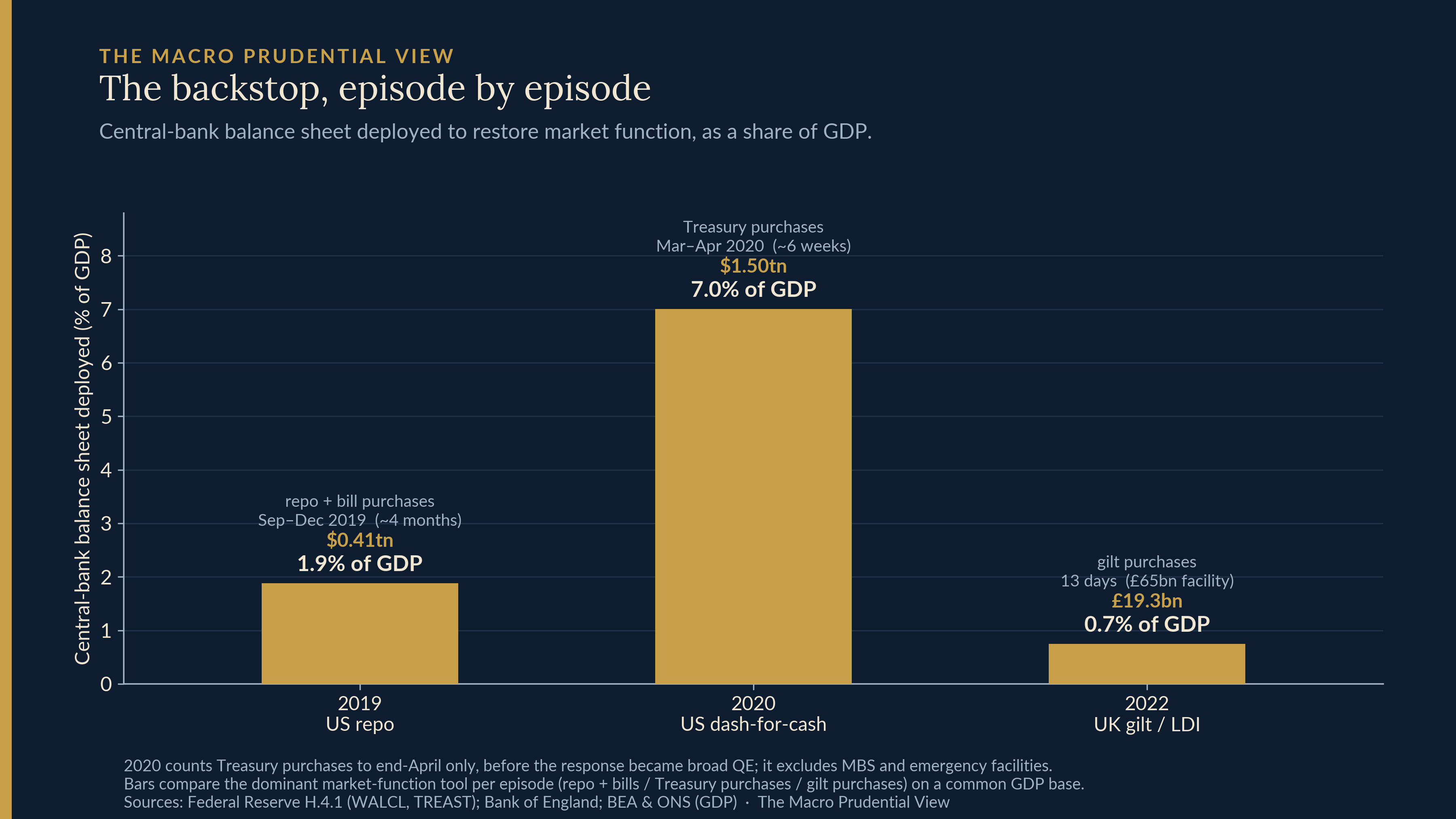
The episodes are heterogeneous, and the chart is illustration rather than proof: three different tools, in three settings, scaled by GDP. In the September 2019 US repo dislocation the Federal Reserve’s balance sheet expanded by around 1.9 per cent of GDP through repo operations and bill purchases. In the March 2020 dash-for-cash it deployed Treasury purchases worth roughly seven per cent of GDP within weeks. In the 2022 gilt and liability-driven-investment episode the Bank of England bought £19.3 billion of gilts — under a facility framed at up to £65 billion — over thirteen days, and had unwound the position by the following January. Small in that last case, and decisive: the credibility of the backstop did more work than its volume.
One honest qualification. We observe the interventions, not the stresses that buffers quietly absorbed without one, so the claim is about the marginal and tail cases, not the whole distribution. And the backstop arrives because the central bank cannot credibly promise, in advance, that it will not. Once a dislocation threatens to become disorderly, intervening is usually the right thing to do after the fact, which is exactly what makes the promise not to intervene hard to believe beforehand. The effect on private incentives is at the margin: where support is anticipated in precisely the states where resilience would matter most, the incentive to hold costly resilience ex ante is weakened there. That is the more modest claim the record will bear. The FSB has framed its own non-bank agenda in compatible terms — strengthening resilience partly in order to reduce the system’s reliance on extraordinary central-bank intervention, which is the language of an authority working on a commitment problem from the inside.
The Eurosystem is not exempt from the structure. Its pandemic asset purchases included an explicit market-stabilisation phase, and the flexibility in how those holdings are reinvested is the form the same liquidity-backstop logic takes inside the monetary union. I am narrowing the comparison to market-function support deliberately, because the distinction carries weight: the public balance sheet reliably backstops liquidity in a dash-for-cash; it is not aimed at a parallel duration repricing of the sort that opened this piece. The March 2025 move was a level repricing rather than a liquidity event, and the liquidity backstop is not aimed at offsetting that kind of shift. The backstop covers one kind of tail well; it leaves macroprudential policy facing the rest.
The credibility discount
Return to the third constraint. If macroprudential policy owns the countercyclical buffer outright, why is it so hard to use?
Call it a credibility discount: the wedge between the cyclical force an instrument is meant to exert and what its setter can credibly commit to in advance, given how observable the instrument is. The property I want to isolate is observability. An instrument whose triggers rest on unobservable, model-based, judgement-laden inputs is hard to make bind through anticipation. Two things follow from that property — discretion makes the setter’s future action hard for anyone to predict, and model-dependence makes tightening contestable in real time — but both run through observability, and it is observability that is worth holding onto.
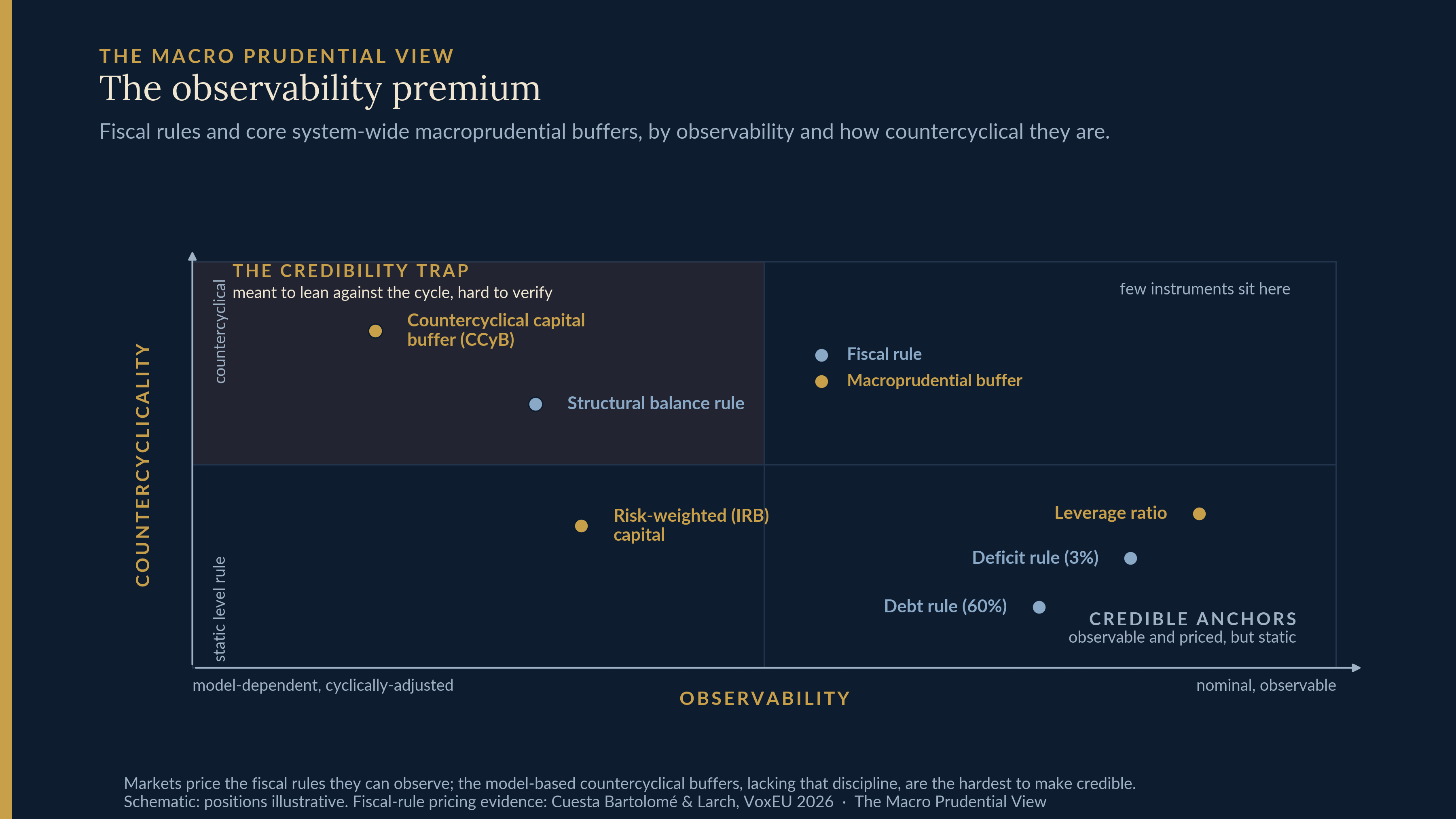
The fiscal side gives the cleanest foothold. Recent work by Cuesta Bartolomé and Larch finds that sovereign markets price compliance with the deficit and debt rules — nominal, observable, unambiguous in real time — but barely price compliance with the cyclically-adjusted, structural-balance rules that hang on an output-gap estimate. Markets discipline what they can verify. The observability condition carries to the macroprudential side; the pricing channel does not, because no market prices the countercyclical capital buffer. What enforces a macroprudential buffer is supervisory resolve and the anticipation of regulated agents, not a yield. The common factor across the two domains is observability, not the disciplining mechanism.
What does the discount do in practice? At the build-up, if banks expect a model-based buffer to be raised only rarely — the signal contestable, the act costly for the supervisor — they will not price an expected future buffer into capital planning during the expansion, so the instrument restrains little just when it is meant to restrain most. At the release, freed capital helps only if banks believe it will not be quietly clawed back once conditions normalise; doubt about that promise blunts the release too. The discount shows up as weak transmission at both ends of the cycle.
The move toward a positive-neutral buffer since 2023 is often read as the fix, and for part of the instrument it is. A static baseline rate, set in normal times, is observable and rule-like; to that extent it belongs with the credible anchors, and it is a sensible answer to the credit-gap signal’s failure. But the baseline is not the cyclical instrument. The countercyclical function — raising the buffer above the baseline as risk builds, releasing it in stress — remains the discretionary, model-dependent act, and that part stays where it was. Positive-neutral makes the floor credible. It leaves the active, countercyclical margin above the floor as exposed to the discount as before.
Borrower-based limits look like a counterexample, observable and seemingly countercyclical at once, but in practice supervisors rarely modulate them over the cycle, because tightening a loan-to-value cap mid-boom to keep first-time buyers out of the market is politically very hard. They function as static, nominal limits that bite harder in a boom mechanically, which places them alongside the leverage ratio among the credible anchors. They confirm the pattern rather than breaking it: the macroprudential tools that command credibility are the ones kept observable and out of cyclical hands.
Calibration, conditional
None of this argues against backstops, and it does not call for bigger buffers as such. Backstops are often the system working as intended, and a buffer earns nothing for size alone. The narrower point is about conditionality. Macroprudential calibration is set inside a regime it does not control — the mix that moves the terrain, the backstop that underwrites the liquidity tail — and the part of its own toolkit meant to lean against the cycle is the part hardest to make credible before it is tested. Positive-neutral has made the floor credible; the active margin above it is the gap that remains.
For the euro area the stakes are concrete. The non-bank sector that can, in a tail liquidity stress, end up leaning on the public balance sheet is now half again the size of the banking core. The fault line the public balance sheet defends runs through the sovereign-bank nexus that March’s repricing lit up. The European Central Bank and the European Systemic Risk Board have, in their joint work and in the spread of positive-neutral buffers across the bloc, already named the under-build and begun to act on it, and the diagnosis here is meant to sit alongside that work rather than second-guess it. The residual claimant does not get to set the terms of the regime it operates in. What it can work on is the credibility of the one instrument those terms still leave in its hands — which, on the evidence of how that instrument has been used, remains the harder half of the problem.
Paweł Fiedor — The Macro Prudential View
The views expressed are the author’s own and do not necessarily reflect those of any institution with which the author is or has been affiliated.
Sources: Ten-year government bond yields for Germany, France and Italy, Stooq, with the German Bund cross-checked against Deutsche Bundesbank (BBSSY_REN_EUR_A630) — https://stooq.com, https://www.bundesbank.de; euro-area non-bank and bank financial assets, Financial Stability Board, Global Monitoring Report on Non-Bank Financial Intermediation 2025 (to end-2024), converted to euro at the FSB’s published euro-area exchange rate — https://www.fsb.org; US broker-dealer total financial assets, Federal Reserve, Financial Accounts of the United States (Z.1), via FRED (BOGZ1FL664090005A), and marketable Treasury notes and bonds, US Treasury Monthly Statement of the Public Debt — https://fred.stlouisfed.org, https://fiscaldata.treasury.gov; Federal Reserve balance sheet (H.4.1), total assets and Treasury securities held outright, via FRED (WALCL, TREAST); US gross domestic product, Bureau of Economic Analysis via FRED (GDP); UK gross domestic product, Office for National Statistics via FRED (UKNGDP); Bank of England temporary gilt purchase operations, September–October 2022 — https://www.bankofengland.co.uk; applicable countercyclical capital buffer rates by member state, European Systemic Risk Board — https://www.esrb.europa.eu; composition of the pandemic capital release, European Central Bank, Macroprudential Bulletin, and European Central Bank and European Systemic Risk Board, joint analysis of positive neutral countercyclical capital buffer rates (2025) — https://www.ecb.europa.eu; fiscal-rule pricing evidence, Cuesta Bartolomé and Larch, VoxEU/CEPR (2026) — https://cepr.org. Chart data as cited in each figure.