


At the Fund’s spring briefing in April, Tobias Adrian described the job with unusual economy. The task for policymakers, the IMF’s financial counsellor said, is “not in and of itself to predict shocks”; it is to make sure the system’s vulnerabilities are understood and contained, and that something can be done if instability arrives.
This is a coherent doctrine, and for the most part a correct one. No one can forecast the next geopolitical rupture, and an institution that tried would mostly embarrass itself. Buffering the vulnerability rather than divining the shock is a reasonable division of labour, and it is the one the whole financial-stability apparatus is built around.
But it draws a line, and something important sits on the far side of it. A doctrine organised around containing vulnerabilities treats the shock as exogenous — as weather that arrives, of uncertain timing and force, against which you hold capital and liquidity. That is the right posture when the shock really is weather. It is an incomplete one when the shock is a move: chosen and timed against the places where you are thinnest. Buffering a vulnerability and anticipating a move are not the same exercise, and the reviews, at least in what they publish, do almost none of the second.
Consider the cleanest recent example. Recently the Riksbank published a careful staff memo, “The transmission of geopolitical shocks to bank lending in Sweden,” by Cristina Cella. Using loan-level data, it shows that after Russia’s 2022 invasion Swedish banks expanded credit overall while pulling back from energy-intensive and financially weaker firms, with the banks most exposed to geopolitical risk tightening hardest. It is good empirical work, and it is entirely representative. It reaches for the Caldara–Iacoviello geopolitical-risk index, names “geopolitical” dozens of times, and uses not one term from the vocabulary strategic studies has built to reason about exactly this kind of risk. The title states the frame: the invasion is a shock, and the task is to trace how it transmits.
That pattern — reaching for salience and for transmission while leaving strategy untouched — is not Cella’s choice. It is the genre’s. In the core geopolitical sections of the flagship reviews, geopolitical risk is measured along two axes the field owns comfortably: how loud it is, and what it does once it lands. The third axis — what the actor wants, whether the threat is credible, where the escalation runs — is the one the reviews barely enter. This piece is about that blank cell, and about what reading only the populated ones costs a supervisor.
Three cells, and an empty one
Picture the problem as a two-by-two.
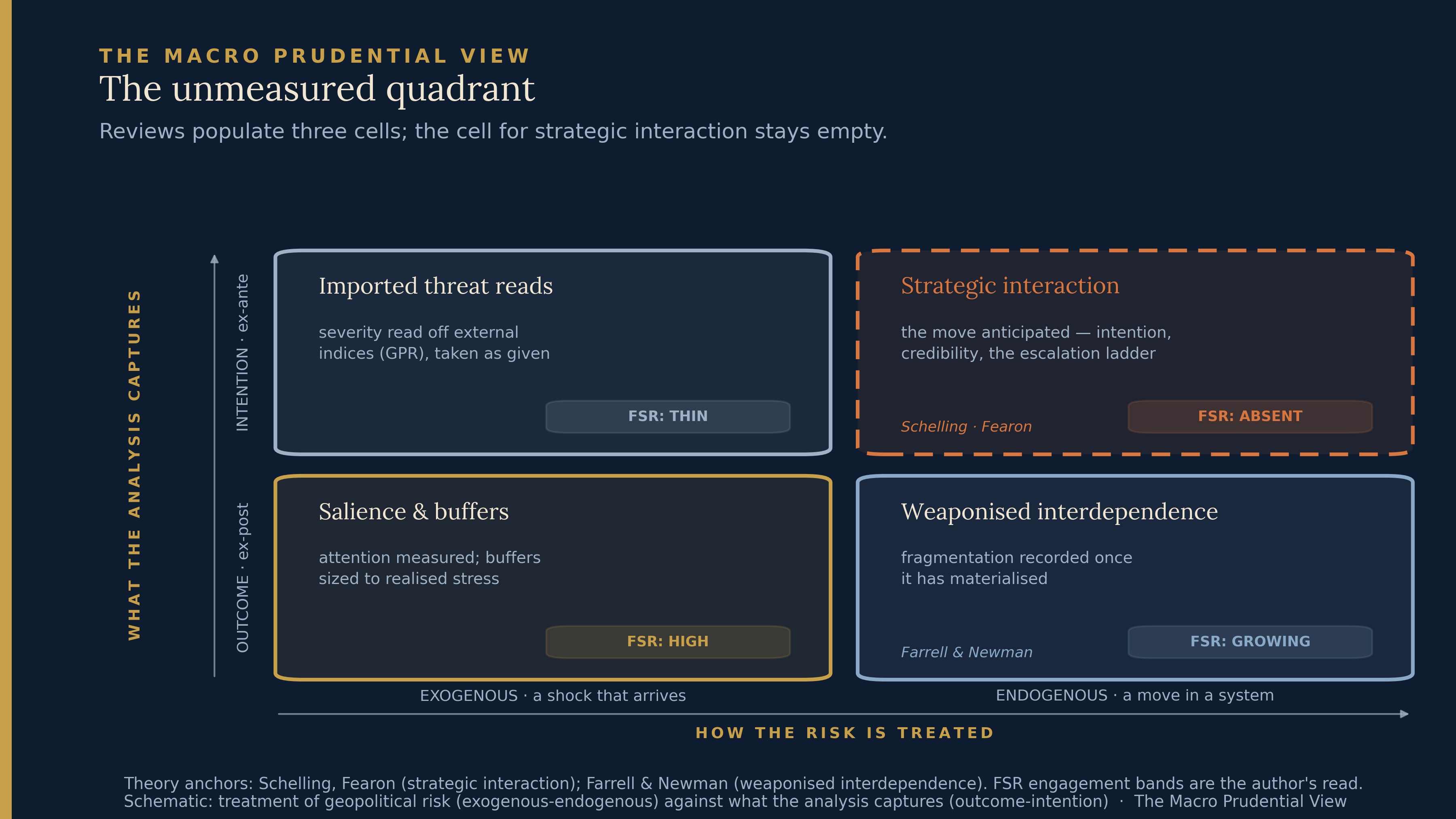
One axis is how the risk is treated: as an exogenous shock that arrives, or as an endogenous move inside a system the analyst is part of. The other is what the analysis captures: the realised outcome, after the fact, or the intention behind it, before.
Three of the four cells are populated, to varying depth. The bottom-left — exogenous shock, realised outcome — is home ground: the salience indices, the news-intensity measures, the stress tests, the buffers sized to historical loss. This is where the reviews are strongest. The top-left — intention, but still treated as something handed in from outside — is thinner: severity read off an external index and dropped into a model as a given. The bottom-right — endogenous, but again only the outcome — is where the field has genuinely moved in the past three years: fragmentation chapters that record the world’s financial linkages splitting along geopolitical lines. That cell is no longer empty, and it matters that it isn’t.
The empty one is the top-right: endogenous and intentional. The move, anticipated rather than recorded. This is the cell strategic studies was built to occupy — Schelling on deterrence and bargaining, Fearon on when bargaining breaks down — and it is the one the reviews do not enter.
A word on scope, because the claim is narrow and the narrowness is the point. I mean the core geopolitical sections of the flagship reviews: the GFSR chapters, the FSR special features, the staff memos that translate them. Pockets of real strategic reasoning exist elsewhere in the official sector — sanctions-impact units, cyber-resilience scenarios, bespoke work that never reaches the flagship. The gap is not that no one anywhere thinks strategically. It is that strategic interaction is not built into the buffer and scenario logic at the same level, with the same machinery, that salience already is.
That the empty cell belongs to the genre and not to one author is visible in the prose itself.
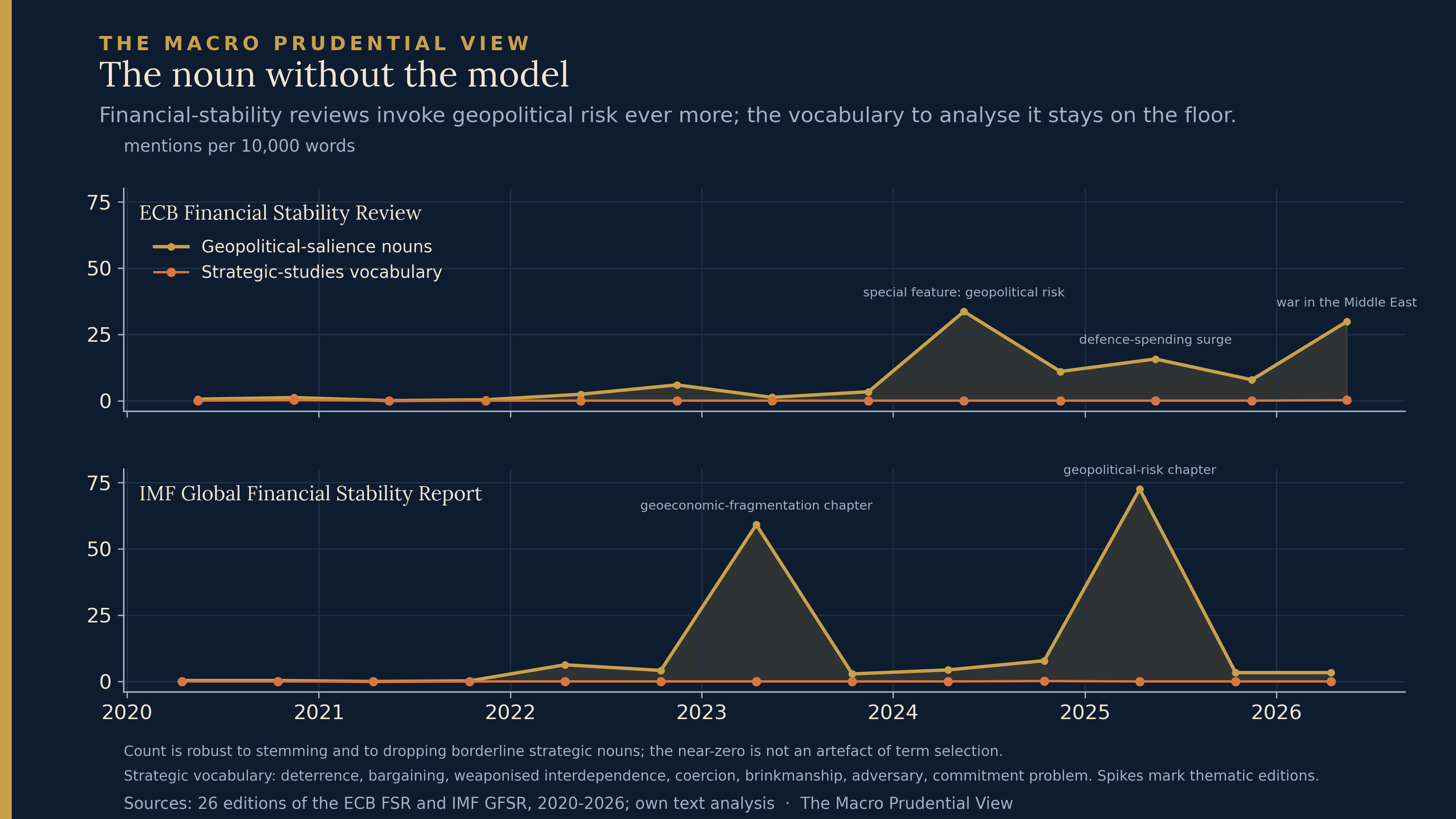
Across twenty-six consecutive editions of the ECB FSR and IMF GFSR since 2020, the vocabulary of strategic studies — deterrence, coercion, bargaining, brinkmanship, commitment problem — is exactly zero in twenty-three of the twenty-six editions, and never rises above a single stray mention in the other three, even as “geopolitical” climbs edition over edition. The starkest cases are the dedicated ones: a single GFSR fragmentation chapter used “geopolitical” nearly three hundred times and the strategic vocabulary not once.
A word count proves absent words, not absent thinking, and I do not want to overclaim from it. So take the strongest of those chapters at its best. When the GFSR maps the fragmentation of cross-border finance, it measures the thing as an outcome to be monitored — a drift in the data, plates sliding. Read with the empty cell in view, the same numbers are something else: a deliberate severing of financial infrastructure, with a timing and an asymmetry that a drift cannot have. The measurement is unchanged. The question it answers moves — from “how far has it drifted” to “who moved it, when, and whether they will move it again.” I will come back to that chapter with the mechanics in hand; for now it is enough that the reframing is available and changes the read.
The obvious objection is that the blank cell is deliberate, and proper. Assessing an adversary’s intent, credibility and escalation ladder is the work of intelligence and defence ministries; an apolitical financial-stability institution should not be naming aggressors and forecasting their moves, and its restraint is a feature. I think that is half right, and the right half is worth conceding cleanly: naming the actor and adjudicating intent is genuinely out of lane.
But the core outputs the reviews produce — buffer adequacy and its timing, adverse-scenario design, the identification of wrong-way risk in backstops and facilities — already require conditional reasoning about how strategic interaction moves exposures. A supervisor running a liquidity stress on a bank with heavy correspondent or custody exposure to the rival bloc is already obliged to ask what a targeted move against that specific node would do to the unwind path, and whether the backstop reaches the severed side. It is the same second-round exposure analysis the reviews already perform for every other risk, run conditionally.
The only difference from a conventional stress test is where the severity comes from. A standard exercise assumes, say, a twenty-per-cent disruption to cross-border clearing as a parameter. The strategic version asks instead which single node in the clearing chain is the point of failure, and assumes a counterparty with the means to close it picks the worst funding window to do so. The logic of a targeted move replaces the logic of a random one.
What keeps that move strategic rather than merely operational is that its feasibility is conditional: a node is exposed only where control over it sits on the far side of a possible fracture, which is read off the same bloc-alignment taxonomy the fragmentation chapters already use. Mapping which nodes are attackable in that sense, and whether the backstop reaches them, requires no forecast of the move and no name for the actor — only the exposure logic the reviews already apply to every other risk.
Declining to name the aggressor is a boundary, and a proper one. Treating the shock as if intention were irrelevant to how it transmits is not a boundary; it is a modelling assumption — an exogeneity built into the published frame, and one the post-2022 record increasingly contradicts.
What the salience index measures
Start with the measure the reviews actually cite.
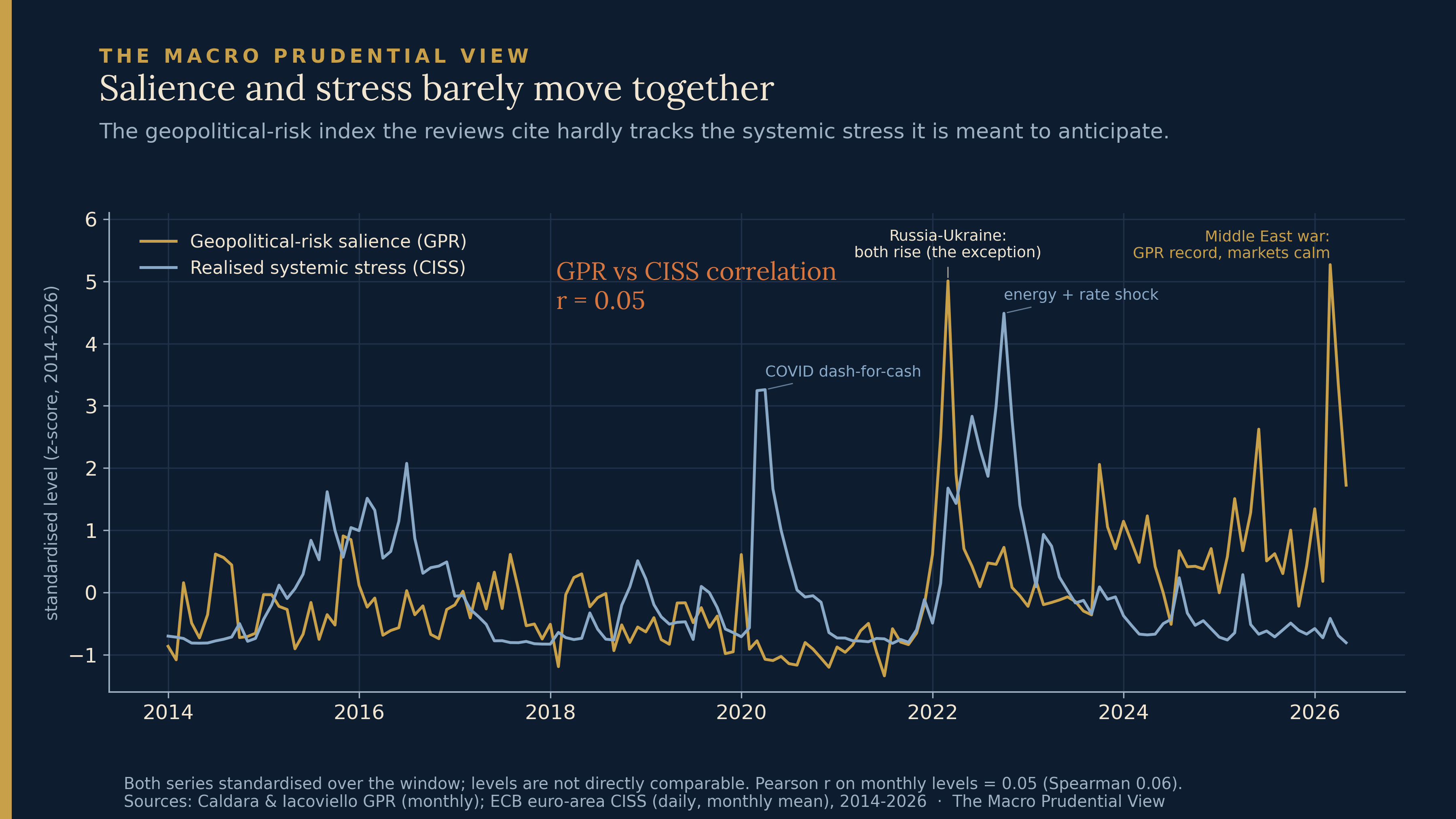
The Caldara–Iacoviello geopolitical-risk index — the GPR, the series that appears across the fragmentation chapters and the staff memos — and the ECB’s euro-area systemic-stress indicator, the CISS, barely move together: the contemporaneous correlation across 2014–2026 is 0.05.
It would be cheap to read that as an indictment, and it isn’t one, so let me grant the honest reading first. A near-zero correlation is close to what the official sector’s own account predicts. Most geopolitical events do not become systemic stress, because facilities and buffers absorb them; the reviews would say, correctly, that the low correlation is a sign the machinery works. The chart is no embarrassment to macroprudential policy.
But granting that closes one door and opens another. Buffers absorbing the realised salience of past events tell you nothing about how the system is positioned against a move timed against a specific chokepoint — which is the case the rest of this piece is about. The low correlation does not vindicate the framework; it relocates the question. And it leaves the narrower point standing: salience and systemic stress are different objects. The GPR is an excellent gauge of how much attention geopolitics is drawing. It is not a measure of where the structural vulnerability sits. The reviews rely on it because it is the available, citable series for geopolitical intensity, in a way that a direct measure of strategic exposure is not — but intensity is not structure, and a model that regresses on the one is not capturing the other.
There is one more reason the blended index misleads, and it points straight at the next section. The GPR is a single number that folds together two very different things: the phase in which a threat is made, and the phase in which it is carried out. Averaged into one series, the attention measure obscures the one window that might actually be informative.
The phase that would lead
Split the index into its parts.
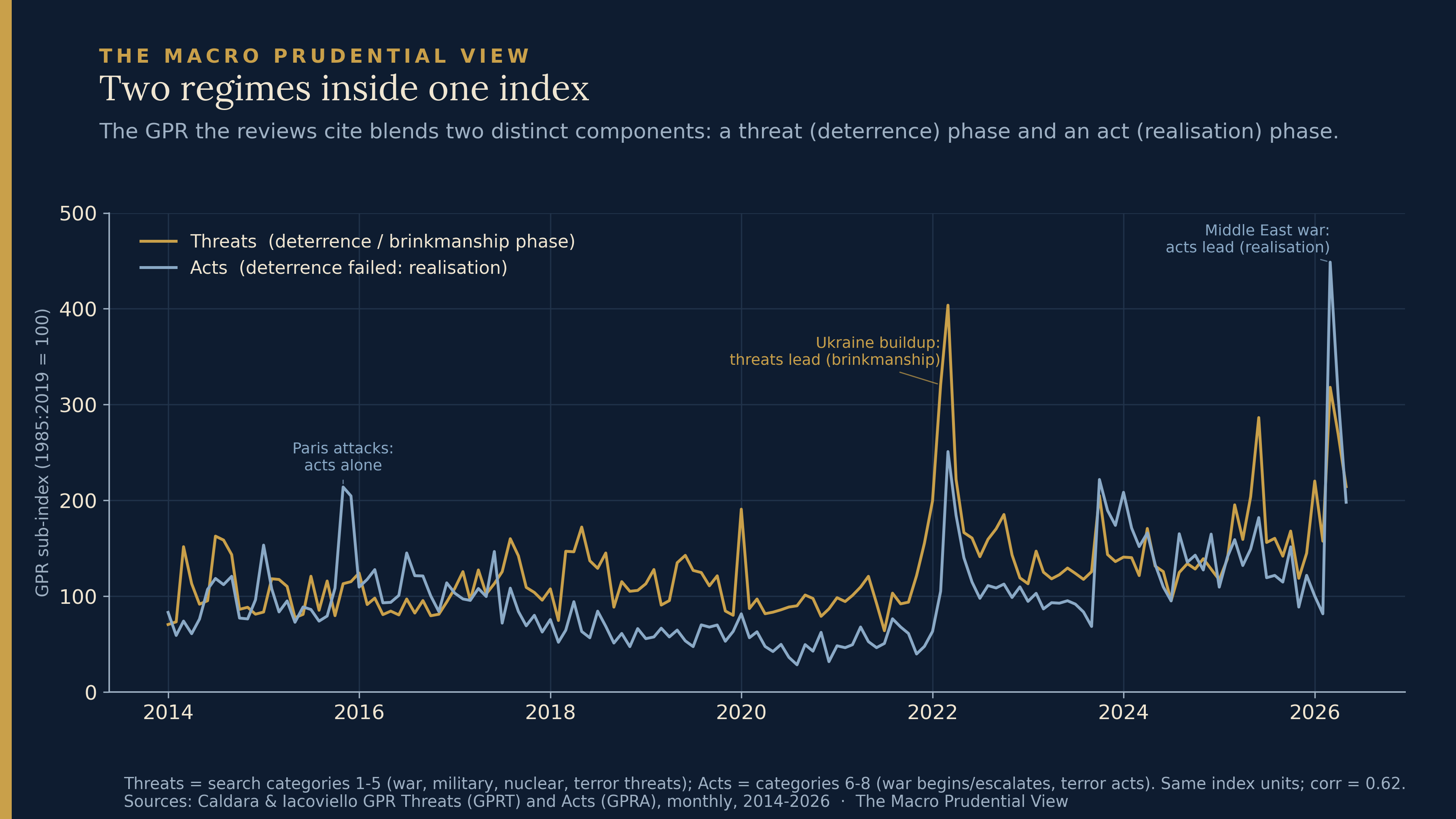
Caldara and Iacoviello publish the GPR in two components, a threats sub-index and an acts sub-index, and they behave like two regimes. Threats rise in the bargaining and brinkmanship phase, when something is being signalled and not yet done. Acts rise on realisation, when it is. The build-up to February 2022 shows up in threats; the Paris attacks of 2015 show up in acts, with no threat phase at all.
If a forward-looking signal lived anywhere in this series, it would live in the threat phase — the bargaining moment is, in Schelling’s account, where intentions are revealed before they are executed. It is worth checking whether it does.
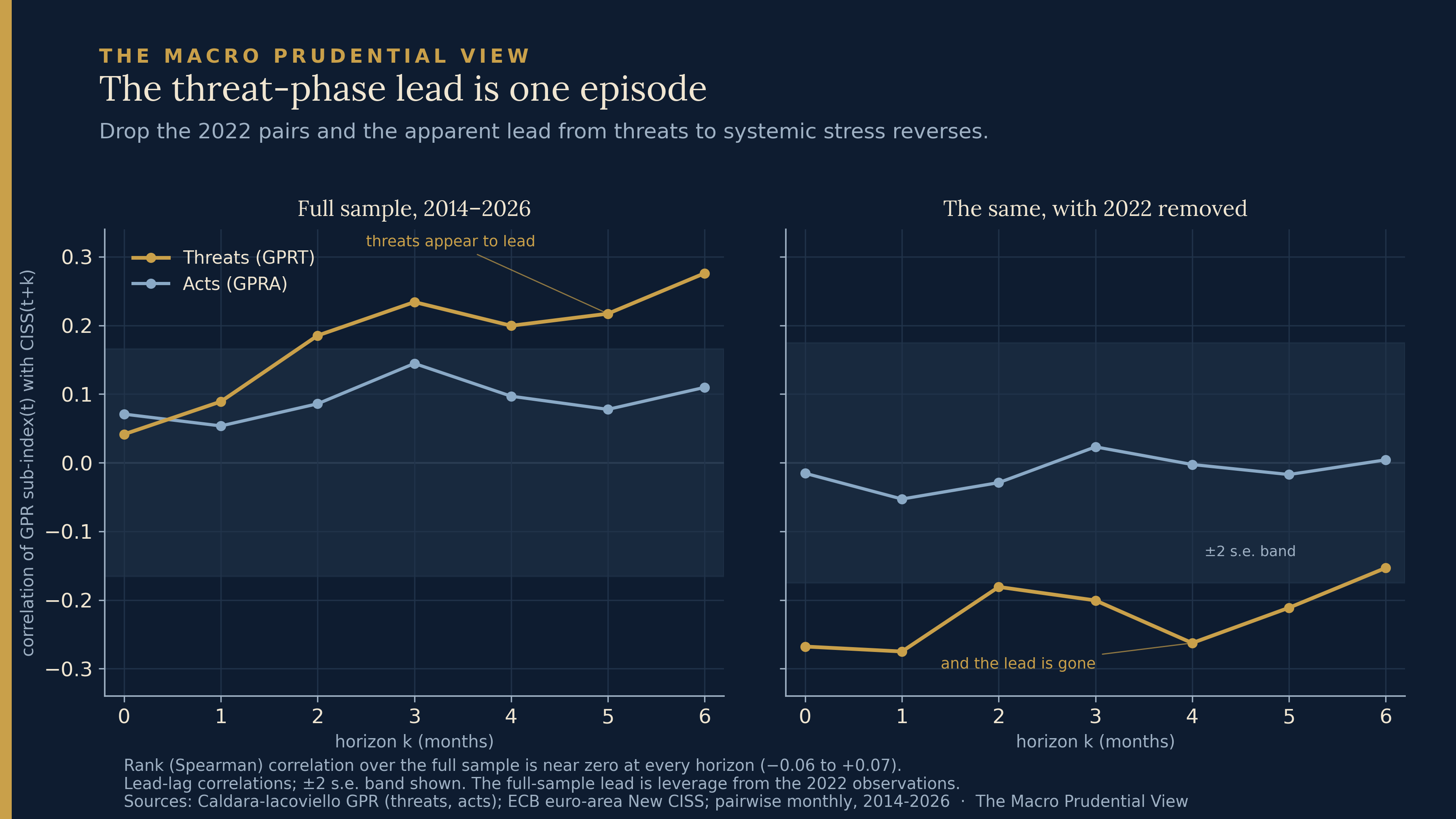
It does not, or not in a way that survives a robustness check. Correlate each sub-index with euro-area CISS across horizons of nought to six months and a threat-phase lead does appear in the full sample, climbing to roughly 0.23 to 0.28 at three to six months while the acts series stays flat. But it is one episode. Drop the 2022 pairs and the threat lead does not merely weaken — it turns slightly negative, the acts series sits near zero, and neither phase shows a stable lead. On rank correlation, which is not hostage to a handful of joint-high months, the threat-phase lead over the full sample is indistinguishable from zero. The apparent channel is 2022 doing the work: a threat phase in January and February that happened to precede the energy-and-rate stress of that year.
That failure has a mechanical cause, and the cause matters. The GPR is built from newspaper text; it measures how much the press writes about geopolitical risk. Financial brinkmanship does not read like that. Quietly probing a clearing system, or shifting custody out of a jurisdiction before it can be frozen, generates exposure rather than headlines. 2022 registers because that coercion was unusually physical and public — armies on a border — while the financial moves that matter most are the ones the press cannot see. So the chart does not show that the strategic window is imaginary; it shows that a media-intensity index is the wrong instrument for finding it. The strategic literature gives good reason to expect a bargaining-phase window; this series cannot identify it, and no supervisor should expect it to.
That leaves the cost where it actually falls. A two-to-six-month strategic window is far too short to move a structural or countercyclical capital buffer, whose governance and phase-in run to several quarters; no one should be setting capital off it, and a framework that declined to would be right. The window belongs to the fast, discretionary instruments — liquidity readiness, a review of collateral eligibility, swap-line and operational preparation against specific chokepoints. A framework that reads only realised salience keeps the slow tool in view and tends to leave the fast one un-cued, and the fast one is the only one a timed move would test. The cue for it cannot come from a public index either; it has to come from exposure mapping and supervisory judgment, which is the structural question the rest of this piece is about.
The network is the weapon
The deeper claim has nothing to do with timing. It is about what kind of thing the system is. In the exogenous picture, the financial system is the thing a shock hits. In the strategic picture, the financial system is the terrain the contest is fought on, and its chokepoints — the points where flows concentrate and can be cut — are the weapons. Henry Farrell and Abraham Newman named this weaponised interdependence: the same network that makes the system efficient hands whoever controls its hubs a coercive instrument. Once that is true, a “shock” is not weather. It is a move, made by someone, against a node they chose because you depend on it.
The banking book is already re-routing around exactly this logic, slowly.
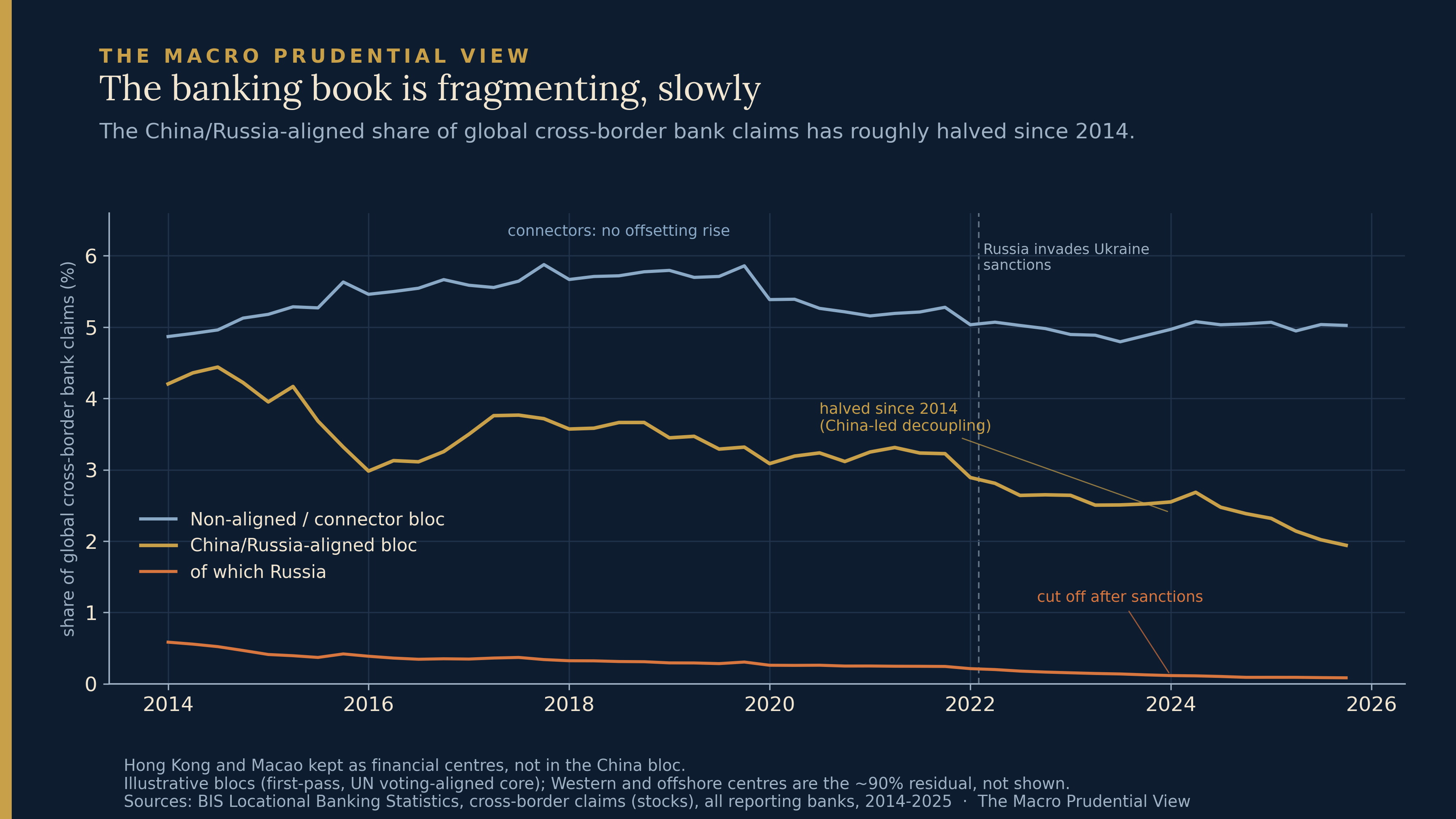
On BIS locational data, the share of global cross-border bank claims on the China- and Russia-aligned bloc has roughly halved since 2014, from about four per cent to under two. The China component is a gradual, decade-long decoupling. The Russia component is something else: a near-vertical collapse after 2022, from a small share to almost nothing, as the system was deliberately cut off. No non-aligned bloc has absorbed the difference in cross-border bank claims — the connector share is flat, though friend-shoring would surface sooner in trade and direct investment than in claims this sticky. The de-linking is asymmetric: the Western-and-offshore core holds at some ninety per cent of the book throughout, and the bloc construction here is a first-pass one, with Hong Kong and Macao kept as financial centres rather than folded into China. But the Russia line is the cleanest recent demonstration of weaponised interdependence on offer: a chokepoint, identified and closed.
One caution about which way it points. The Russia line shows the West using its own network centrality against an adversary; it does not show the West on the receiving end. For a European supervisor the defensive question is therefore the narrower one: which nodes run the other way, where both the dependence and the control over it sit on the far side of a possible fracture, including dependence on infrastructure controlled inside the Western bloc itself. The exhibit proves the mechanism is live; it does not locate your own exposure for you.
The reason this matters for supervision is that it converts into observables. Farrell and Newman’s argument, put into the language a risk authority already speaks, says to track a particular set of exposures: funding-currency concentration; custody and jurisdiction concentration; dependence on payment and market infrastructure — correspondent banking, and the central counterparties and securities depositories that sit in sanctioning jurisdictions; and backstop eligibility conditional on bloc alignment. None of these requires naming an adversary. All of them are balance-sheet or plumbing facts a supervisor can map today. And the banking book is only the baseline — capitalised, supervised, slow to fragment; the same concentrations compound in the non-bank sector, where leverage is opaquer and the backstop slower, which is where they bite first.
The point is not the list but the rule that orders it, and the rule is what a review would act on. Rank these exposures by where they compound: flag the positions at which collateral location, legal jurisdiction and payment access could fracture together, because that is the configuration in which standard liquidity support fails — the asset is sound, but it sits where the home backstop cannot reach it at the moment it is needed. Put formally: map the concentrations at which a severance is both feasible for the counterparty and non-offsettable by the home backstop within the bargaining window in which it would be used.
The sharpest case is the interaction of two of these exposures. A reserve asset held in a custody node on the wrong side of a sudden fracture loses its eligibility as central-bank collateral at the precise moment a liquidity run makes that eligibility matter most. For an official holder the Fed’s FIMA repo facility now reaches part of this — Treasuries custodied at the New York Fed can be turned into dollars without a fire sale — which is precisely why the binding exposure is the one the facility does not cover: the commercial bank, and above all the non-bank, holding the same asset in the same place with no such line. Custody-jurisdiction concentration and backstop eligibility are each tolerable alone; together, and outside the reach of a standing facility, they are wrong-way risk of the purest kind. Fearon supplies the timing — the dangerous windows are the commitment-problem moments, when a bargain that cannot be credibly held breaks down, which is as good a one-line description of February 2022 as any. Kindleberger supplies the question that closes the loop: does the backstop span the fracture? The Fed’s swap lines are a Western-bloc good. A backstop that reaches only your own side of a severed network is itself a wrong-way property.
So return to that GFSR fragmentation chapter, now with the mechanics in hand. Measured in the bottom-right cell, it is a fact about drift: the share of claims on one bloc has fallen. Measured in the top-right cell the chapter does not occupy, the same fall is a deliberate move: a chokepoint someone closed, in a particular month, with a backstop that did not reach the far side. The data point is identical. The supervisory question it answers is not, and only one of the two tells you where to look next.
The policy world is, in places, already ahead of the analysis. The EU’s Anti-Coercion Instrument exists precisely to raise the cost of economic coercion — which is an institutional acknowledgement that the strategic layer is real and legible. The financial-stability analogue would be to map the chokepoint exposures and ask the instrument’s own question in reverse: given our specific dependencies, what is the least-cost move against this particular node?
There is a reason this work belongs in supervision rather than in the flagship reviews. Some of the empty cell is not an analytical gap at all. A review answerable to a multilateral board has understandable reasons not to print a liquidity scenario conditioned on a named member severing infrastructure, and the restraint on the publication is neither unreasonable nor likely to lift. But a constraint on what can be printed is not a constraint on what can be examined, and the examination has an obvious home: supervisory scenario design and liquidity-preparedness review, where a conditional path can be run against the exposures without a flagship’s need to name anyone. That is the institutional home the argument is asking for. Collateral policy and operational contingency mapping follow from it; they do not need a separate venue.
What it costs
Put the whole thing in the form a risk officer will recognise. A liquidity or capital stress test today dials geopolitical severity as an exogenous parameter: assume conditions worsen by some amount, and check that the buffers hold. The unmeasured quadrant asks a different question. Given our specific exposures to dollar clearing, reserve custody, and correspondent banking with the rival bloc, what is an adversary’s least-cost way to force a disorderly unwind — and in which bargaining window would they choose to execute it? The first question is about how bad the weather can get. The second is about what an opponent does when they can see where you are thin. They produce different stress tests, and only the second is conditioned on the thing that has actually changed about the world.
The gap bites hardest where the backstop is slowest. In the non-bank system, funds and insurers carry liquidity promises on top of the same chokepointed infrastructure, but the central bank’s reach there is the most discretionary and the least automatic — so a strategic move would pick a funding or collateral node precisely because no standing facility covers it, landing as a margin call or a collateral freeze before a discretionary backstop could be authorised.
None of this is a case for central banks to become strategists, or a correction of any particular report. Adrian’s doctrine holds: the job is to contain vulnerabilities, not to predict shocks. The argument is only that one of those vulnerabilities is now the system’s own exposure to a deliberate move against its chokepoints, and that this vulnerability lives in the one cell the reviews do not yet measure. The shock itself cannot be predicted, and the reviews are right not to try. The board it would be played on — its chokepoints, and the backstops that may not span them — can be mapped. That is the cell they still leave unmeasured.
Paweł Fiedor — The Macro Prudential View
The views expressed are the author’s own and do not necessarily reflect those of any institution with which the author is or has been affiliated.
Sources: Tobias Adrian’s remarks, IMF Global Financial Stability Report press briefing, Spring Meetings, 14 April 2026 — https://www.imf.org; Cristina Cella, “The transmission of geopolitical shocks to bank lending in Sweden: Evidence from Russia’s full-scale invasion of Ukraine,” Sveriges Riksbank Staff Memo, June 2026 — https://www.riksbank.se; geopolitical-salience and strategic-studies vocabulary counts across twenty-six editions of the ECB Financial Stability Review and IMF Global Financial Stability Report, 2020–2026, own text analysis; Geopolitical Risk (GPR) index and its threats and acts sub-indices, Caldara and Iacoviello — https://www.matteoiacoviello.com/gpr.htm; euro-area New Composite Indicator of Systemic Stress (CISS), European Central Bank Data Portal (series CISS.D.U2.Z0Z.4F.EC.SS_CIN.IDX) — https://data.ecb.europa.eu; cross-border bank claims by counterparty, Bank for International Settlements Locational Banking Statistics — https://data.bis.org; illustrative bloc construction based on UN General Assembly voting alignment, following Bailey, Strezhnev and Voeten (2017) and the IMF’s geoeconomic-fragmentation analysis (GFSR, April 2023; Aiyar et al., 2023), with UN Resolution ES-11/1 (March 2022) as a robustness check; theoretical anchors: Thomas Schelling, The Strategy of Conflict and Arms and Influence; James Fearon, “Rationalist Explanations for War” (1995); Charles Kindleberger on the lender of last resort; Henry Farrell and Abraham Newman, “Weaponized Interdependence” (2019); EU Anti-Coercion Instrument, Regulation (EU) 2023/2675 — https://eur-lex.europa.eu. Chart data as cited in each figure.