



What Was Holding the Buffers Up
In June, writing about the European Commission’s money market fund review, I described the United Kingdom as proposing “to raise weekly liquid assets toward 50%” and as having “confirmed the opposite instinct” to Brussels. That was already wrong when it published. The FCA had set out a revised position on 8 June, a fortnight earlier: it intends to keep the existing minimum liquidity requirements in rules, and to place 40% for stable NAV funds and 20% for variable NAV funds in supervisory guidance. Those are the Commission’s two numbers. The error is worth correcting slowly, because the piece it sits in was about the difference between a requirement and an expectation, and the UK has moved across that line since.
What the FCA announced
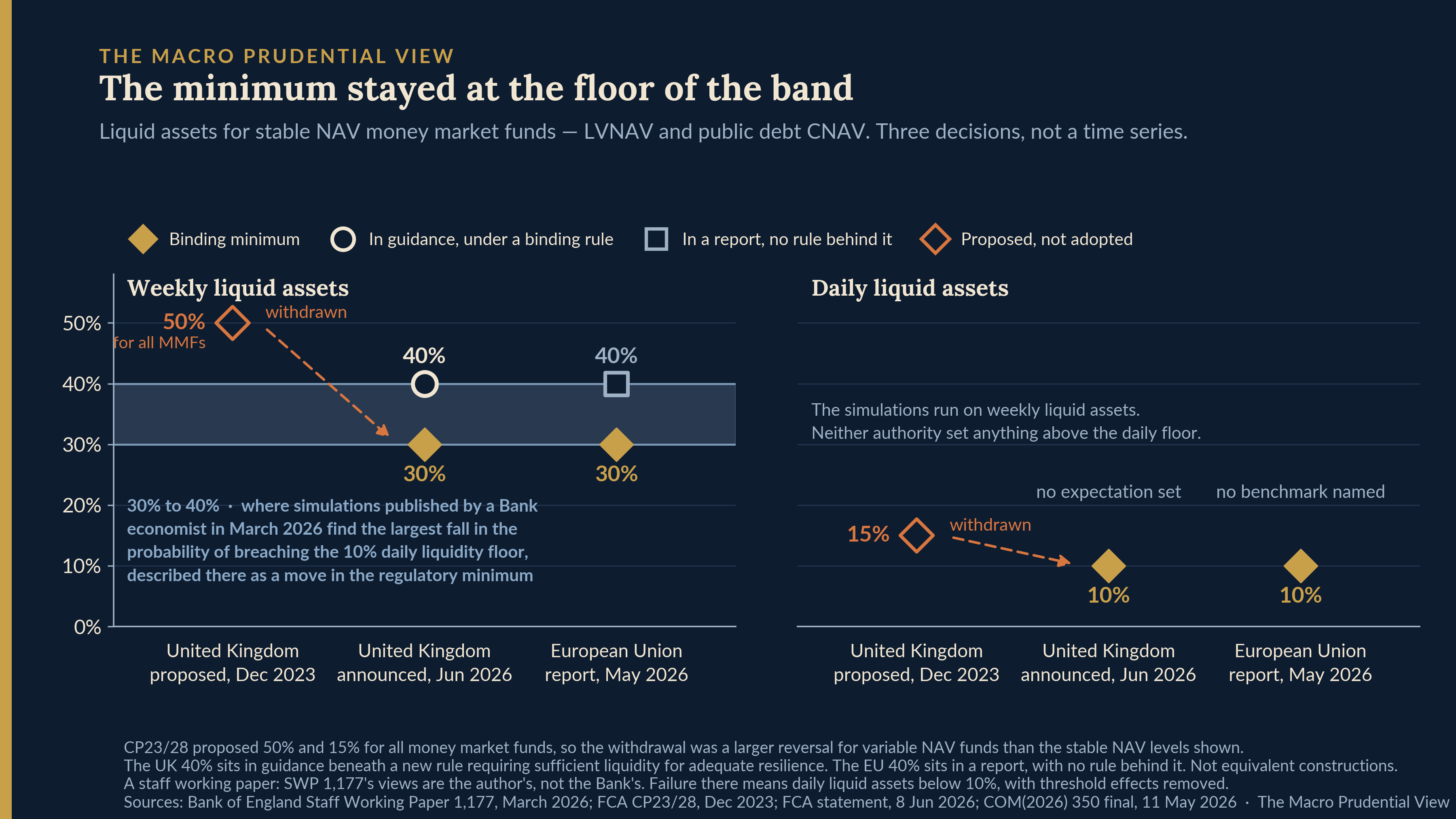
The FCA plans a new rule requiring “that all MMFs hold sufficient liquidity for adequate resilience”: a binding duty with no figure in it. Beneath that rule will sit guidance carrying a “strong supervisory expectation” that stable NAV funds hold 40% weekly liquid assets and variable NAV funds 20%, “in order to meet the new resilience requirement”. The numerical minima stay where the retained UK regulation left them, at 30% weekly and 10% daily for low-volatility and public debt constant NAV funds. The 2023 proposal to raise the weekly and daily minima to 50% and 15%, for all money market funds rather than the stable NAV ones alone, has gone; on daily liquid assets the FCA will retain the 10% floor and does “not plan new guidance on DLA levels”.
None of this is yet in force. The FCA has said it will publish interim final guidance on weekly levels; the statement page still carried its 8 June date when this was checked on 18 August, with neither the guidance nor the policy statement issued. The Treasury, announcing the reform jointly with the FCA on 14 May, expects the new regime in place by the fourth quarter of 2026, subject to Parliamentary approval. What follows is about a decision taken, not an instrument issued.
The package also includes delinking: removing the regulatory connection between a stable NAV fund’s liquidity level and the board’s obligation to consider fees or gates. That connection is the cliff edge in the run literature, and removing it is the most substantial thing in the package.
Where forty came from
Three months before the FCA moved, a Bank of England staff working paper asked what the buffer should be. Rishabh Kumar’s A simulation framework for sterling money market funds estimates redemption capacity and failure probability across a range of redemption profiles and market-liquidity conditions. It finds that “the reduction in failure risk is concentrated in the transition from 30% to 40% WLA; beyond 40%, additional increases in WLA typically generate comparatively smaller marginal improvements in survival across horizons”.
Failure there is a term of art. A fund fails, in this framework, when its daily liquid assets fall below 10% of total assets: a breach of a regulatory floor rather than a gate, a suspension or a loss to investors. It is a measurement device for whether a fund got into trouble, and the headline reads more dramatically than the thing it counts.
The paper describes its result in the language of the rulebook. What it models is “increasing the requirement to around 40%”, and the gain it finds comes from “increasing the current regulatory minimum to a higher buffer”. That establishes less than it appears to. The simulations vary the liquid assets a fund holds; they do not model legal instruments, so they cannot show that a binding minimum is the only way to get funds to 40%, or that guidance would fail to. Whether an expectation holds the lower tail of the distribution as reliably as a numerical floor is an open question, and neither authority has published anything on it. The chart below sets the three decisions against the band the simulations identify.
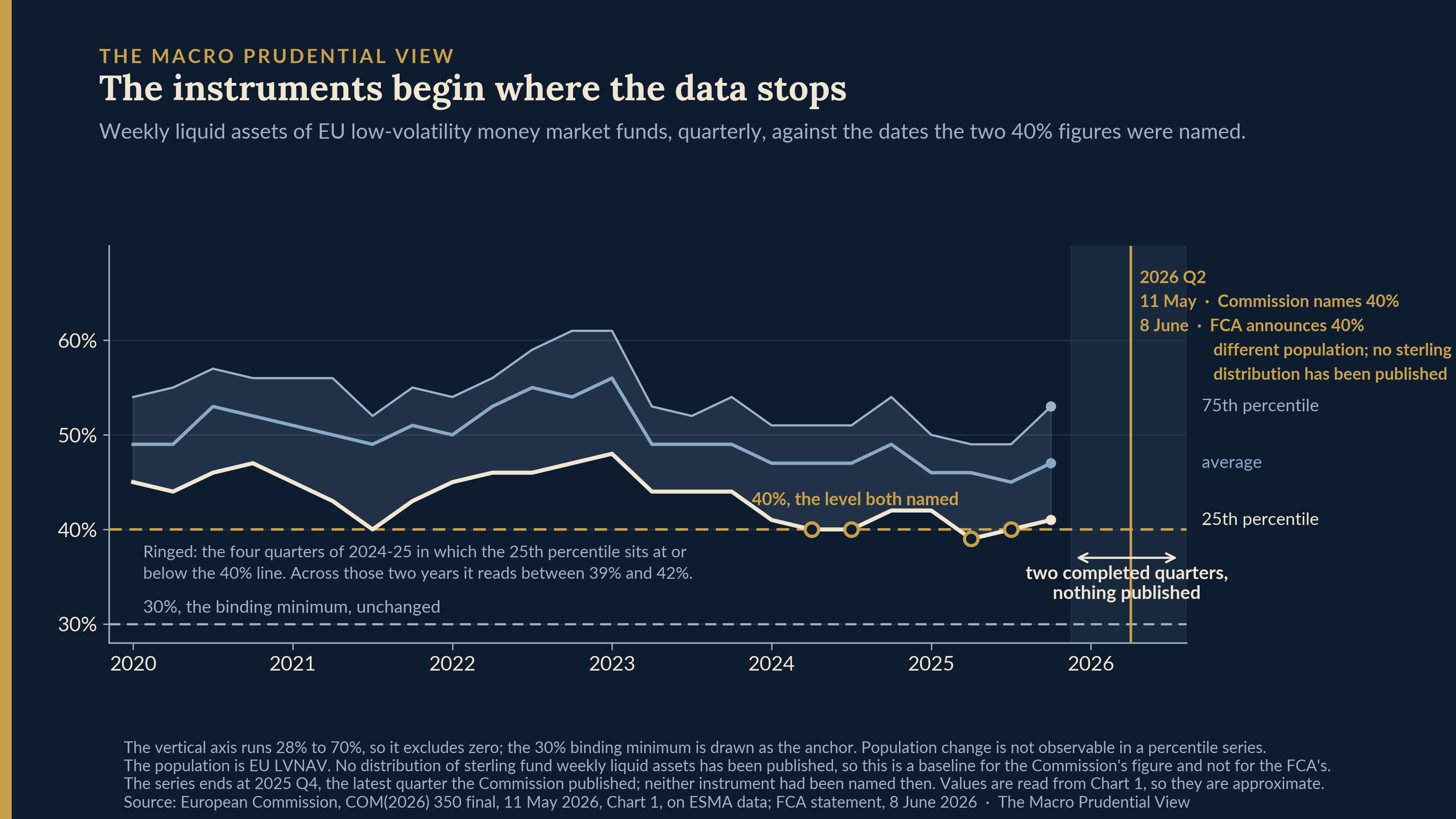
There is a baseline against which it could be answered, and the Commission has published it. Its own data put the 25th-percentile cutoff for EU low-volatility funds close to the 40% line for two years, and then stop: the series ends before either instrument exists. That is an EU population and the benchmark in question is the EU one, so it is a baseline for the Commission’s figure alone, and the holdings predate the benchmark in any case. It is the starting line, and someone should be measuring from it, as the next chart shows.
The 30-to-40 result comes from a specific counterfactual: runs under historically extreme shocks, with the 30% threshold effect switched off. Removing that effect, the paper finds separately, itself “yields sizeable resilience gains by reducing cliff-edge behaviour”. It is the same effect the FCA is now removing, so the two halves of the package belong together.
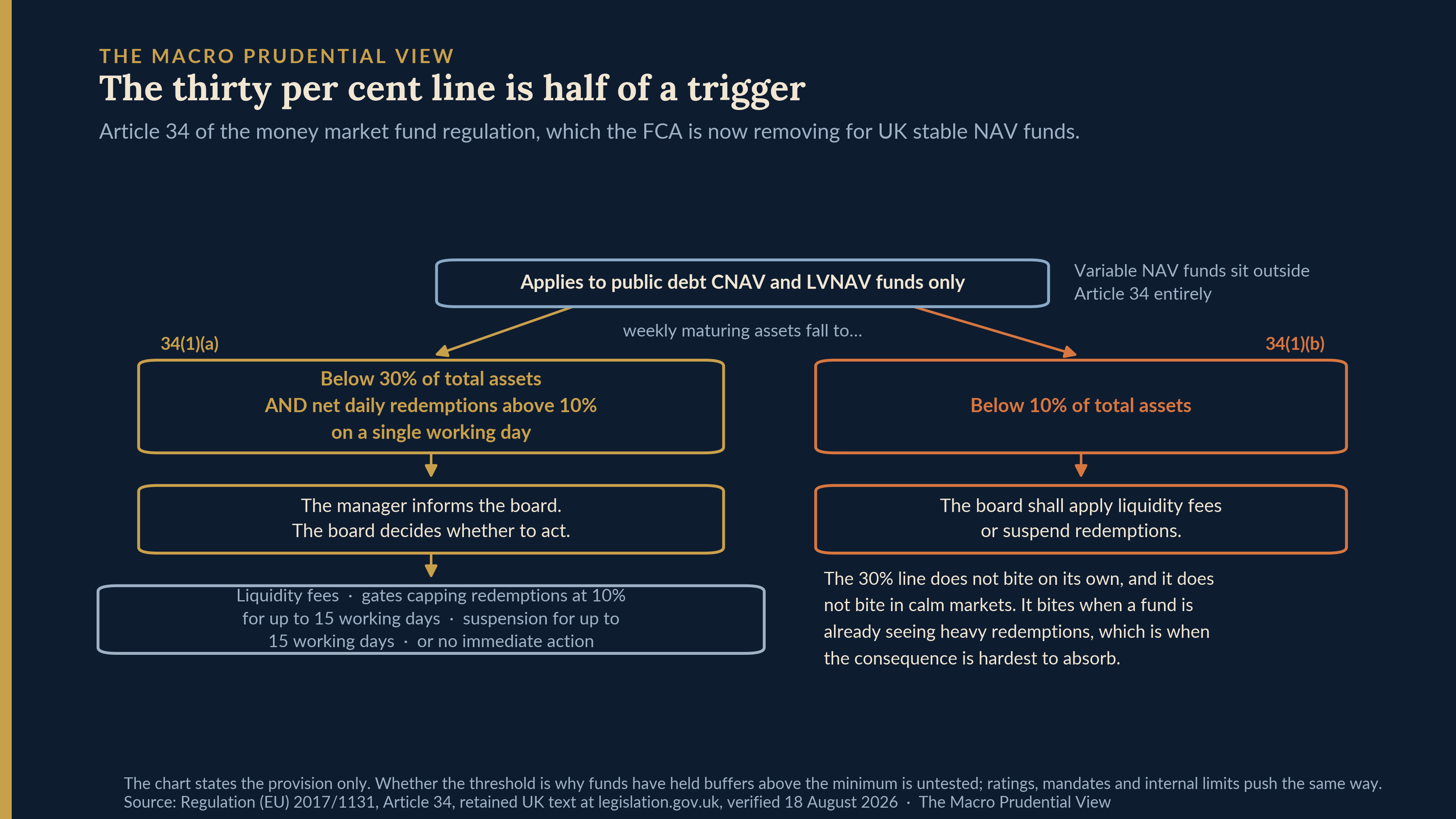
The cliff is narrower than it is usually made to sound. Article 34 is a joint condition rather than a single line, it reaches only stable NAV funds, and the chart below sets out both of its limbs. The 30% line does not bite in calm markets. It bites in precisely the conditions in which a manager can least afford it, and that is a reason to hold enough that a run cannot carry you across it.
The Commission’s series shows EU low-volatility funds holding weekly liquid assets in the forties on average against a floor of thirty from 2020 to 2025, with the 25th-percentile cutoff close to the 40% line from 2024. Whether the threshold is why, I cannot show, and neither can anyone else from public data. For sterling funds the distribution is reported to supervisors and never published. Article 37 requires every UK money market fund to report at least quarterly, and the reporting template in the FCA’s own Handbook asks, at field A.4.6, for the percentage of assets qualifying for the weekly liquidity buffer. Equivalent returns reach the Central Bank of Ireland and the CSSF for the funds that hold the other nine tenths. The supervisory picture exists in three places and is public in none of them. Some of that is unavoidable: the FCA authorises three stable NAV funds, and a distribution over three funds identifies them. But an aggregate is publishable — the FCA published one in 2023 — and none has appeared since, in any jurisdiction, while both authorities were naming forty. Ratings methodologies, investor mandates, internal limits and plain post-2020 caution all push the same way. The test that would separate them — whether variable NAV funds, which face no Article 34 cliff, also sit well above their own 15% minimum — needs a fund-type breakdown the Commission does not publish. Treat the cliff as one channel among several.
What does not depend on the mechanism is what was previously proposed. CP23/28 put delinking and a higher numerical floor in the same package: remove the threshold link, and raise the weekly minimum to 50%. I am not going to claim the FCA said the one was there to replace the other, because it did not say so. The observable fact is that the earlier package contained both and the announced one contains delinking with the number in guidance. It may hold. Nothing published shows that it will.
The older modelling, which points the other way
Annex 4 of the FCA’s 2023 consultation reported that holding 40% weekly liquid assets “would be insufficient to provide resilience against the largest historical outflows in sterling MMFs without resorting to what could be fire sales of assets”, with 50%, 60% and 70% covering progressively more. Read flatly, that is the FCA settling in 2026 on a level its own consultation rejected in 2023.
It does not read flatly. Annex 4 asks whether a buffer covers a given outflow without selling assets; the 2026 paper asks where the marginal reduction in breach probability is largest once the cliff-edge effect is gone. The two metrics answer different questions, so the results do not conflict.
It is also a reconciliation nobody has published, and the FCA says as much. Its June statement cites the exploratory scenario as the reason for coming off 50%, and then undertakes that “our policy statement will provide more detail on the updated proposals and the modelling on which they are based”. Until that arrives, no public document takes the scenario’s results and derives forty rather than fifty, or forty-five.
The case for the FCA
That case is stronger than the shape of this piece implies.
The stated basis for coming off 50% is the exploratory scenario, which “indicates that, in some scenarios, outflows from MMFs may be somewhat lower than in previous stress episodes”. Revising a calibration when the evidence moves is what a supervisor is for. And guidance beneath a binding rule is a real constraint. Firms manage to supervisory expectations, and supervisors engage on them. The resilience requirement gives the figure a hook a free-standing expectation would lack.
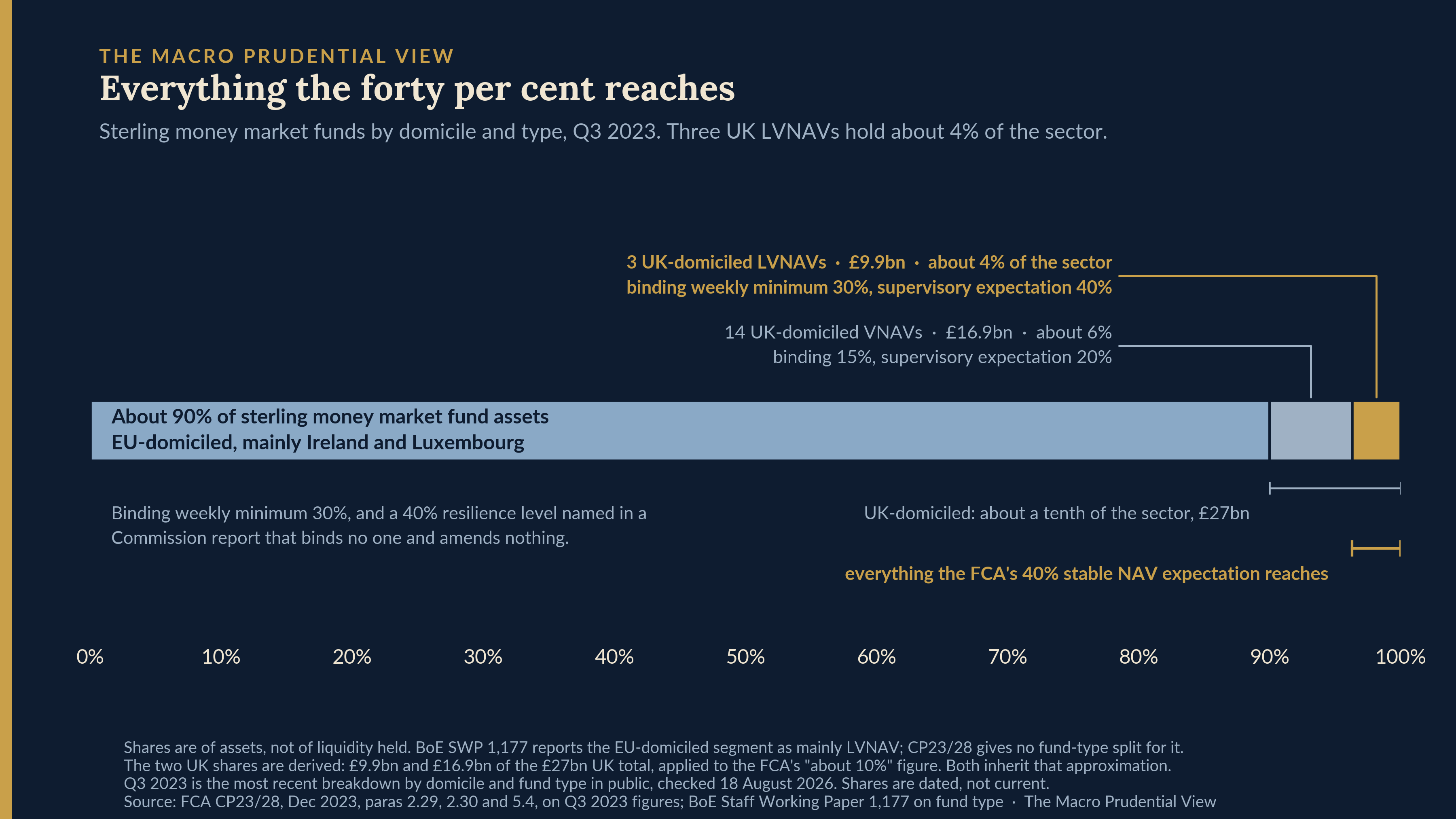
Then there is the argument the FCA has not made in public, which may be the strongest available to it. The chart below has the sterling sector as the FCA last published it: the regulator supervises about a tenth of it by assets, and the stable NAV expectation reaches a fraction of that tenth. Nine tenths sit in EU-domiciled funds, mainly Ireland and Luxembourg, against a 30% floor, a split the 2026 paper independently reports for its own sample.
A binding UK 40% would therefore have fallen on a handful of funds while their competitors carried on unaffected. The cost lands on the funds the FCA authorises, and redomiciliation into the regime they are competing against is one response available to them. Whether it is the cheapest response I cannot say — the trade against simply absorbing the yield cost of a larger buffer depends on portfolio structure and on legal and operational costs that nobody has published — but it is on the table in a way it would not be for a regulator covering the whole market. This is a hypothesis. The FCA has published no impact assessment on it and has not offered it as a reason.
There is a second constraint, and it is the more concrete of the two. The minima sit in retained UK legislation that FSMA 2023 lists for revocation but which has not been commenced, and the Treasury has said most requirements for UK money market funds will end up in FCA rules and guidance. The FCA’s own words are that it intends to “retain in rules the current minimum WLA requirements as set out in UK MMFR”, which reads as the regulator restating the figures in its own rulebook and therefore able to choose them. Whether it could have chosen differently without further Treasury action is not spelled out anywhere public. Some Treasury action is coming in any event, since the timetable is subject to Parliamentary approval; its scope is not stated.
Two instruments
The UK will have a qualitative rule requiring adequate liquidity, with 40% carried in guidance underneath it and the numerical minimum left at 30%. The EU has 40% in a Commission review report: a review-and-report exercise that may still be followed by a legislative proposal and until then changes nothing. The binding weekly minimum for an Irish or Luxembourg LVNAV remains 30%, where it has sat since the regulation began to apply in 2018.
There is an obvious question the UK construction leaves open, and it cannot be answered yet because the guidance has not been written. What happens to a fund sitting at 34% — above the floor, below the expectation, and in breach of nothing numerical? Some supervisory conversation presumably follows, and its force is the whole of the difference between this arrangement and a rule. Until the interim guidance appears, the supervisory trigger and its consequences are unstated.
So the larger part of the sterling sector faces no 40% of any kind, only a figure in a report and whatever its national supervisor makes of it — and national supervisors, along with ESMA and the ESRB, retain instruments of their own that do not require amending the regulation. Those funds are not unregulated from a UK standpoint — they need recognition or permission to market here, and UK conduct requirements travel with that — but their liquidity rules are set in Dublin, Luxembourg and Brussels, and their access to UK investors is itself unsettled. The Government has said it intends to extend the Temporary Marketing Permissions Regime “with a view to establishing a longer-term solution on market access”, which is one route by which a UK liquidity condition could reach them, if one were ever wanted.
Locking in
The Financial Policy Committee took this up in July. Its record says the Committee “judged that it remained important to lock in the higher levels of resilience that had been held by MMFs since the ‘dash-for-cash’ in 2020, as liquidity mismatch in these funds remained a key potential source of vulnerability”, and that it “welcomed recent statements by HM Treasury and the FCA on their plans to enhance MMF resilience”.
The object of that sentence is levels held, not levels required, and the distinction has some history. In December 2023, on the day the proposals appeared, the FPC recorded that it “welcomes proposals by UK authorities to increase the resilience of UK-based money market funds, which have been published today” — those being the proposals for a binding 50% weekly and 15% daily. In July 2026 it welcomed the statements that withdrew both. The wording of the Committee’s support is consistent across a change in the substance it was supporting, which is not an accusation of anything; it is what a committee’s welcome is worth as evidence.
Preservation is a coherent objective, and an expectation can serve it. What preservation assumes is that the buffers stay where they are. One of the things that may have been holding them up is being removed, and the number that would have replaced it is in guidance rather than in the rules. The most recent published analysis of the sterling sector models funds at around forty breaching the daily floor materially less often than funds at thirty. A staff working paper is not committee policy and its author’s views are his own. Nobody has argued against the finding either.
Two decisions sit behind this. The FCA is restating the numerical minima in its own rulebook and restating them unchanged; whether it could have restated them at a different figure without Treasury action is unresolved on anything public. The Commission has so far stopped short of proposing an amendment to the money market fund regulation, which is the most it could have done alone, since raising the EU minimum would then have needed the Parliament and the Council, and its report leaves a later proposal open. What the two outcomes share is only this: the figure ends up somewhere other than the rules. The Commission gave a reason for declining to raise the minimum, that doing so would not be proportionate given the heterogeneity of the sector and its fund types. The FCA has not said why forty sits in guidance rather than in the rules it is writing.
Relocating the seam, on 31 August, asked whether the powers to act on fund-sector systemic risk move together with the supervisor. This is what happens to a power that has not moved anywhere.
Paweł Fiedor - The Macro Prudential View
Positions described are as at 18 August 2026.
The author works at the Central Bank of Ireland and in the ESRB Secretariat. This piece is written in a personal capacity; views are the author’s own and should not be attributed to the Central Bank of Ireland, the ESRB, or the Eurosystem. It draws exclusively on publicly available sources and takes no position on whether the proposals should be adopted.
Sources: Financial Conduct Authority, Update on reforms to the UK Money Market Fund Regulation, 8 June 2026 — https://www.fca.org.uk/news/statements/reforms-uk-money-market-fund-regulation; FCA, CP23/28, Updating the regime for Money Market Funds, December 2023, including the Bank of England modelling at Annex 4 and the sector figures at 2.29, 2.30 and 5.4 — https://www.fca.org.uk/publication/consultation/cp23-28.pdf; Rishabh Kumar, A simulation framework for sterling money market funds: estimating redemption capacity and evaluating liquidity requirements, Bank of England Staff Working Paper No. 1,177, March 2026 — https://www.bankofengland.co.uk/-/media/boe/files/working-paper/2026/a-simulation-framework-for-sterling-money-market-funds.pdf (the views expressed in a staff working paper are the author's and not necessarily those of the Bank of England or its committees); Bank of England, Record of the Financial Policy Committee, 7 July 2026, paragraph 49 — https://www.bankofengland.co.uk/-/media/boe/files/financial-policy-committee-record/2026/fpc-summary-and-record-july-2026.pdf; Bank of England, Financial Stability Report, December 2023 — https://www.bankofengland.co.uk/financial-stability-report/2023/december-2023; European Commission, Report on the functioning of Regulation (EU) 2017/1131 on money market funds, COM(2026) 350 final, 11 May 2026, Chart 1 — https://ec.europa.eu/finance/docs/law/260511-money-market-funds-report_en.pdf; HM Treasury, Reforms to Money Market Fund Regulations, written ministerial statement and accompanying publication, 14 May 2026 — https://www.gov.uk/government/publications/reforms-to-money-market-fund-regulations; Regulation (EU) 2017/1131, Articles 24, 25, 34 and 37, and the retained UK version — https://www.legislation.gov.uk/eur/2017/1131; and the Article 37 reporting template, Commission Implementing Regulation (EU) 2018/708, Annex, as it stands in the FCA Handbook — https://handbook.fca.org.uk/technical-standards/provision/s135c1153sn0p1713. Chart data as cited in each figure.