



The proposition
Every euro that backs the stablecoin EURCV sits as cash at Société Générale. The issuer, SG-FORGE, is an e-money institution licensed by the ACPR, and Société Générale is its own parent bank. There is about 129 million euro of it. That is a small number, and nothing in what follows suggests that a stablecoin this size threatens a globally systemic bank.
But EURCV is one of the three largest euro-denominated stablecoins, and the only ones publishing reserve disclosures detailed enough to read against each other. Smaller euro tokens exist; on the figures reconciled below these three are about nine-tenths of the euro-pegged market by value. Together they make a useful small map of how a private euro connects to the banking system. The connection is closer, and more varied, than their combined half-billion-euro footprint would suggest.
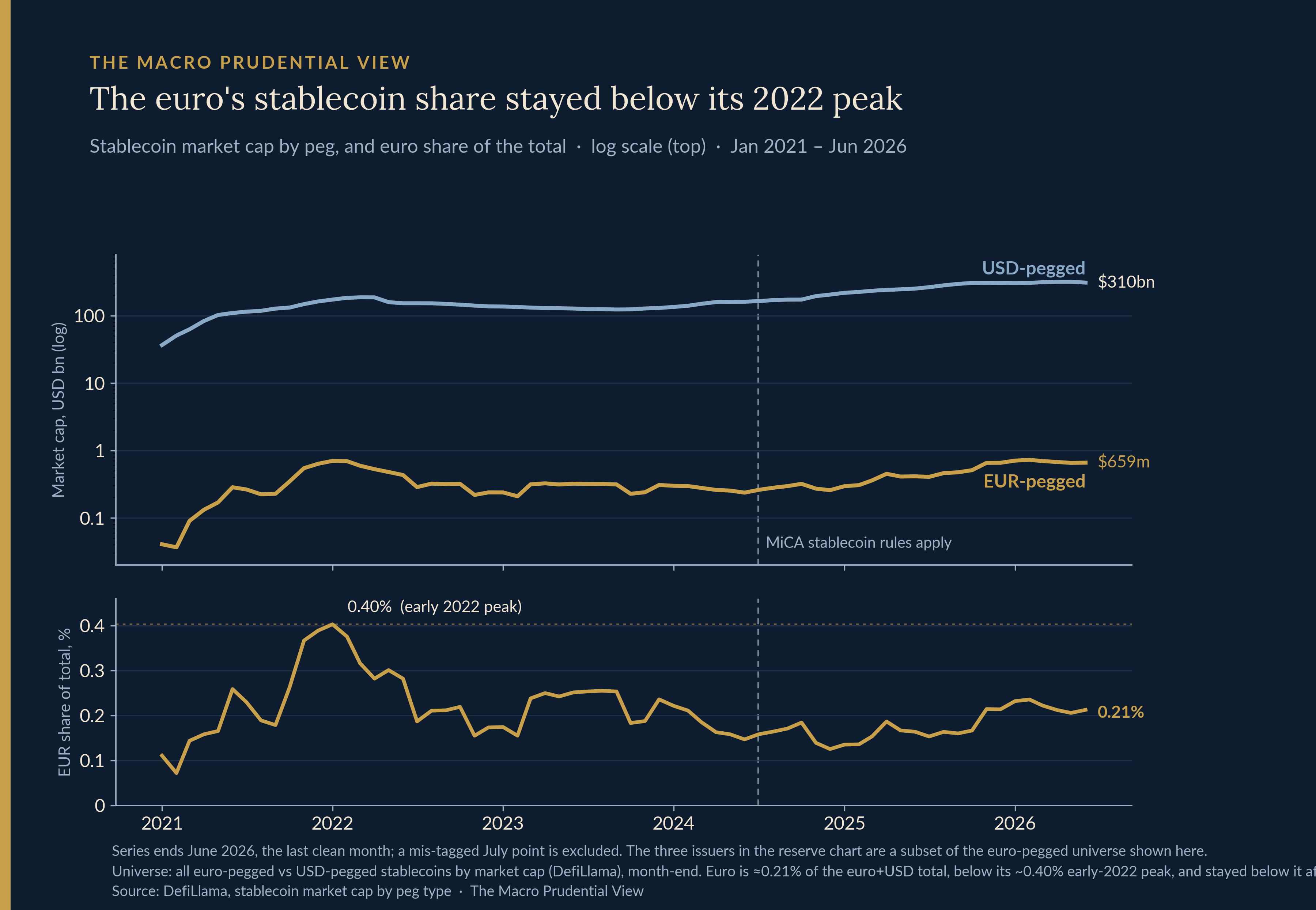
Set the scale first. Euro stablecoins are a rounding error in a market that is almost entirely dollar. The euro-pegged tokens are worth something over half a billion euro between them; the whole stablecoin market is around 300 billion dollars. The euro’s share of it has never held above four-tenths of a percent, and sits near a fifth of a percent today. What follows is a question about structure, at a size that is not yet a question about stability.
That structural question is timely because Europe is, at the same moment, building a public euro: in July the European Parliament handed its negotiators a mandate on the digital euro, a retail central-bank instrument still some years from issuance. The proposal in front of the legislators is a retail instrument, aimed at the card rails; the Eurosystem’s work on settling tokenised transactions in central-bank money is a separate, wholesale track. Neither is aimed at the crypto-native, on-chain retail euro, which is left, for now, to private issuers under MiCA.
For most of what that leaves in private hands, the supervisory map is drawn. MiCA sets who may issue these tokens, who supervises them, and how their reserves must be held, and the European Banking Authority has written the recovery and redemption playbooks. One seam is less settled, and it is the one I want to sit with: what happens to a private euro’s reserve when the bank holding it is the one in trouble, and how a promise to redeem the token at par meets a reserve that a bank resolution can freeze.
Three reserve structures
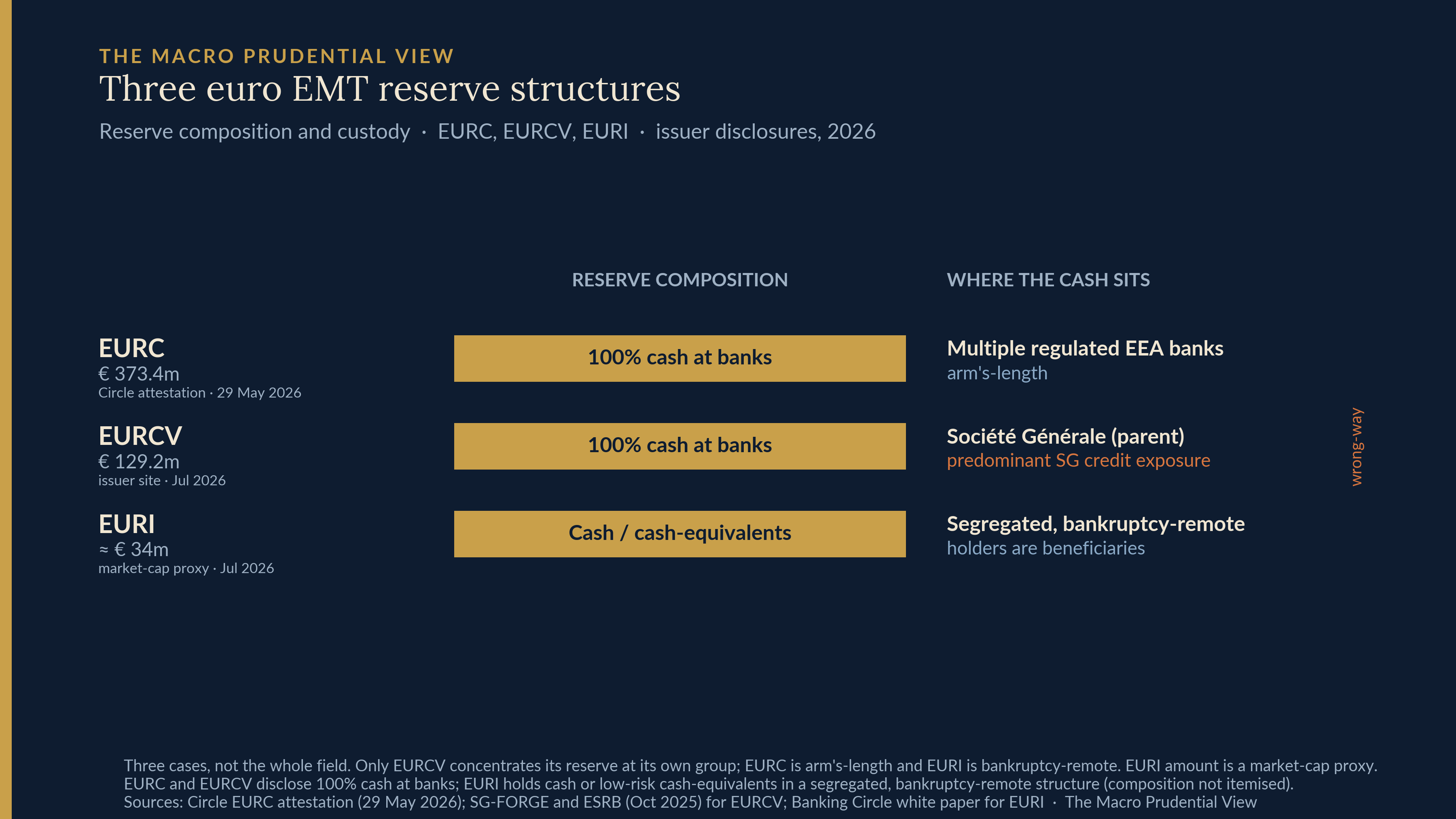
Begin with what the three share. Each holds its reserve as cash at commercial banks rather than as a book of securities. For the two larger issuers that is documented. Circle’s EURC held 373 million euro at the end of May, all of it cash at regulated European banks, on its monthly attestation. EURCV’s 129 million is likewise all cash, on SG-FORGE’s own reporting. EURI, the smallest at around 34 million euro, holds its reserve in a segregated fiduciary structure; its issuer describes the assets as cash and cash-equivalents but does not itemise them. For the two documented cases there is no securities book to sell into a falling market; a redemption is met by drawing down a bank balance.
The differences are in whose bank, and on what terms.
Circle is a licensed e-money institution rather than a bank, and it spreads EURC’s cash across several regulated institutions in the EEA at arm’s length. If one of those banks fails, EURC has others.
EURCV concentrates. Its cash sits, in full, at Société Générale, which is also the parent of the issuer. The white paper does not hide this; it tells holders they carry “predominant SG credit exposure.” Reserve and issuer share one point of failure by construction.
EURI differs in its legal structure. Its funds sit in a segregated, bankruptcy-remote fiduciary structure under Luxembourg’s 2003 safeguarding law, with EURI holders named as the beneficiaries; what the structure holds is cash and cash-equivalents, whose allocation and custody are not itemised, and the claim on it is built to survive the issuer’s failure. That, with the undisclosed composition, is why it sits here as a contrast rather than a third instance of the same thing.
So the three do not share a reserve model. EURC diversifies its bank exposure, EURCV concentrates it inside its own group, and EURI segregates the reserve away from the issuer.
None of this needs a contrarian reading of the reserves. When the ESRB examined crypto-to-bank links last October, it treated EURCV’s backing as bank deposits for the plain reason that the cash is at a bank and the token is a claim that runs through it.
Three names are not a market. These are the euro stablecoins large enough to disclose reserves worth reading; smaller issues, and anything that changes its arrangements after this is written, sit outside the argument. Three is enough, though, to fix the feature the rest turns on. For the two documented cases the reserve is a commercial-bank deposit, whole and plain: a redemption is a bank withdrawal, and there is nothing else to sell. EURI’s safeguarded structure may behave differently, and its composition is undisclosed, so I hold it apart. For the deposit cases, at least, the bank is not a detail of the structure. It is the structure.
A two-way interface
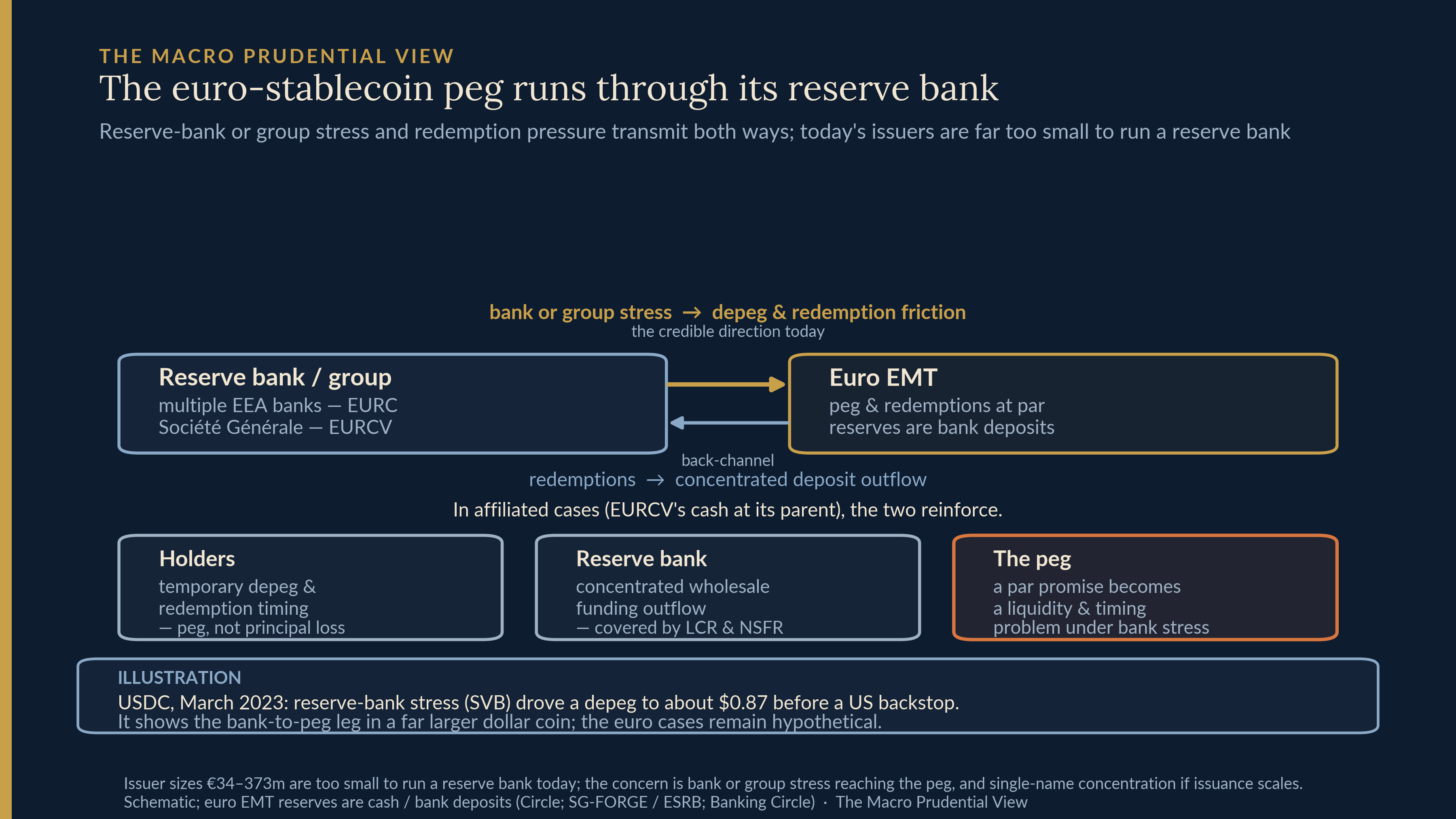
The mechanism here is a deposit story, so take the two cases whose reserves are documented as deposits, EURC and EURCV. EURI sits out, and for a reason worth stating: with its composition undisclosed, a run on it might work through the sale of whatever assets sit in its fiduciary structure rather than the drawdown of a bank balance. That is a market-liquidity channel, not a deposit one, and the disclosure does not let me follow it. Between the two cases that remain, stress moves in both directions, and unequally.
The direction that matters at today’s sizes runs from the bank to the token. If a reserve bank comes under stress — a funding problem, or a failure — the issuer’s access to the cash behind its token is suddenly in question, and the promise to redeem at par becomes a matter of timing and liquidity rather than a certainty. This is the credible leg. It does not depend on the stablecoin being large. It depends on the bank.
The reverse leg runs from the token to the bank: a wave of redemptions obliges the issuer to pull its reserve cash out, which lands on the reserve bank as a concentrated wholesale deposit outflow. This one is already discounted. A non-operational deposit from a financial customer attracts the highest outflow assumption in the bank’s thirty-day liquidity rules, feeding the bank’s aggregate requirement rather than earmarking assets against this one balance; and at half a billion euro across the three, with 129 million the largest single-bank balance any of them discloses, the outflow would not normally trouble a large bank. This is the weaker leg, and it grows teeth only at a scale the tokens have not reached.
The two legs meet in one place. Where the reserve sits at the issuer’s own group — EURCV at Société Générale — a shock to the bank and a shock to the issuer are closer to being the same event, and each can feed the other. For EURC, spread across arm’s-length banks, they stay largely separate.
The one time something like this played out, it played out in dollars. In March 2023 roughly eight percent of the reserve behind USDC was stuck at Silicon Valley Bank when it failed, and the token broke its peg, trading down to about 87 cents before recovering over the following days, as the issuer set out its reserve position and the US authorities invoked a systemic-risk exception to make all SVB depositors whole. The depeg travels to the euro case; the recovery does not. European resolution is built not to extend that kind of public make-whole to uncovered wholesale deposits of financial institutions. That episode illustrates the bank-to-peg direction cleanly enough, though it understates the concentrated case: USDC’s exposure was a partial slice of a diversified reserve, and EURCV’s would be the whole of it. There is no euro precedent here, only a dollar illustration and a euro structure more concentrated than the illustration.
Two qualifications carry through the rest. The subject throughout is the peg and the timing of redemption. A principal-loss outcome is not assumed, and what a holder can claim, and how quickly, depends on the structure. EURI’s segregated beneficiaries stand differently from a holder’s ordinary claim on a parent bank. And the magnitude stays honest: at these sizes the concern is the bank-to-peg direction, and the single-name concentration that would bite harder if issuance ever grew.
What is settled, and what is left implicit
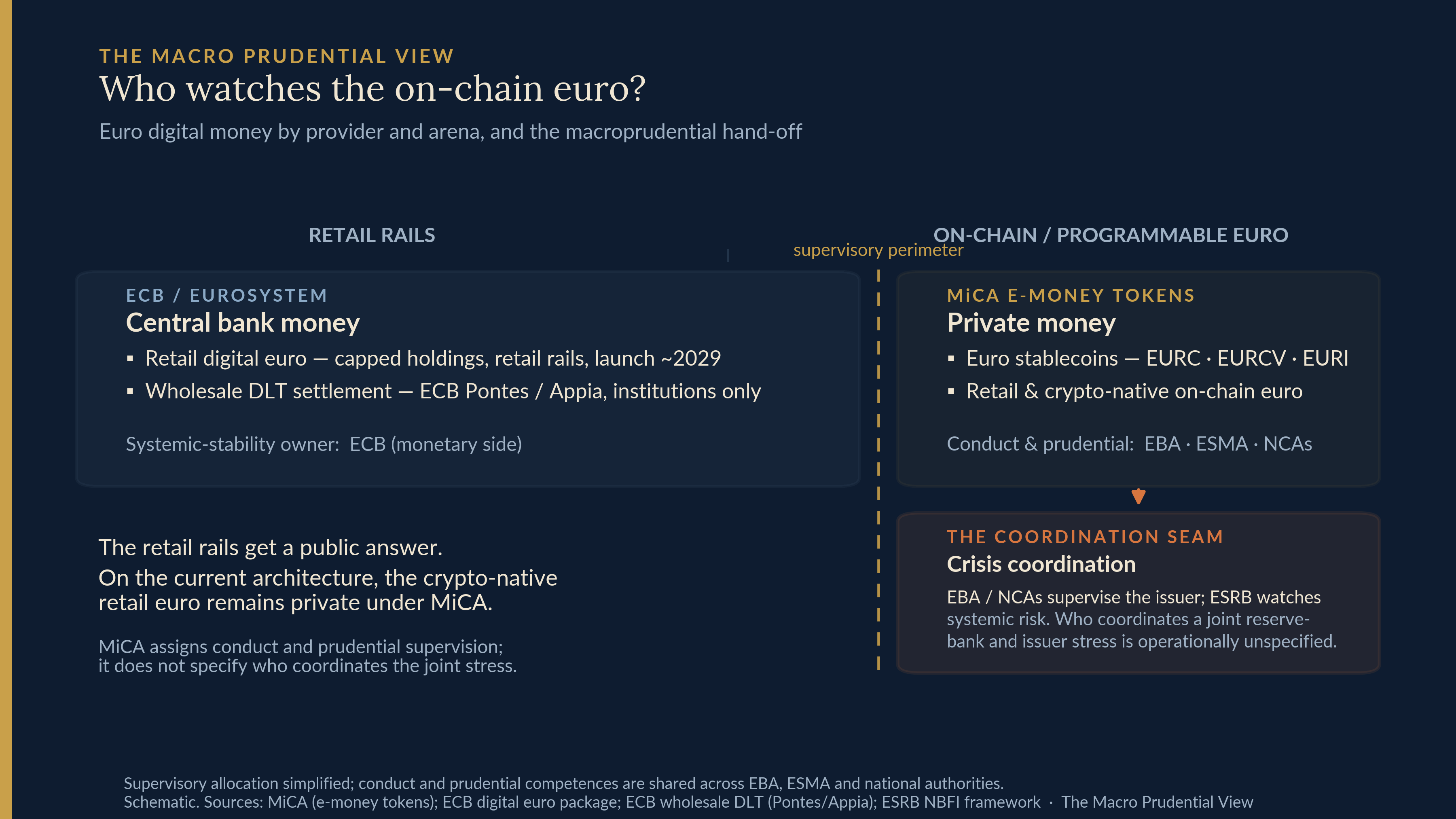
Most of the supervisory questions these tokens raise have answers. Under MiCA a euro e-money token must be issued by a licensed e-money institution or a bank; a national competent authority authorises the issuer and supervises its conduct and prudential compliance; the reserve must be held and safeguarded to a standard the regulation sets. The EBA has gone further and written the recovery and redemption plans every issuer must keep, whatever its size, and those guidelines already ask issuers to account for the size, composition and concentration of the assets behind the token.
Above this sits the significant-token regime, for issues large enough to matter system-wide. Designation is not a single trigger: it requires meeting at least three of a set of statutory criteria, one of which is that the value issued, market capitalisation or reserve size exceeds five billion euro, alongside holder numbers, daily transaction activity, cross-border reach and interconnectedness. Once designated, the EBA supervises the issuer’s compliance with the significant-token requirements, while the home authority keeps the entity’s own authorisation. On size, no euro token is near: EURC’s 373 million euro is about a thirteenth of the five-billion mark, and the three together about a tenth of it. Holder counts and transaction activity can be read off the chain, and would need their own study; on the strength of the size test alone these tokens are an order of magnitude short, and none has been designated.
The assigned map is real, then, and worth stating plainly before pointing at what it does not cover. What it does not cover is a specific moment, and the moment is nameable.
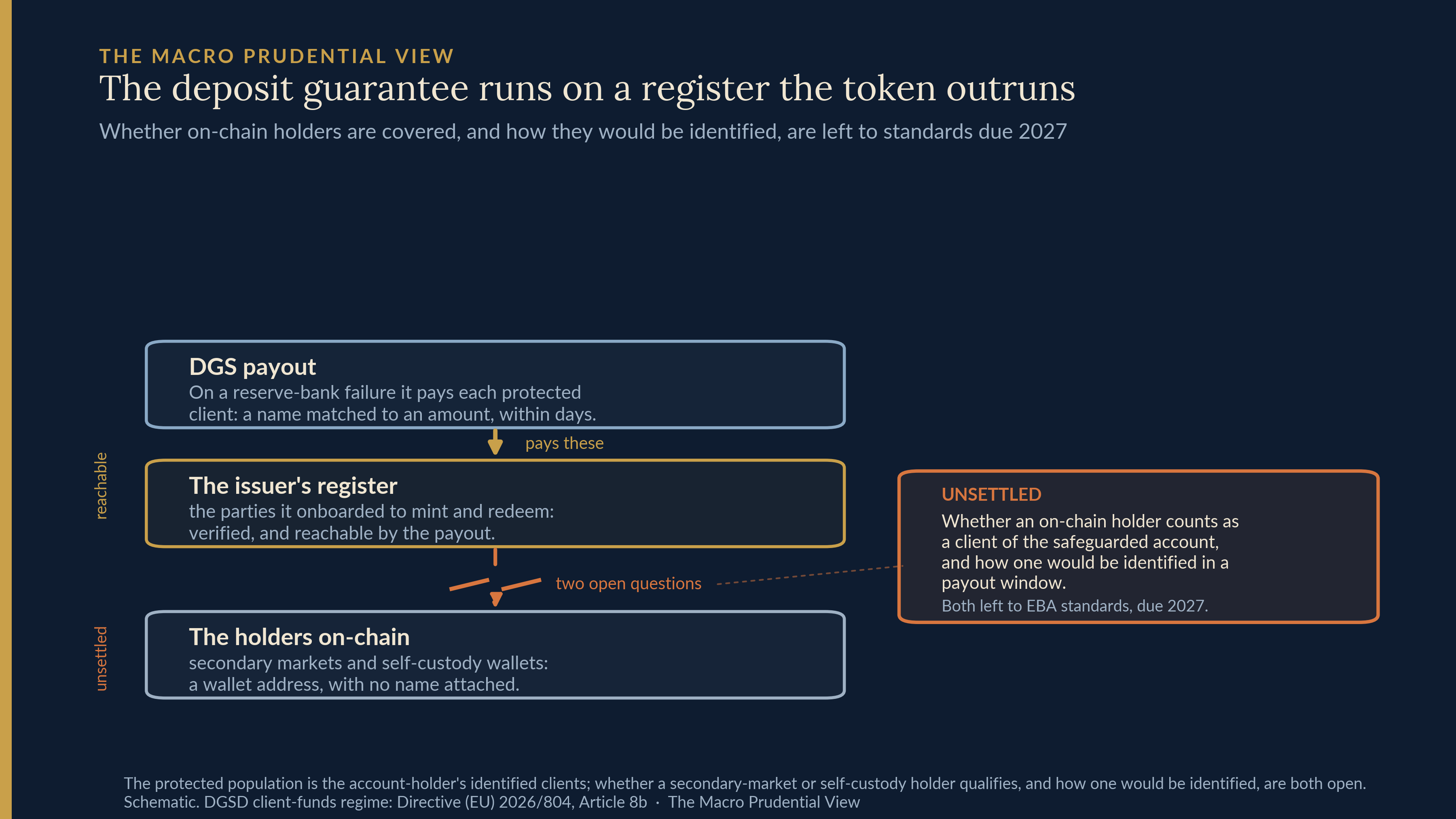
The reserve behind one of these tokens is, at the bank, a deposit placed by a financial institution, and the deposit guarantee does not straightforwardly cover it. The scheme excludes deposits placed by financial institutions, and whether an e-money institution’s safeguarding account sits inside that exclusion has been read differently across member states, a divergence the EBA documented in opinions in 2019 and 2021. The 2026 reform of the framework, part of the wider crisis-management package, harmonises the treatment: client funds held in segregated safeguarding accounts can carry protection up to 100,000 euro per identified client.
Two questions sit behind that protection, and only the second is a matter of plumbing. The first is legal: whether someone who bought the token on a secondary market is a client of the safeguarding arrangement at all. Look-through of this kind is built around the account-holder’s own clients, and whether it reaches a subsequent transferee of a bearer-style claim is not settled on the face of the reform. The second, if it does reach them, is operational: a deposit guarantee pays against a register, matching each protected client to an amount within the few days a failed bank allows, and a self-custody wallet address is not that. Both run through the technical standards due in 2027. Until they are written, what a dispersed on-chain holder is owed by a deposit guarantee, and how it would reach them, is unresolved. Deposit guarantee assumes an institution that knows its clients. A bearer instrument on a public chain is built so that, past issuance, its issuer largely does not.
Set against that is the reserve bank’s own resolution, where the proximate risk is timing. If a reserve bank is failing, a pre-resolution moratorium can suspend payment out of the account for a short window. Whether that holds up redemptions depends on what else the issuer can reach: cash at other banks, committed lines, or a buffer held outside the frozen account. For a diversified reserve the suspension may be bridged; for a reserve held at one bank there is nothing else to draw on. None of the three publishes its contingency arrangements, so the size of that cushion is not something a reader can check. An actual write-down of the deposit is a further and more remote matter. The deposit is an ordinary unsecured claim within the scope of bail-in. It gets no help from the deposit preference in the creditor hierarchy, which lifts covered deposits and the eligible deposits of individuals and smaller firms above ordinary claims and does not reach a deposit placed by a financial institution. What sits in front of it is the stack of own funds and eligible liabilities a large bank must maintain, and resolution authorities keep discretion to spare liabilities whose write-down would spread contagion. An intragroup balance is a weaker candidate for that discretion than a third-party deposit, since internal loss-absorbing capacity exists to be used inside the group. That buffer is thinner at a smaller reserve bank than at a G-SIB. The MiCA duty to redeem at par does not displace any of these resolution powers, and I have found no public, stablecoin-specific protocol setting out how a redemption obligation and a bank moratorium are meant to act on the same deposit at the same time. Resolution planning is not all public, so this is an absence in the published framework rather than proof that no authority has considered it.
That is the seam, and it is a narrow one. The legal hierarchy is settled and the reserves are supervised. What is not yet settled is operational: how a par-redemption promise is honoured when the deposit behind it can be frozen by a bank moratorium, and how far that protection reaches when the holders who matter sit out on the chain, outside the register a deposit guarantee works from. Neither is a supervisory failing. Both wait on rules and playbooks now being written.
Two features of the three cases sharpen this. On the financial side, concentration is the risk, and EURCV carries the most of it: its entire reserve stands or falls with one bank, which happens to be its own parent, so an idiosyncratic problem at Société Générale would hit reserve and issuer together. EURC, spread across arm’s-length banks, is the less exposed case, though its per-bank allocation is not published. The institutional side offers EURCV no offset. It is tempting to read the in-group structure as tidy — one bank, one supervised group, one resolution authority — but a resolution authority’s mandate runs to continuity of critical functions and financial stability, and an intragroup deposit from a small subsidiary is exposed to how that mandate is exercised. Its legal rank is not lowered by the affiliation. What changes is that one event hits reserve and issuer together, and the discretion over that deposit belongs to an authority weighing the group. EURC’s reserve, spread across third-party banks a non-bank issuer does not control, is instead the clean illustration of the cross-perimeter problem: the duty to redeem and each bank’s resolution answer to different authorities on different balance sheets. The concentrated structure is the more exposed, and the diversified one is where the coordination question shows most plainly. Neither removes the seam. EURI, issued by a bank rather than an e-money institution, falls in a different exclusion category again, one more reason to treat it apart.
One clarification forecloses an easy objection. It might seem that a bank leaning on a large, redemption-sensitive deposit is carrying a hidden funding risk that supervisors have missed. The prudential rules already discount it. An at-call, non-operational deposit from a financial customer attracts the highest outflow assumption in the thirty-day liquidity rules and little or no credit as stable funding in the one-year rules, so it flatters neither ratio and will not support longer assets. That treatment runs through the bank’s aggregate position rather than setting assets aside against this one deposit, so it reduces the concern without erasing it. The sharper residual sits with the token: a par promise exposed to a moratorium, and holder protection that is unresolved.
Scale
Return to scale, because the seam above is a structural feature and not a live exposure, and the difference matters.
The euro-pegged stablecoins are, collectively, about a fifth of a percent of the combined euro- and dollar-pegged market. The share is small, and it has not grown. It reached about four-tenths of a percent in early 2022, on the back of tokens that have since wound down, and it sits below that level now, after MiCA’s stablecoin rules took effect in 2024. Non-compliant euro tokens were delisted and the market consolidated around compliant issuers, and through all of it the euro’s on-chain share stayed below where it had been four years earlier. Read the chart as a level and a date. It does not show that MiCA held the share down; the peak came first, and the flat line came after.
A word on the numbers, since two measures sit close together in this piece. The market-cap series counts every euro-pegged token against every dollar-pegged one, in dollars, from public on-chain data; the reserve figures earlier are the disclosed euro reserves of three named issuers, on their own reporting dates. At the euro’s level over the June-July window, about 1.14 dollars, the three issuers’ half-billion euro is roughly 610 million dollars, against a euro-pegged total near 660 million. The difference is other, smaller euro tokens and the usual gaps of date and source. The three are a large majority of the euro-pegged universe, not the whole of it.
The scale does not dismiss the structure; it places it. A monitoring seam on a market this size is a thing to specify before it grows, and the reform timetable in the last section is, in that light, well-judged: the rulebook is being written while the market is still small. The mistake would be to read the structure as a present danger. Nothing here is a present danger.
The public euro
One question has hung since the opening: why is any of this a public-versus-private story, rather than simply a story about three private tokens? The answer is the digital euro, and it is worth being careful about what the public project is built to do.
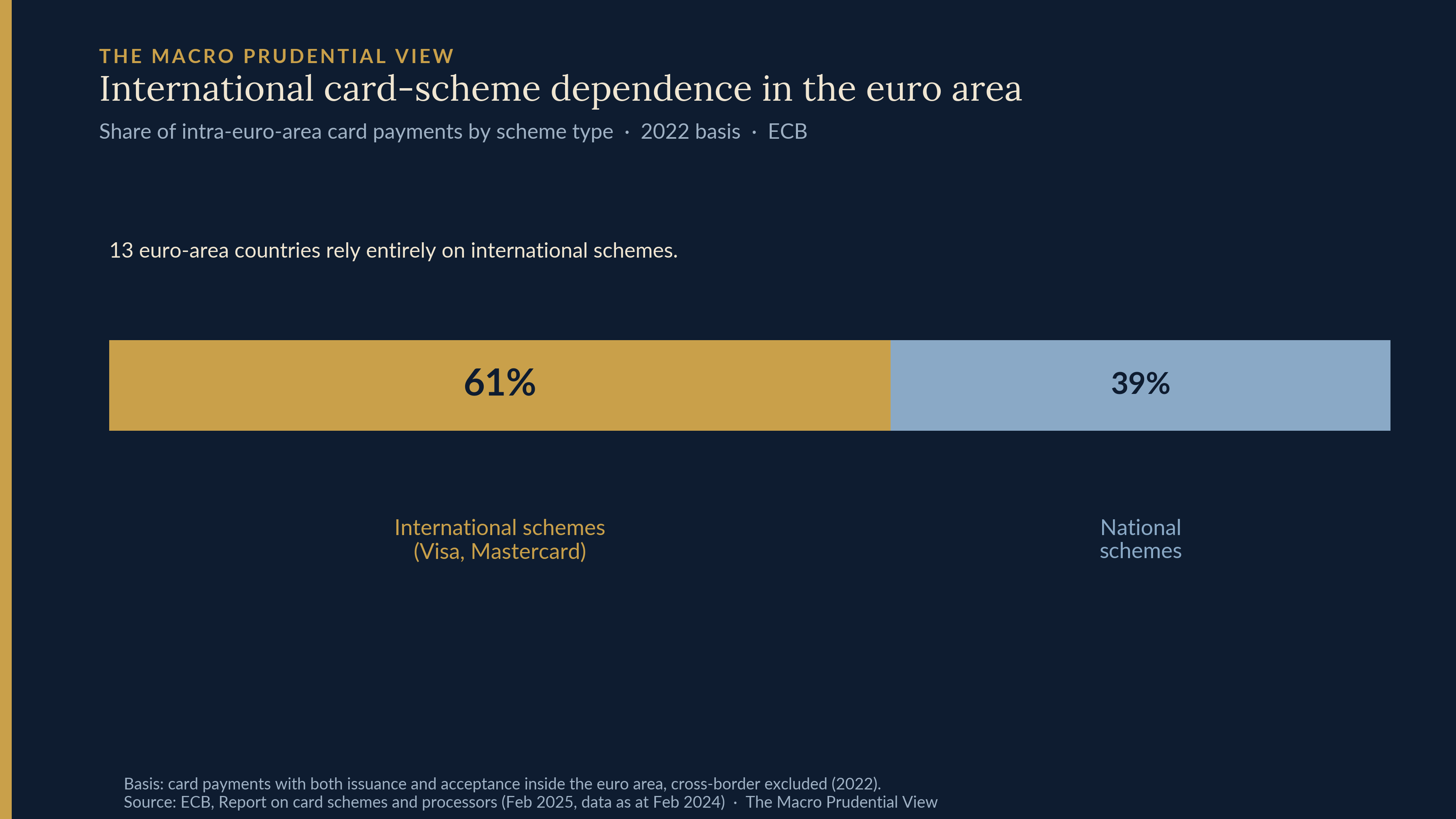
The case for a public retail euro is, in large part, a sovereignty case, and the sovereignty case is about the card rails. On the ECB’s figures for 2022, published in its 2025 report on card schemes, international schemes — Visa and Mastercard — carried around 61 percent of euro-area card payments measured within the area, and 13 euro-area countries rely on international schemes entirely, with no domestic card scheme of their own. That is the dependence the digital euro is designed to answer. (The figure is a card-scheme share rather than a claim about the whole acquiring and settlement stack, and it is dated; treat it as context.)
What the public project is built for shapes what it leaves to others. On the architecture now before the legislators, the digital euro addresses retail payments, and the Eurosystem’s separate DLT-settlement work addresses wholesale infrastructure. Neither is primarily designed for the crypto-native, on-chain retail euro: the euro that settles a trade on a public chain or sits in a self-custody wallet. That space is, for now, private, and filled by the three tokens this piece has been about. The division may prove lasting, or may be an artefact of the current design and timetable; either way, it is why a supervisory question about private euro reserves is also a question about where the public euro’s own perimeter is drawn.
What the three show
None of the three tokens is big enough to be a problem for the banking system. That is the frame the argument sits in, and it holds all the way through. What the three show is smaller and more particular than a systemic risk. It is an interface.
A euro stablecoin’s holder is promised redemption at par. Behind that promise, in two of the three cases, is the issuer’s access to a cash deposit at a commercial bank — spread across several for EURC, concentrated at its own parent for EURCV; behind the third is a safeguarded fiduciary claim whose composition its issuer does not disclose. The gap that can move a peg is the fast one. A resolution authority can suspend payment out of that deposit for a short window, and a par promise that cannot be met on demand is a broken peg long before any question of compensation arises. Behind it sits a slower question about the holders: whether a deposit guarantee, capped and paid against a register of identified clients, reaches people who acquired the token on-chain and never entered that register. The first is a stability question and the second a matter of holder protection. The public framework has not yet settled the operational answer to either.
That is a narrow finding, and it should stay narrow. Europe’s on-chain euro is supervised, and half a billion euro of tokens is no threat to anything by itself. The finding is only this: a small part of the euro’s money, private and on-chain, connects to the banking system through its reserves in three different ways, and meets that system at a join the rulebooks are still, on their own timetable, closing.
Paweł Fiedor — The Macro Prudential View
Positions described are as at 17 July 2026 unless a different disclosure date is given; reserve figures carry their own attestation dates and are not a single point-in-time snapshot.
The author works at the Central Bank of Ireland and in the ESRB Secretariat. This piece is written in a personal capacity; views are the author’s own and should not be attributed to the Central Bank of Ireland, the ESRB, or the Eurosystem. It draws exclusively on publicly available sources and takes no position on whether the policy measures discussed should be adopted.
Sources: Circle, EURC reserve attestation, 29 May 2026 — https://www.circle.com/transparency; Société Générale-FORGE, EURCV white paper and daily reserve disclosure — https://www.sgforge.com; Banking Circle, EURI white paper — https://www.bankingcircle.com; DefiLlama, stablecoin market capitalisation by peg type — https://stablecoins.llama.fi; CoinGecko and CoinMarketCap, EURCV and EURI market data, July 2026; ESRB, “Crypto-assets and decentralised finance” and accompanying recommendation, October 2025 — https://www.esrb.europa.eu; ECB, “Report on card schemes and processors”, February 2025 (data as at February 2024), and material on the digital euro and wholesale DLT settlement (Pontes, Appia) — https://www.ecb.europa.eu; European Parliament, digital euro negotiating mandate, July 2026 — https://www.europarl.europa.eu; Regulation (EU) 2023/1114 (Markets in Crypto-Assets), including the significant-token criteria (Articles 43 and 56) and the recovery- and redemption-plan requirements (Articles 46 and 55); European Banking Authority, Guidelines on recovery plans under Articles 46 and 55 of MiCAR (EBA/GL/2024/07), Guidelines on redemption plans, and Opinions on the treatment of client funds under the DGSD (2019, 2021) — https://www.eba.europa.eu; Directive 2014/49/EU (Deposit Guarantee Schemes Directive), Articles 5 and 6; Directive (EU) 2026/804 amending the DGSD (Article 8b), Directive (EU) 2026/806 amending the BRRD, and Regulation (EU) 2026/808 amending the SRMR (Crisis Management and Deposit Insurance package); Directive 2014/59/EU (Bank Recovery and Resolution Directive), Articles 33a and 69; Single Resolution Board, resolution tools — https://www.srb.europa.eu. Chart data as cited in each figure.