



The Uses of Slack left one question open on purpose. The ECB’s fund statistics show that Austrian open-ended real estate funds borrowed their way through a four-year redemption run — a loan stock of €627m in mid-2022 and €1.6bn at its peak in the third quarter of 2024, with the largest quarterly draw, €361m, in the last quarter of 2023, when redemptions peaked — and a sector series cannot say whether the funds that borrowed were the funds that faced the redemptions. A handful of vehicles can. Austria’s public-offer property funds publish audited annual reports and unaudited half-year reports under § 13 of the Immobilien-Investmentfondsgesetz, each with a balance sheet, a flow statement and a management review, and there are five of them. This note assembles that record from 2020 to 2026 and puts each fund’s borrowing next to its own flows.
The short answer is that the cross-section sorts nobody. Every public fund bled, and every public fund borrowed. The interesting material is within each fund — what changed between one reporting date and the next — and the record there is heterogeneous enough that the note keeps it so.
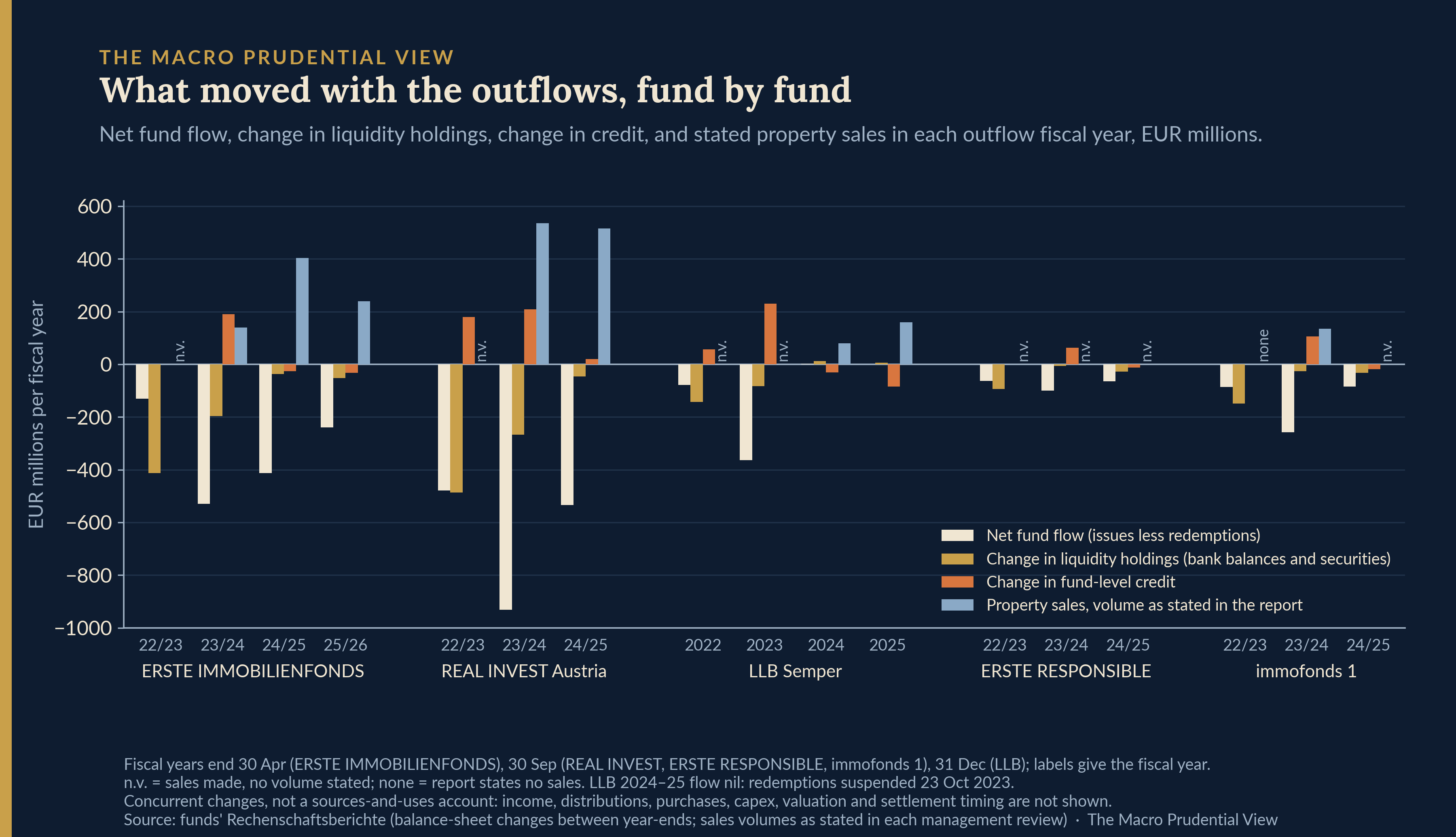
Five funds, four calendars
The population is small. Five public-offer funds under the ImmoInvFG were in existence through the run and reported on it: ERSTE IMMOBILIENFONDS and ERSTE RESPONSIBLE IMMOBILIENFONDS (ERSTE Immobilien KAG), REAL INVEST Austria (Bank Austria Real Invest), immofonds 1 (Union Investment Real Estate Austria) and LLB Semper Real Estate (LLB Immo KAG). The FMA’s register also lists a sixth public fund, launched in January 2025 and outside everything below except the residual, one fund for professional investors, and five Immobilienspezialfonds with no public report at all. “The five” in this note means the five incumbents. The five report on three different year-ends — 30 April, 30 September, 31 December — which is why nothing below is a quarterly series and why the reconciliation to the sector at the end is a set of bounded points.
Borrowing throughout means the credit line of the fund’s own Vermögensaufstellung — Kreditverbindlichkeiten, Verbindlichkeiten aus Krediten, Verbindlichkeiten aus Fremdfinanzierung — as the fund draws it. Where a report shows property companies as participations with loans of their own, as at REAL INVEST and ERSTE IMMOBILIENFONDS, that debt is outside the line; where a report presents a property partnership transparently, as ERSTE RESPONSIBLE does with one Vienna partnership, its €30m bank loan sits on the fund’s own long-term credit line and is counted here because the fund counts it. That is the fund’s statutory balance sheet, which is also the unit the ECB’s investment-fund statistics collect, under Regulation 1073/2013 to November 2025 and the recast Regulation 2024/1988 from December 2025. The comparison with the sector series later on is therefore a comparison of concept; there is no published line-by-line mapping, and the note says so where the comparison is made. Part 1 checked that every change in the sector’s loan stock since the peak equals its transactions, which leaves no room for a reporting-population break at the changeover. Every figure below was read on its page in the fund’s report; sales volumes are the ones the management reviews state, and where a report records sales without a volume the chart says so.
Who bled
REAL INVEST Austria is the largest fund and took the largest outflow. Its own review puts net outflows since June 2022 at “rd. EUR 1,5 Mrd.” by September 2024 and “rd. EUR 2 Mrd.” by September 2025; the flow statements give gross redemptions of €668m, €1,010m and €578m in the three fiscal years to September 2025, against fund assets that went from €4.4bn to €2.6bn. ERSTE IMMOBILIENFONDS ran a net outflow of €530m in the year to April 2024, then €413m and €240m. LLB Semper Real Estate took €380m of redemptions in the ten months of 2023 before it suspended on 23 October — its report says the first half was institutional money, the second half retail — on a fund of €1.1bn. immofonds 1 lost €258m net in the year to September 2024, on €1.3bn. ERSTE RESPONSIBLE, the smallest, lost about €100m in its worst year.
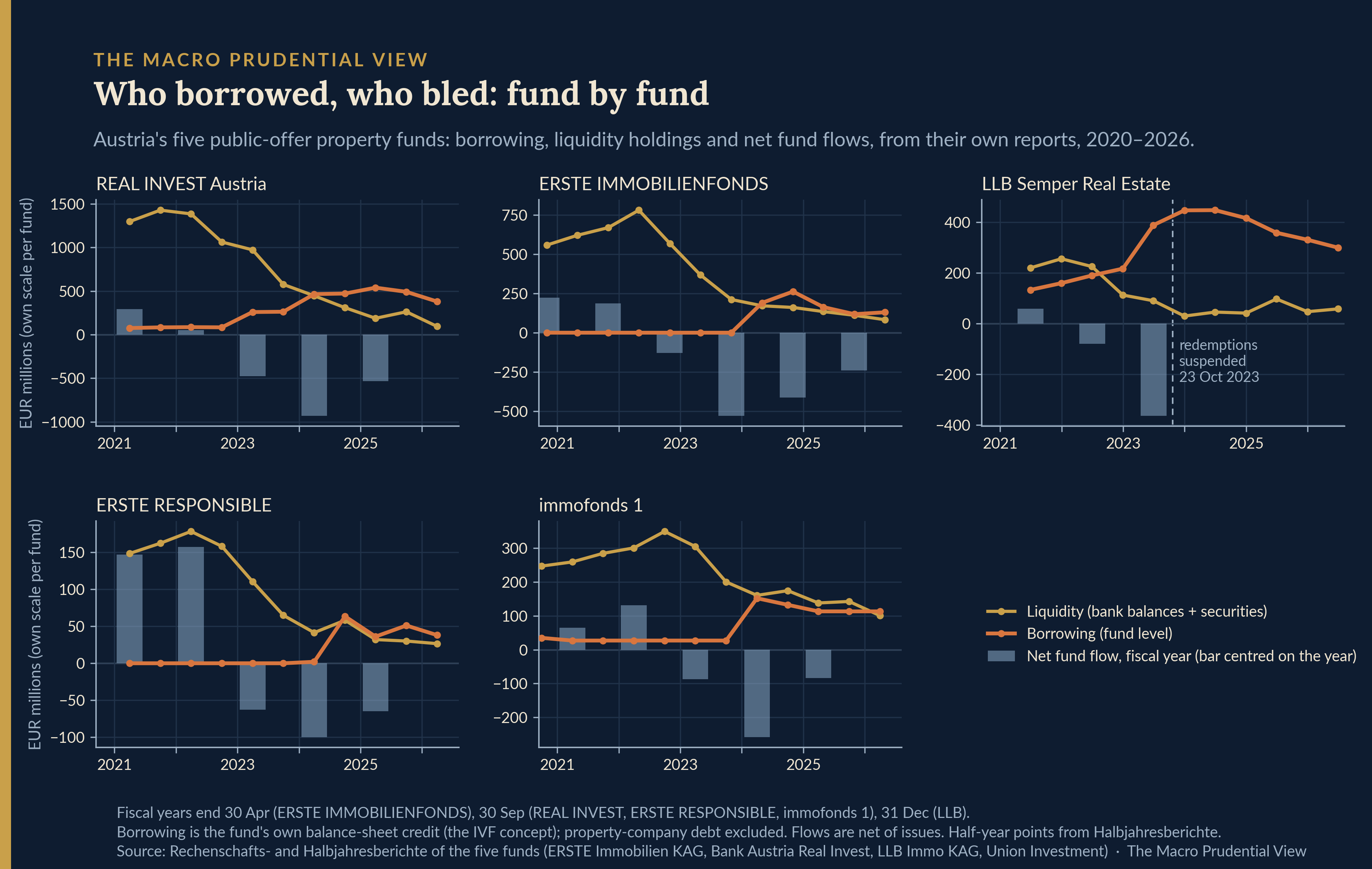
The OeNB’s Financial Stability Report recorded the sector’s 2024 net outflows at €1.6bn, some 17.6% of assets; the fund reports add the other side of each balance sheet.
Who borrowed, and in what order
At two funds the reporting dates fall where an order can be seen, so they come first.
ERSTE IMMOBILIENFONDS held €781m in bank balances in April 2022 and no credit. By April 2023 the balances were €368m; by October 2023, €212m; still no credit. The half-year report at that date records ten Vienna residential properties sold “im Herbst 2023” and announces that the management company will draw credit “bei Bedarf”, because “mit der Aufnahme von Fremdfinanzierung … wollen wir die Liquiditätssituation der Immobilienfonds stärken”. The first borrowing appears in the year to April 2024 — €190m at the year-end, 9.41% of fund assets before deduction — and rose to €262m by October 2024, 16.04% on the same basis. That was the year of the €530m outflow and of fifteen property sales the review values at around €140m, ten of them the autumn ones. The following year the fund sold twenty properties for around €403m and reduced the credit; a year later, nine for €239m, and the credit stood at €130m — €100m long-term, plus €30m short-term drawn again after the short-term lines had been repaid in June 2025. The wording moved with the years: “Stärkung der Liquiditätsquote” in the 2023/24 report, credit “zur Bewirtschaftung der Immobilien” in 2024/25 and 2025/26.
immofonds 1 reads similarly, and its record arrived last, from the management company itself, because the fund’s website carries only the current year. Liquidity ran from €349m in September 2022 to €200m in September 2023 with credit unchanged at €27m and, the report says, no sales that year. Between October 2023 and March 2024 the fund drew €125m, taking credit to €152m, in a half-year of €174m net outflows; one forward-funded purchase agreed in 2022 also completed in that half. Five properties, “rund EUR 135 Mio.”, were sold in the fiscal year — one transferred in March 2024, inside the half-year of the draw, the other four between June and September — and the credit was then reduced to €113m, where it has stayed. The 2023/24 review says redemptions were met “aus den liquiden Mitteln” and lists, as its liquidity-risk measures, “die Aufnahme von zusätzlichem Fremdkapital und die Vorbereitung und Umsetzung von Immobilienverkäufen”; the 2024/25 review describes liquidity as steered “über drei Säulen … Netto-Zuflüsse, Einsatz von Fremdkapital und Objektverkäufe”.
At the other three the rundown and the drawing overlap, and the note describes the overlap and claims no order.
REAL INVEST Austria lifted its credit from €83m in September 2022 to €259m by March 2023 while still holding €972m in bank balances and securities, then to €465m by March 2024 and a peak of €539m in March 2025, before repaying to €379m. Its liquidity holdings fell from €1.06bn to €262m over the same three years. The review’s account of the borrowing is that properties bought with equity were “mit langfristigem Fremdkapital refinanziert” while the fund’s voluntary securities reserve was sold down to meet redemptions, and it gives a broader leverage figure that includes the property companies’ debt — “rd. 17 %” of property volume in 2024, “rd. 20 %” in 2025 — which is a different quantity from the fund-level line charted here. It also sold: eighteen properties with a book value of around €536m in the year to September 2024, twenty more for around €516m the year after, and by its own count 43 properties with a book value of around €1.2bn between October 2023 and November 2025, which is more than twice what its credit ever rose.
LLB Semper Real Estate entered the run already borrowing, at €160m in December 2021 and €217m a year later, and drew hardest in the first half of 2023: €389m by June, €447m by December, on a fund whose assets had fallen to €676m. The 2023 report is the plainest of the five about purpose. Credit lines were drawn “zur Erhöhung der Liquidität”, and a short-term loan was taken “zur Bedienung von Anteilscheinrücknahmen in zwei Tranchen”. Liquidity was 4.45% of fund assets at the end of 2023 and 8.84% at the end of 2024, both below the 10% floor of § 32, and the report says so. The fund suspended redemptions on 23 October 2023, its management company gave the six months’ notice of § 15 on 23 April 2025, and the fund has been in liquidation since 24 October 2025 with about €300m of credit still on the balance sheet.
ERSTE RESPONSIBLE, which had no credit before 2024, had about €62m by September 2024 — €32m of short-term credit drawn under Pfandbestellungsurkunden of up to €60m, and a €30m bank loan at a property company the fund consolidates — and has since moved between €36m and €51m. Its report calls the credit Fremdmittel “zur Bewirtschaftung des Immobilienportfolios” and the sale of its main stake in a Vienna campus property a step “zur Sicherung der Liquidität”.
Five funds, then, and five ways of describing the same balance-sheet line: redemptions, liquidity, refinancing, management, a pillar. Whether these are one function in five legal shapes is my inference, and it is labelled as one. What the balance sheets establish is narrower and firmer: at every fund, between the start of its outflows and the end of its worst outflow year, cash fell and credit rose; at two of the five the reports place the cash rundown before the borrowing; and borrowing-before-sales is visible nowhere: at ERSTE the autumn-2023 sales came before the first credit, and at immofonds 1 the March-2024 transfer sits inside the draw half-year.
Two routes to the same line
The Austrian statute gives a real estate fund two ways to raise money against its assets, and the structure of the second says which one the record is looking at.
The ordinary route is § 5(2). A fund may borrow and encumber its properties, “unbeschadet des § 11”, where the fund rules provide for it, where it is “im Rahmen einer ordnungsmäßigen Wirtschaftsführung geboten”, and where the depositary consents to the borrowing and the encumbrance “weil sie die Bedingungen … für marktüblich erachtet”; borrowing and encumbrances together may not exceed 50% of the market value of the fund’s real-estate assets. The other route is § 11(2), which is written for exceptional circumstances. Where bank balances and the proceeds of securities do not suffice for redemptions and orderly management, the fund is to sell assets; redemption may be refused for up to a year, two if the fund rules say so; and only after that period may the management company encumber the fund’s assets “wenn das erforderlich ist, um Mittel zur Rücknahme der Anteilscheine zu beschaffen”, unwinding the encumbrance as soon as it can and notifying the FMA at once.
The two are concurrent powers — the “unbeschadet” says so — but the second opens only after a fund has refused redemptions under § 11(2) and the refusal period has run. Four of the five funds never refused a redemption: their flow statements show every year’s redemptions paid, and no report of theirs records a refusal or a notice to the FMA. For them the period never started, the § 11(2) power never opened, and their borrowing can only have been § 5(2) borrowing, consented to by the depositary in the ordinary course. LLB Semper refused redemptions from 23 October 2023 with €389m borrowed at the June 2023 date before the gate and €447m at the December one; the refusal period could not have run before October 2024, its credit stock has fallen since June 2024, its 2024 and 2025 reports describe no encumbrance taken to fund redemptions, and redemptions never reopened. For LLB that is an absence of any sign, since gross draws are not observed; for the other four it is the statute. None of this is a claim that any order was reversed or any rule breached: the fund rules are FMA-approved, the reports are audited, and the legislative materials of 2003, 2021 and 2026 say nothing about whether credit that meets redemptions falls within “ordnungsmäßige Wirtschaftsführung”. No public FMA statement on the point has been found. The relationship between the two provisions is left, on the record, unresolved.
One governance observation belongs here, stated exactly. The security behind both ERSTE funds’ credit is disclosed property by property, and it reconciles to the euro. At 31 October 2024 ERSTE IMMOBILIENFONDS’s €262m was €162m drawn under Pfandurkunden of up to €240m “zugunsten der Erste Group Bank AG”, a €70m mortgage in favour of the same bank, fully drawn, and €30m under a €36m Simultanpfandrecht in favour of Erste Bank der oesterreichischen Sparkassen AG. ERSTE RESPONSIBLE’s €62m at 30 September 2024 was €32m under Pfandbestellungsurkunden of up to €60m in favour of Erste Group Bank AG and a €30m “Bankkredit der Erste Bank der oesterreichischen Sparkassen AG” at a consolidated property company. Erste Group Bank AG is the depositary of both funds and the parent of their management company; Erste Bank der oesterreichischen Sparkassen AG is its Austrian banking subsidiary. So the pledge beneficiary and the consenting depositary are the same group bank, and where a lender is named it is the group’s bank. For the Pfandurkunden facilities the reports name the pledgee and not the lender, and the note does not infer one from the other. The other three funds’ reports name neither; Part 1 found 86% of the sector’s loans owed to domestic banks.
What the pairing cannot show
A fund-by-fund record invites a test, and the honest version of the test is thin. The reports give twenty-two fund-years. Five are inflow years, all before the run. Two are the zero-flow years of a gated fund. Fifteen are outflow years, and seven of those carry a material increase in borrowing — one at each of the five funds, plus a second at REAL INVEST and at LLB. No fund increased borrowing materially in an inflow year. That is a period effect in a window that contains one shock, and the empty cell says more about the window than about behaviour.
Nor can the annual and half-year dates resolve the quarter Part 1 flagged. The sector’s largest draw, €361m, came in the last quarter of 2023. Between their autumn-2023 and spring-2024 reporting dates four funds drew: ERSTE IMMOBILIENFONDS €190m, REAL INVEST €203m, immofonds 1 €125m, LLB €58m in the second half of 2023. The windows overlap the quarter without matching it, and the split stays open.
The larger limit is use of proceeds. Money is fungible and a balance sheet records positions, so the same year-end can show an outflow, a smaller cash pile, a larger loan and a list of sales, and cannot say which paid for which. REAL INVEST’s 2022/23 year is the clean illustration: liquidity fell by €487m and credit rose by €179m against a net outflow of €479m, with property up €59m and distributions of €50m — the changes over-explain the outflow, because income, purchases, capital expenditure, valuation and settlement timing are all moving too. Chart 1 groups the four changes instead of stacking them for that reason, and the phrase “the money came from” does not appear in this note. That the public accounts cannot identify use of proceeds is one of the note’s results.
Distance to the cap
Part 1 could say only that nothing showed the statutory ceiling binding. The reports allow the ratio to be stated on the statute’s own base.
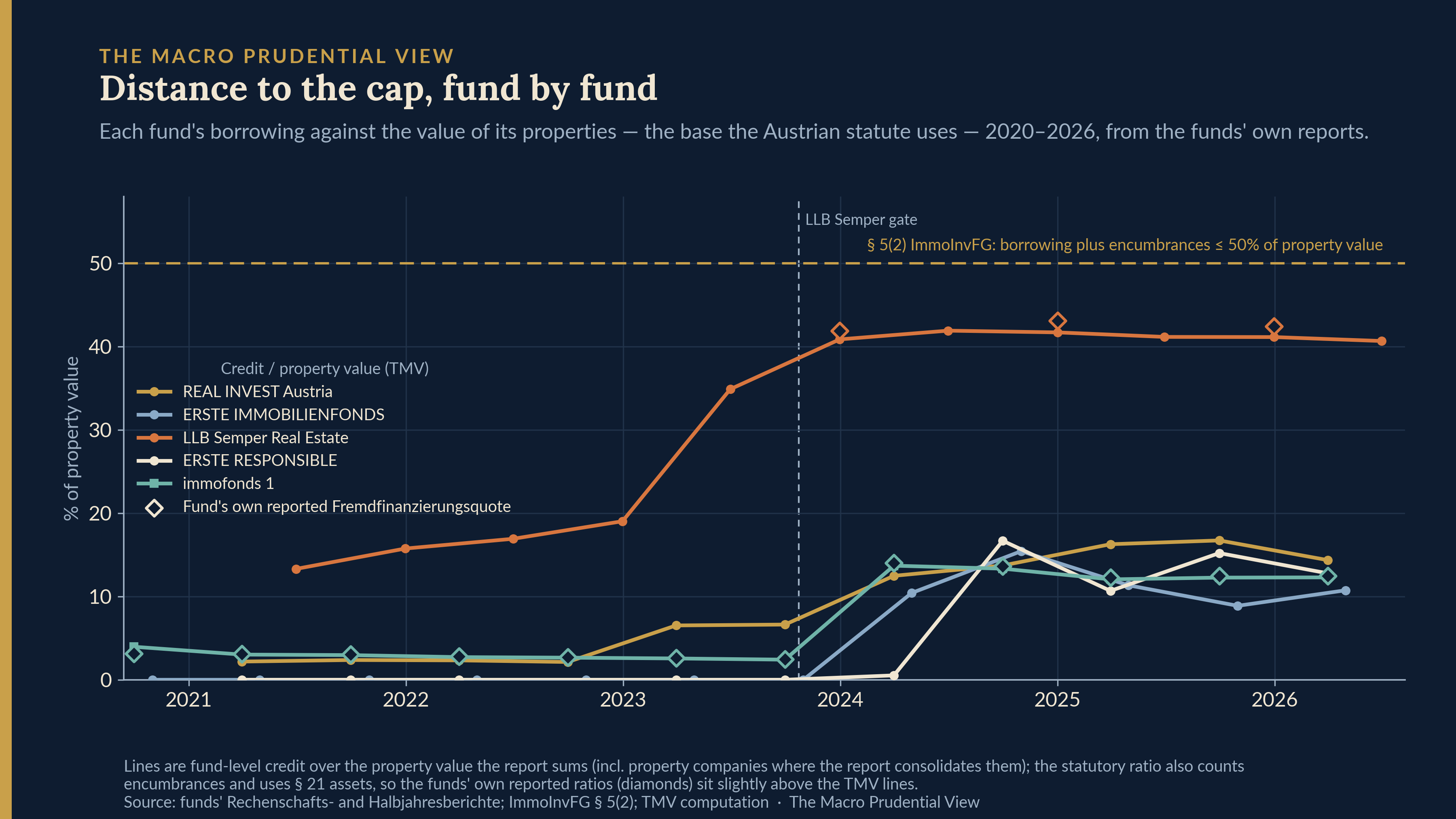
LLB Semper’s Fremdfinanzierungsquote, as it reports it, was 41.88% at the end of 2023, 43.10% at the end of 2024 and 42.40% at the end of 2025, against 50%. immofonds 1 prints its own ratio too: 2.46% in September 2023 and 14.0% six months later. ERSTE and REAL INVEST print the rule and not the ratio, so for them the chart’s line is credit over property value — a lower bound, since the statutory numerator also counts encumbrances — and it stayed at or below about 17%. At the floor, two funds disclose breaches of § 32’s 10% liquidity minimum in their own words: LLB in 2023 and 2024, and ERSTE IMMOBILIENFONDS “zeitweilig” in 2023/24 and “vorübergehend” in 2025/26, its liquid assets at 10.4% and 11.22% of fund assets on the two April year-ends. That is what the funds disclosed. The note does not claim the ceiling or the floor bound anyone’s conduct, and the sentence from Part 1 stands: fund rules, lender covenants and credit supply bind long before a product-law maximum does.
The rest of the sector
The five public funds are most of the Austrian sector’s borrowing, and the reports let that share be stated at reported dates. At each 31 March and 30 September from 2023 to 2026, three funds report on the day; LLB Semper and ERSTE IMMOBILIENFONDS do not, and each is taken as the range between its two adjacent reporting dates. Summed that way, the five stood at 55–74% of the ECB loan stock in March 2023, 59–64% in September 2023, 67–78% in March 2024, 78–85% in September 2024, 76–86% in March 2025, 84–90% in September 2025 and 84–88% in March 2026. Each range assumes only that a fund’s credit on the intermediate date lay between its two adjacent reported values.
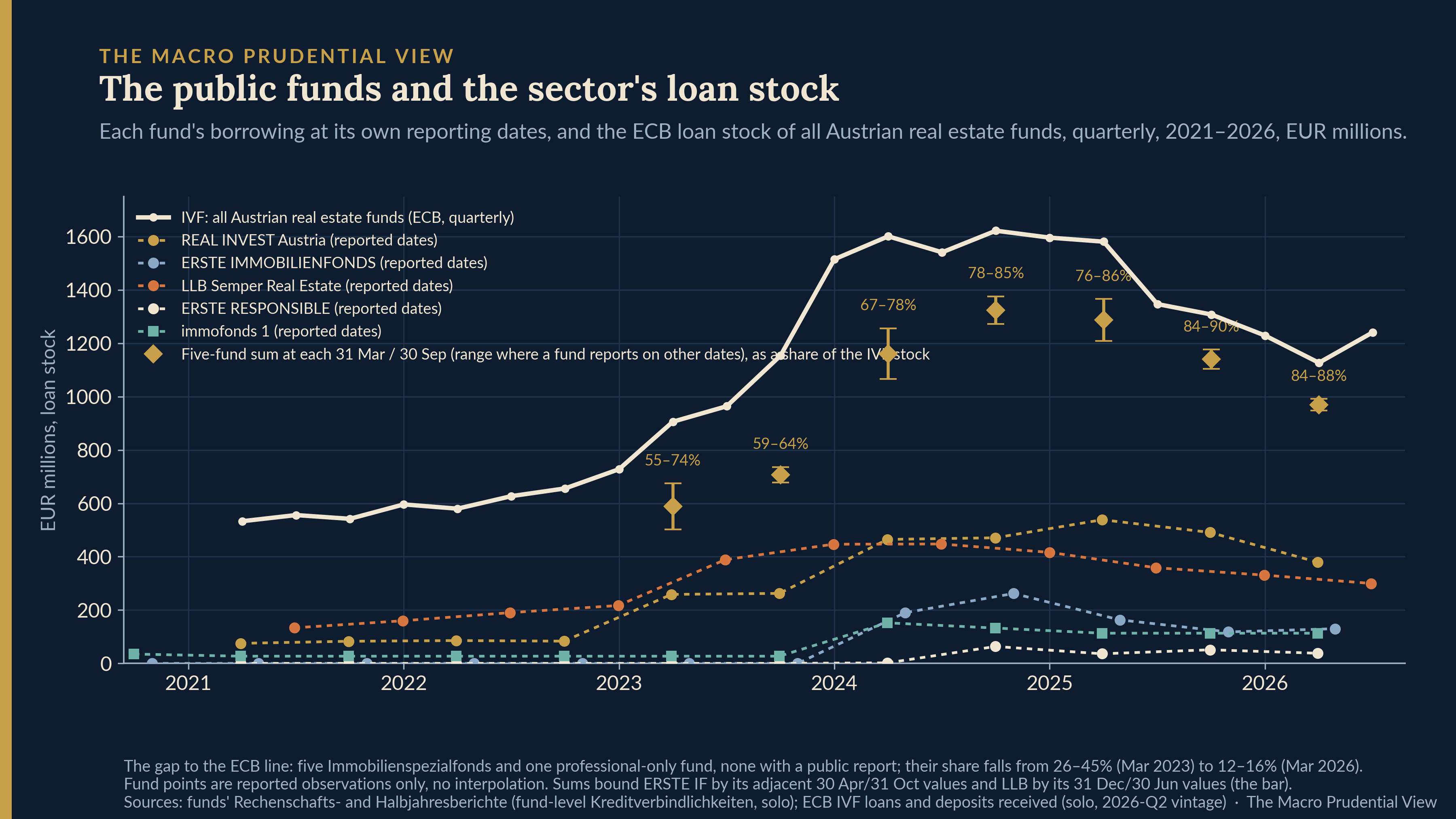
The remainder is the five Spezialfonds, the professional-only fund and, from 2025, the newly launched sixth public fund, and it is a residual — the ECB stock minus the public sum — so it absorbs every difference of concept between a fund’s statutory balance sheet and the ECB item, every reporting gap and the changeover of regulation in December 2025. It moved, though: from €232–403m in March 2023 to €418–476m in September 2023, then down to €246–349m by September 2024 and €136–179m by March 2026, while the public five were adding €540–700m between September 2023 and September 2024. The arithmetic is reported because it is part of the reconciliation, and it is indicative: a residual of this kind can move for accounting reasons as well as borrowing ones. Nothing in it says what the non-public funds did or why, and the note claims nothing about them.
What is left
What the public layer cannot say is what it could not say at the start: collateral beyond the pledge ceilings two funds disclose, recourse, the gross draws and repayments behind the net year-end figures, and the behaviour of the unobserved sixth of the sector. With five funds and one shock it estimates nothing; it is a case assembly, said once.
Two things it does say. The Austrian episode in Part 1 was the sector; it is now the funds, and it is all five that were there for it. And the credit on their balance sheets through the run went through the ordinary-course door of the statute at the four funds that never refused a redemption, with the depositary’s consent, and shows no sign of the other door at the fifth. Against the 50% ceiling, the two funds that print the statutory ratio were at 42–43% (LLB) and 14% (immofonds 1); the other three print no statutory ratio, and on credit alone were at 17% of property value or less, which bounds their headroom from one side only. What it was for is what the funds say it was for, and they do not say the same thing: LLB’s report ties its short-term loan to redemptions; ERSTE’s tie credit to liquidity and then to management; immofonds 1 lists it as one of three pillars; REAL INVEST, cash-rich when it started drawing, calls it the refinancing of equity-bought property. At four funds the stock has come down from its peak and at none is it back where it started. At the fifth it is part of the liquidation. LLB Semper’s reports are a public account of an Austrian property fund unwinding under § 17, where distribution to unit-holders comes “erst nach Erfüllung der Verbindlichkeiten des Immobilienfonds”: ten properties sold in 2025 for close to €158.7m, credit down to €300m, a first partial distribution of €70m in December 2025. Whether the borrowing lengthened the fund’s life or the unit-holders’ wait is not something its reports can settle, and the note does not.
The legislator’s answer arrived before the run. The 2021 amendment that takes effect on 1 January 2027 rewrites § 11(1) for existing funds: a twelve-month minimum holding period, twelve months’ notice of redemption, redemption dates at least quarterly. It is the instrument Germany adopted in 2013 with half the holding period — the German rule is twenty-four months’ holding and twelve months’ notice — so the verdict in Twelve years of evidence does not transfer as it stands. The Austrian act that transposed AIFMD II in July 2026 then added, on its own initiative and not the directive’s, an allowance for holders on the books at the end of 2026: €20,000 a year in 2027 and 2028 and €10,000 in 2029 and 2030, redeemable without the notice period, suspended while a liquidity tool is active. § 5 was left untouched. ERSTE has already written gating and notice extension into its fund rules, in April 2026. So a run in 2027–30 meets a twelve-month notice period, a retail allowance running beneath it, and an unchanged credit power; after 2030, the first and the last.
The question Part 1 left — whether the funds that borrowed were the funds that bled — has an answer for the public funds that were there for the run: all five of them, on their own published numbers, audited at each year-end. The prior work on this record, a 2025 TU Wien thesis on the liquidity-management toolkit, names the funds and the § 32 floor and does not pair borrowing with redemptions; the pairing is above. It shows one path under a common shock, taken by five funds in five somewhat different ways. Whether the next set of rules produces the same path is a question for the next run.
Paweł Fiedor — The Macro Prudential View
Views are my own. This article is a personal analytical piece based on public sources. It does not represent the views of the European Systemic Risk Board, the Central Bank of Ireland, the Eurosystem, or any other institution.
Fund reports (all figures read on the cited pages; EUR; fiscal years as stated)
ERSTE Immobilien KAG — ERSTE IMMOBILIENFONDS, Rechenschaftsberichte FY2020/21–2025/26 (30 April) and Halbjahresberichte (31 October); autumn-2023 sales and the liquidity wording HJB 2023/24 p. 4; 9.41%, floor wording and Pfandurkunden RB 2023/24 pp. 4, 20; 16.04% figure and the three security packages HJB 2024/25 pp. 5, 14; short-term repayment and “zur Bewirtschaftung” RB 2024/25 p. 4; 2025/26 floor breach and rule amendment RB 2025/26 p. 4. ERSTE RESPONSIBLE IMMOBILIENFONDS, Rechenschaftsberichte FY2020/21–2024/25 (30 September) and Halbjahresberichte to 31 March 2026; credit composition, wording and stake sale RB 2023/24 p. 4; Pfandbestellungsurkunden p. 18; the property-company bank loan p. 39. Both at ersteimmobilien.at.
Bank Austria Real Invest — REAL INVEST Austria, Rechenschaftsberichte FY2020/21–2024/25 (30 September) and Halbjahresberichte to 31 March 2026; narrative on outflows, refinancing and the 17% figure RB 2023/24 pp. 6, 8; “rd. EUR 2 Mrd.”, “rd. 20 %” and the 43-property figure RB 2024/25 p. 6. At realinvest.at.
LLB Immo KAG — LLB Semper Real Estate, Rechenschaftsberichte 2021–2024 (31 December), Abwicklungsbericht 2025, Halbjahresberichte to 30 June 2026; credit-line and loan wording, Fremdfinanzierungsquote and liquidity ratio RB 2023 pp. 10, 12 and RB 2024 pp. 11–12; 2025 sales, first distribution and 42.40% AB 2025 pp. 10–12. Suspension, termination and liquidation dates from LLB investor information.
Union Investment Real Estate Austria — immofonds 1, Rechenschaftsberichte FY2019/20–2024/25 (30 September) and Halbjahresberichte to 31 March 2026; back years supplied by the management company, September 2026; liquidity-measures wording RB 2023/24 p. 5, sales p. 9; “drei Säulen” RB 2024/25 p. 5. Current reports at union-investment.at.
Legal texts
ImmoInvFG (BGBl. I Nr. 80/2003), §§ 5, 11, 13, 15, 17, 32 and 43a, consolidated text on RIS; § 11(1) as amended by BGBl. I Nr. 198/2021 (applicable to existing funds from 1 January 2027 under § 43a(2)); § 43a(2a)–(2c) and § 11(1a) inserted by Austrian BGBl. I Nr. 57/2026 (AIFMD II transposition, in force 29 July 2026). Legislative materials: RV 97 d.B. XXII. GP (2003), RV 1100 d.B. XXVII. GP (2021), RV 502 d.B. XXVIII. GP (2026), all at parlament.gv.at.
Regulation (EU) No 1073/2013 (ECB/2013/38), repealed with effect from 1 December 2025 by Regulation (EU) 2024/1988 (ECB/2024/17) — investment fund statistics: fund-by-fund reporting under both, the concept the reconciliation uses on both sides.
KAGB § 255 — the German twenty-four-month holding and twelve-month notice rule for retail open-ended property funds.
Official reports and prior work
OeNB, Financial Stability Report 49 (June 2025), p. 37 — the 2024 outflow figure; Reports 50 and 51 carry no real-estate-fund passage.
FMA, Fondssuche — the register of ImmoInvFG funds, read 1 September 2026.
Giller, Liquiditätsstrategien der österreichischen Immobilienfonds nach der Zinswende 2022, master’s thesis, TU Wien, submitted 20 February 2025 — the prior document analysis of the liquidity-management toolkit.
Data
ECB Investment Fund Statistics (IVF), 2026-Q2 vintage — the Austrian loan stock (loans and deposits received, all maturities and counterparts), as in The Uses of Slack.
Calculations. The fund-year table, the disposals file and the reconciliation are compiled by The Macro Prudential View from the reports above; every value carries the PDF page it was read on. Liquidity holdings are bank balances plus securities at the reporting date. Changes are between consecutive fiscal year-ends. “Material” borrowing increase means at least 1% of opening fund assets. Coverage at each 31 March and 30 September takes REAL INVEST, ERSTE RESPONSIBLE and immofonds 1 at their own figures on the date and ERSTE IMMOBILIENFONDS and LLB Semper as the range between their adjacent reporting dates (30 April/31 October and 30 June/31 December respectively); no interpolation is used anywhere. Translations from the German are mine