



Who Lends to Euro-Area Hedge Funds
The IMF’s October 2026 GFSR lists hedge funds’ counterparty relationships and cross-border activities among its main data gaps. ECB statistics fill one narrow corner. Recorded borrowing by euro-area-domiciled hedge funds nearly tripled between end-2023 and mid-2026. Irish funds account for two-thirds of it and borrowed almost entirely from lenders resident outside the euro area; Luxembourg funds borrowed mostly from MFIs elsewhere in the euro area.
The second chapter of the IMF’s October 2026 Global Financial Stability Report is about hedge funds, and one of its conclusions is that their vulnerabilities remain hard to monitor because of “significant data gaps, particularly regarding leverage, derivatives exposures, counterparty relationships, and cross-border activities.” Most of that cannot be closed with public data. A small part can. The ECB’s investment fund statistics record how much euro-area-domiciled funds have borrowed and where the immediate lender is resident, and they separate changes in the stock into transactions and everything else. This note reads that series for hedge funds since the end of 2023.
The scope is narrow, so it comes first. The series covers hedge funds domiciled in the euro area; lending to funds in the Cayman Islands or the United States is outside it, whoever the lender. It records the residence of the entity that books the loan, which need not be where the lending group is headquartered: a euro-area bank lending through its London branch counts as outside the euro area, and a US dealer’s Frankfurt subsidiary counts as inside. And it is a single liability item, “loans and deposits received”. The ECB’s reporting regulation lists what it consists of: loans, cash received under repo, and cash collateral received against securities lent or gold. Margin on derivatives is not on that list, and the two compilers treat it differently. The Banque centrale du Luxembourg tells funds to report margin deposits received as borrowings, which brings them into the item; the Central Bank of Ireland’s return records margin received under other liabilities, separately from loans. So the Luxembourg figures probably include cash margin received and the Irish ones probably do not. At mid-2026 the item stood at €141bn. The IMF’s own figures, from US Office of Financial Research data, put hedge funds’ global repo borrowing at $3.24tn and prime-brokerage borrowing at $3.22tn in the first quarter of 2026.
The increase
Recorded borrowing by euro-area hedge funds was €39.6bn at the end of 2022, €47.8bn at the end of 2023, €115.8bn at the end of September 2025 (the last quarter under the old national returns) and €140.6bn at the end of June 2026. The build-up starts in the first quarter of 2024, which is why the note measures from end-2023. Over those ten quarters the funds’ net asset value went from €374bn to €484bn, so borrowing grew by a factor of 2.9 and capital by 1.3.
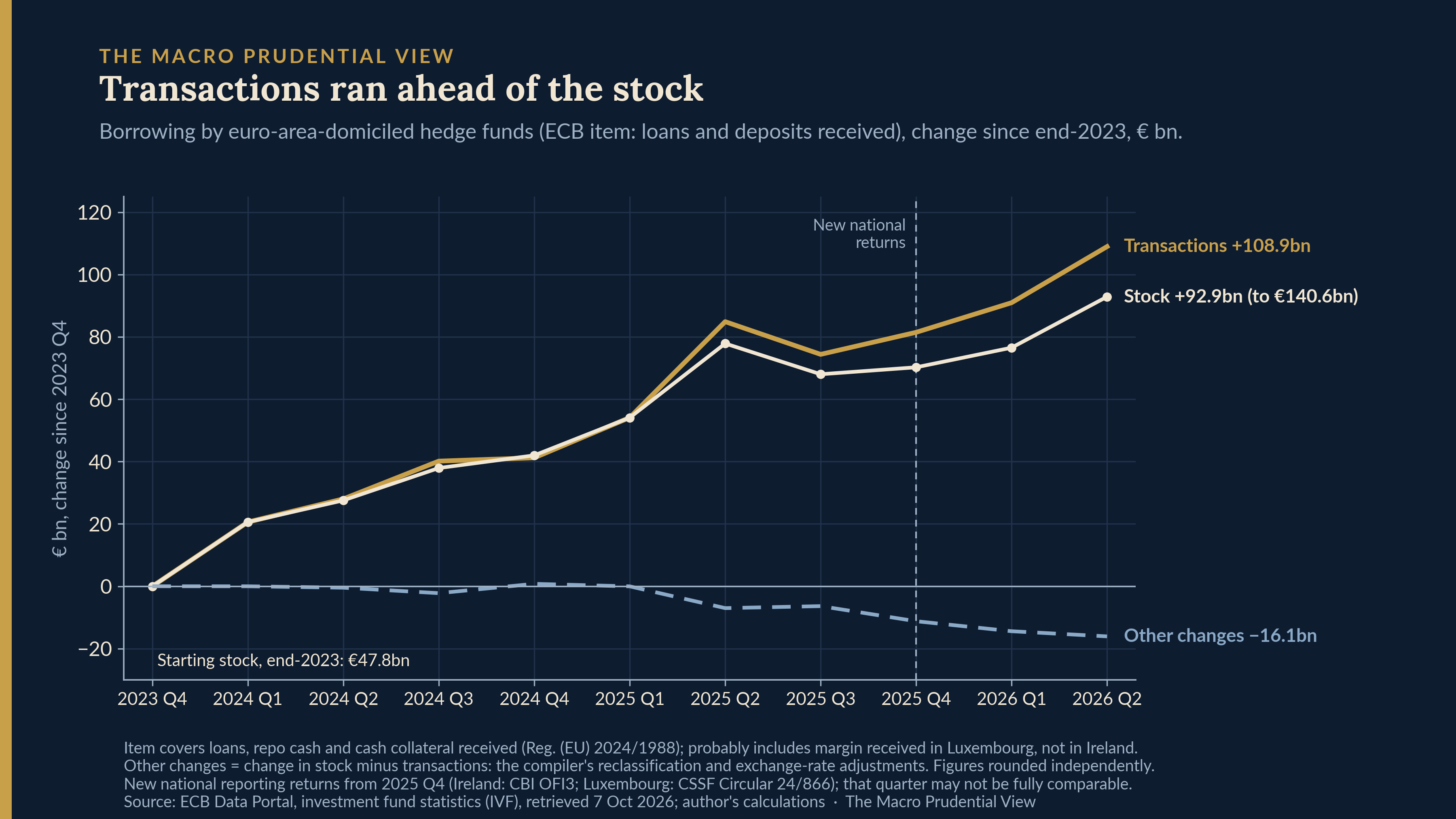
The series is compiled, and it should be read through how it is compiled. For this item funds report stocks, not transactions (the ECB’s investment fund manual lists loans and deposits received among the items for which funds report no transactions). Each national central bank derives transactions by taking its own reclassification and exchange-rate adjustments out of the change in the stock, and a fund moved into the hedge-fund category from another fund type goes into the adjustments. How funds entering the population are treated is not documented for fund statistics. The ECB’s bank-statistics convention would put business brought in from outside into adjustments, but I cannot confirm that compilers apply it here, and the aggregates cannot separate borrowing by funds that already existed from borrowing by funds launched during the period.
Read that way, transactions ran about €16bn ahead of the stock over the ten quarters, the gap being other changes. The gap opens in the second quarter of 2025, two quarters before the reporting change described below, and widens after it. Two quarters stand out: +€20.6bn in the first quarter of 2024 and +€30.8bn in the second quarter of 2025, which was followed by −€10.5bn in the third. About €74bn of the transactions came before December 2025. From that reference period a new ECB reporting regulation applied, and with it new national returns: the CBI’s OFI3 return, effective for fourth-quarter 2025 data, and in Luxembourg the reporting set out in CSSF Circular 24/866 and BCL Circular 2024/245. The definition of the item is the same under both ECB regulations, but the national reporting behind it changed, so the fourth quarter of 2025 may not be fully comparable with the quarters before it.
Ireland and Luxembourg
Two domiciles account for nearly all of it. Irish hedge funds’ borrowing rose from €37.1bn to €97.8bn, about two-thirds of the rise in the stock, and they recorded €72.0bn of net borrowing transactions, two-thirds of the total. Their NAV went from €180bn to €240bn. Luxembourg hedge funds’ borrowing rose from €9.4bn to €36.6bn on NAV of €169bn rising to €219bn, with €31.3bn of transactions.
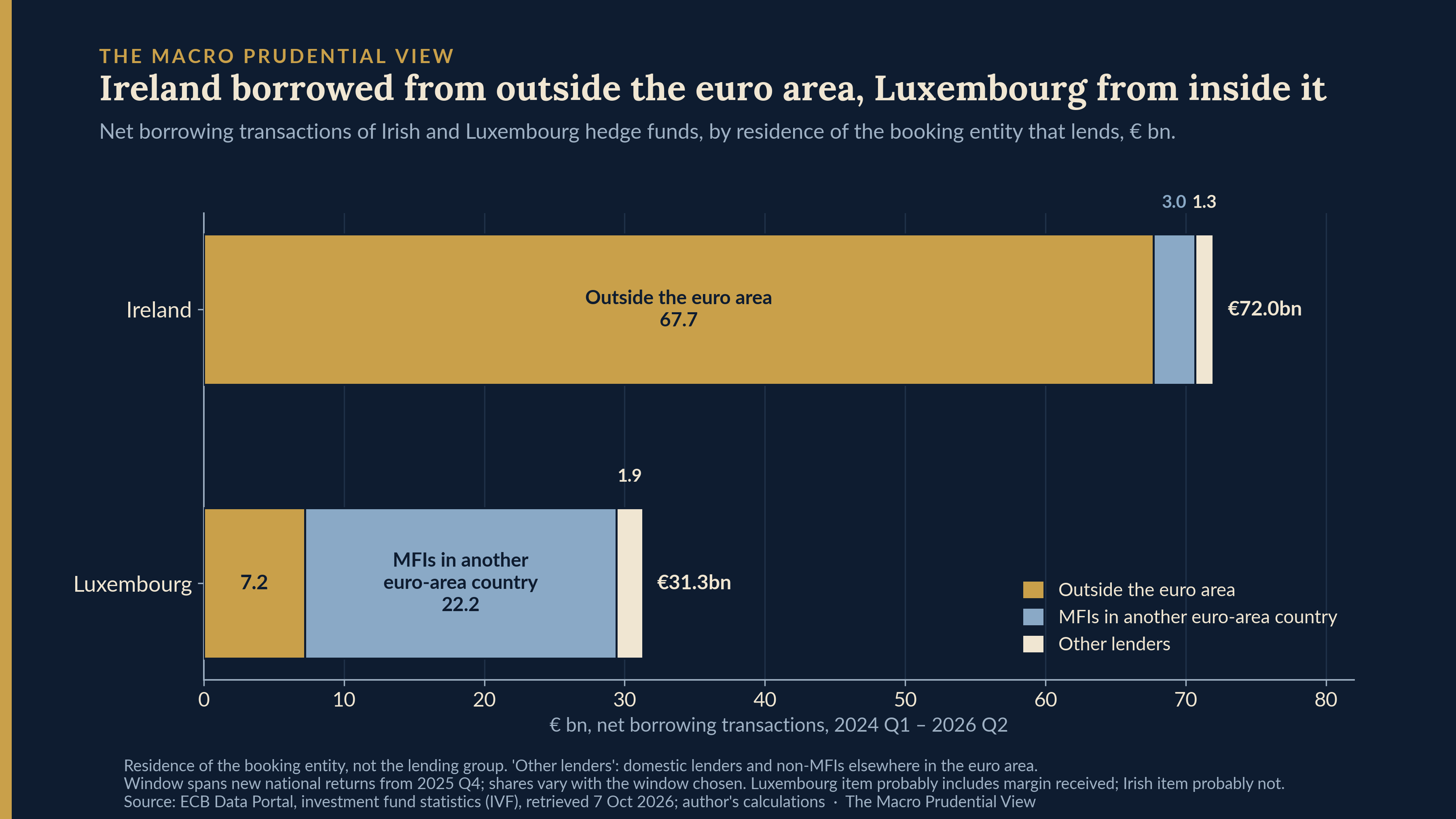
The immediate lenders sit in different places, whether measured by net transactions or by what is outstanding. About 94% of Irish net transactions were with lenders resident outside the euro area, and about 71% of Luxembourg's with MFIs in another euro-area country ("other lenders" in the chart are domestic lenders and non-MFIs elsewhere in the euro area). In outstanding borrowing at mid-2026, 82% of the Irish book was owed to lenders outside the euro area (97% in September 2025) and 67% of the Luxembourg book to MFIs in another euro-area country. For Luxembourg this describes the published item, which may include margin received; I cannot separate that part. Because the series records booking residence, this need not mean different lending groups: one dealer group could book Irish funds' business in London and Luxembourg funds' business in Frankfurt or Paris, and nothing here can rule that out. The cumulative split is robust to the windows I tried. Whether the period starts in late 2022 or late 2024, or leaves out the fourth quarter of 2025, the Irish share from outside the euro area stays between 88% and 92%; in the window ending before the new regulation it is all of it, with small net repayments to other lenders. The Luxembourg share from other-euro-area MFIs stays between 61% and 78%, the low end being the window that includes the new national returns.1 The flow comparison also assumes that the Central Bank of Ireland and the Banque centrale du Luxembourg derive transactions in comparable ways.
The Irish result points the same way as the Central Bank of Ireland’s April 2026 analysis, which found from securities financing data that the main leverage providers to Irish hedge funds “are located outside the EU, mainly in the US and UK, and are mainly banks and broker-dealers”. The two are measured differently: the CBI looks at securities financing transactions and at lenders outside the EU, a narrower set than lenders outside the euro area; this series covers one balance-sheet item and the residence of the booking entity relative to the euro area.
The rest of the Irish fund sector recorded net repayments in aggregate. Irish funds outside the hedge-fund category had net borrowing transactions of −€13.2bn over the same ten quarters, the sum of repayments by “other” funds (−€20.2bn), bond funds (−€2.8bn) and mixed funds (−€1.8bn), and new borrowing by equity funds (+€7.4bn) and real-estate funds (+€4.2bn). Against that, Irish hedge funds’ +€72.0bn stands out. Luxembourg is less distinctive on this score: Luxembourg’s “other” funds alone recorded +€44.4bn. The two hedge-fund books also differ in balance-sheet leverage (total assets to NAV of 1.77 in Ireland and 1.40 in Luxembourg, both at mid-2026), and national practice in assigning funds to the hedge-fund category may differ, so the comparison is between domiciles and I would not read it as a comparison of similar funds.
The stocks should be read with the transactions, and the fourth quarter of 2025 shows why, with the comparability caveat above. The third chart sets it beside the same quarter a year earlier.
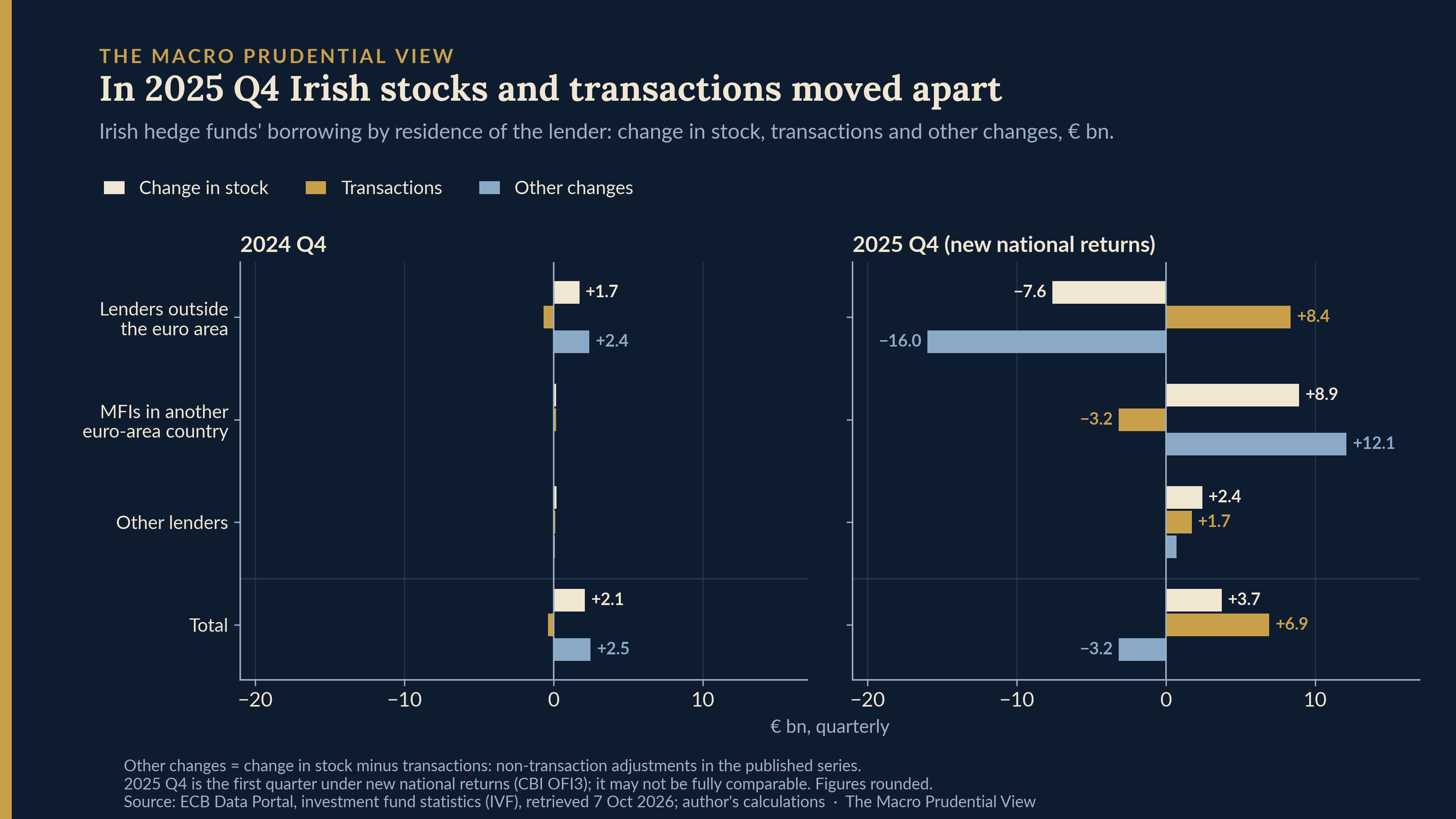
In 2024 Q4 the other changes were small and ran in one direction. In 2025 Q4, the first quarter under the new national returns, they were large and offsetting: +€12.1bn for MFIs in other euro-area countries and −€16.0bn for lenders outside the euro area, both non-transaction adjustments in the published series. Read from the stocks alone, that quarter looks like a move towards euro-area lenders. The transactions went the other way, +€8.4bn with lenders outside the euro area and −€3.2bn with MFIs in other euro-area countries, so net new borrowing did not shift towards euro-area lenders. What moved the stocks the published data do not say. Because the reporting changed in the same quarter, I treat 2025 Q4 with caution, and footnote 1 shows the main result with that quarter left out.
What these series cannot tell you
Prime brokers and lending groups are not identified. Derivatives exposures are outside the item, and margin received appears to be inside it for Luxembourg funds and outside it for Irish ones. Funds domiciled outside the euro area, which is where euro-area banks’ larger hedge-fund exposures may well be, are not covered at all. The aggregates cannot separate existing funds from new ones, and concentration and strategy are left to supervisory data.
Turning this into an exposure measure needs the counterparty data in SFTR and EMIR, which supervisors hold and which the CBI’s article draws on for Ireland.
Paweł Fiedor — The Macro Prudential View
Views are my own. This article is a personal analytical piece based on public sources. It does not represent the views of the European Systemic Risk Board, the Central Bank of Ireland, the Eurosystem, or any other institution.
Official reports
IMF (October 2026), Global Financial Stability Report, Chapter 2, “Hedge Funds and Financial Stability” — the data-gap sentence (Key Points) and the repo and prime-brokerage borrowing figures (Figure 2.2 data, from US Office of Financial Research data).
Central Bank of Ireland (April 2026), Financial Stability Risk Assessment of Irish Hedge Funds, Quarterly Bulletin Signed Article — leverage providers to Irish hedge funds, p. 12.
Legal texts and reporting instructions
Regulation (EU) 2024/1988 (ECB/2024/17), Annex II Part 1, category 8, applicable from 1 December 2025, and Regulation (EU) No 1073/2013 (ECB/2013/38), Annex II Part 1, category 7 — the content of “loans and deposits received”, unchanged between the two.
CSSF Circular 24/866 and BCL Circular 2024/245, “Modification of the statistical data collection for investment funds (as from December 2025)”; BCL, Statistical reporting of investment funds: FAQ (2025) — margin deposits received reported as borrowings.
Central Bank of Ireland, Resident Investment Funds Return (OFI3): Notes on Compilation, v0.6, March 2026 — effective for Q4 2025 data; loans (section 5.3) and margin received under other liabilities (section 5.4).
Statistical methodology
ECB (2017), Manual on investment fund statistics, paras 21 and 167–170 — fund-type reclassification and the derivation of transactions for loans and deposits received.
ECB (2024), Manual on MFI balance sheet statistics, section 5.5 — the treatment of institutions joining the reporting population.
Data
ECB Investment Fund Statistics (IVF), 2026-Q2 vintage, retrieved 7 October 2026 — hedge funds (all, UCITS and non-UCITS) and other fund types; loans and deposits received by counterpart area, sector and original maturity (stocks and transactions); total assets and fund shares; euro area, Ireland and Luxembourg.
Calculations. Other changes are the change in the stock less transactions. Lender shares are shares of cumulative net transactions unless stated as outstanding amounts. “Other lenders” are domestic lenders and non-MFIs elsewhere in the euro area. Figures are rounded independently, so components may not sum to totals.
Irish share of net transactions with lenders outside the euro area / Luxembourg share with MFIs in another euro-area country: 2024 Q1–2026 Q2 excluding 2025 Q4, 91% / 75%; 2023 Q1–2026 Q2, 92% / 71%; 2025 Q1–2026 Q2, 88% / 61%. In 2024 Q1–2025 Q3, before the new national returns, Irish hedge funds' net borrowing from lenders outside the euro area was +€52.6bn against net repayments of €1.2bn to all other lenders (total +€51.4bn); the Luxembourg share was 78%.