



On 29 October the Bank of England opened a consultation on tokenised collateral at clearing houses. It proposes no change to what a UK clearing house may accept. Its fifth question, though, asks for evidence on three things that are not accepted today: stablecoins, tokenised gold and tokenised units of money market funds. On the fund units the paper is specific about what worries it. Are there barriers to redemption? How quickly could a clearing house get at the value? Would margin calls drive redemptions at the worst moment?
A week later a policy brief published by SUERF made the case for the other side. On its account, units of money market funds that hold only government paper do not move in price and redeem at par on demand. What kept them out of margin accounts, the brief argues, was settlement: units live on a transfer agent’s register and cannot be delivered like a bond. Put the register on a ledger and the obstacle goes.
The two documents are answering the same question, and public sources already say a good deal about it. European clearing houses report no fund units as margin on the line their disclosures provide for them, and on my reading of the EU rules they could not accept them today. ESMA has not ruled on the point. If that changed, the question would become how a clearing house turns a unit into cash when a member has defaulted. For an EU money market fund the answer runs through the fund itself: its board can suspend redemption for up to 15 working days, and an unlisted unit can be transferred only to a holder the fund accepts. A token changes how the unit moves. It does not change either of those terms. And in euro the product is scarce: 1% of the margin at Eurex Clearing alone is about an eighth of the euro government funds I can identify.
None of this says the idea cannot work. A clearing house in Chicago has taken government fund shares for years, under tight limits. The evidence points to what such a programme has to contain, and the EU documents I have read do not yet ask about it.
What EU rules admit today
EMIR’s collateral standard is wider than cash and government bonds. It admits “transferable securities and money-market instruments” that meet a list of conditions, and European clearing houses use the room: at the end of June, bonds on the corporate line of the common disclosure template were 19% of the margin held at Eurex Clearing and 39% at Nasdaq Clearing. The template has no separate row for bank or covered bonds, so that line may include them.
Fund units are a different matter. In a Q&A of October 2022, ESMA reads eligibility off the MiFID definitions: a bond qualifies because it is a transferable security, commercial paper because it is a money-market instrument. MiFID lists “units in collective investment undertakings” as a separate class of financial instrument. On that reading a fund unit is in neither admitted class. That is my reading, and ESMA has not said it of fund units. But I am not alone in it. This spring, responding to an ESMA consultation, Deutsche Börse Group wrote on behalf of Eurex Clearing and ECC that the current drafting, “which categorises eligible financial instruments into narrowly defined sub-categories”, “effectively excludes ETFs from use as collateral”. It asked for “exchange traded funds” to be added to the list. ESMA’s final report on that standard, published on 19 October, proposes changes to the rules on guarantees and leaves the admitted classes alone. Asked in the same exercise to let clearing houses invest in government money market funds, ESMA declined to “create additional categories of instruments” and noted that substantial broadening “may go beyond the Level 1 mandate”. Both remarks concern what a clearing house may invest its own cash in, which is a separate provision from what members may post. They show ESMA’s appetite for new categories this year. They do not settle the collateral question.
There is one awkward fact for this reading, and it belongs in the open. Eurex did accept fund shares once. A circular of March 2016 admitted five iShares equity ETFs as margin collateral from 1 April that year, and Eurex’s disclosures show fund units held from mid-2017 to early 2018, peaking at EUR 79 million. Its collateral page now says ETFs are not eligible. I have not found the circular that ended the programme or the reason for it. So one EU clearing house admitted listed fund shares under the same standard, reported holding them for about a year, stopped, and now asks for the standard to be changed. The classification is contestable. What is not in dispute is that none is reported today.
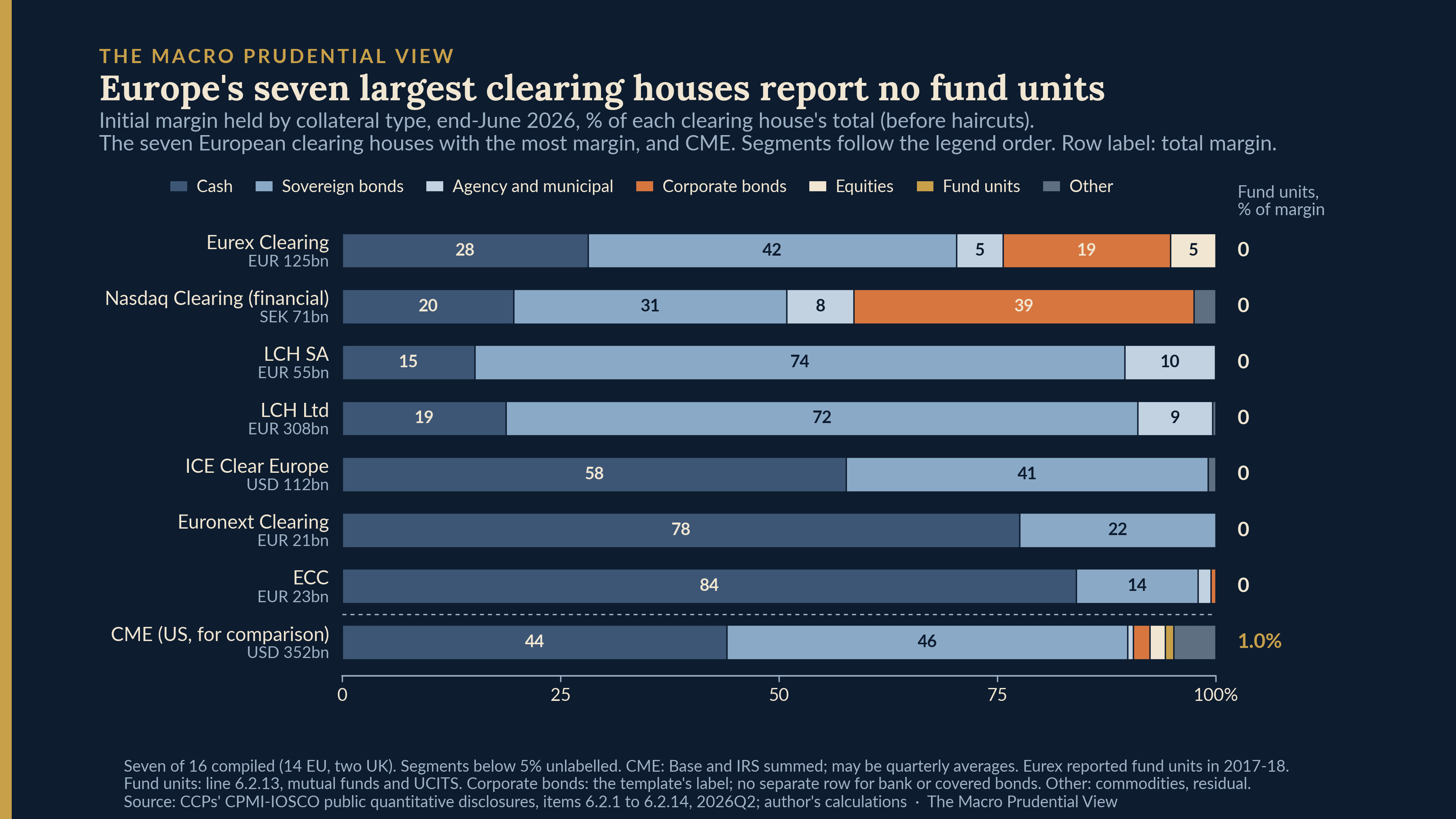
The disclosures show the present position. Clearing houses publish their collateral by type each quarter, on a common template with a line for mutual funds and UCITS. I have compiled the disclosures of 16 clearing houses, 14 in the EU and two in the UK (LCH Ltd and ICE Clear Europe), which are outside EU law; the charts show the seven that hold the most margin, with CME for comparison. Across the 16, that line is empty in every quarter since 2015, the Eurex episode aside. The catch-all “other” line is empty at all but three of the 15 that reported for June: 0.4% of margin at LCH Ltd, 2.5% at Nasdaq Clearing, and EUR 71 million at CCP Austria, a quarter of a small margin pool. The disclosures do not say what is in that line, so a fund unit reported there cannot be ruled out.
This matters for who the question is addressed to. If fund units are outside the admitted classes, a clearing house cannot decide to take them, tokenised or otherwise. The standard would have to change first, and that is a matter for ESMA and the Commission. ESMA’s own call for evidence on tokenised collateral, published on 9 October, says it is “not intended to reassess or expand the categories of assets eligible”. In 35 pages it does not mention money market funds.
If the classes were opened
Suppose the list were widened. A fund unit would then face the same conditions as any other security. Two of them bear on a fund unit. The collateral must be “freely transferable and without any regulatory or legal constraint or third party claims that impair liquidation”. And it must have “an active outright sale or repurchase agreement market, with a diverse group of buyers and sellers”, which the clearing house can reach “including in stressed conditions”.
Behind those conditions sits a cash requirement. When a member defaults, the clearing house keeps paying the surviving members what they are owed, every day, while it closes out the defaulter’s positions. The rules require it to meet payments “as they fall due” and restrict what it may count as a liquid resource: cash, committed credit lines, committed repos, and securities that are “convertible into cash on a same-day basis using prearranged and highly reliable funding arrangements, including in stressed market conditions”. Other collateral can be held and realised later, but only because something on that list carries the clearing house in the meantime. The resources have to be enough for the default of the two entities to which it is most exposed.
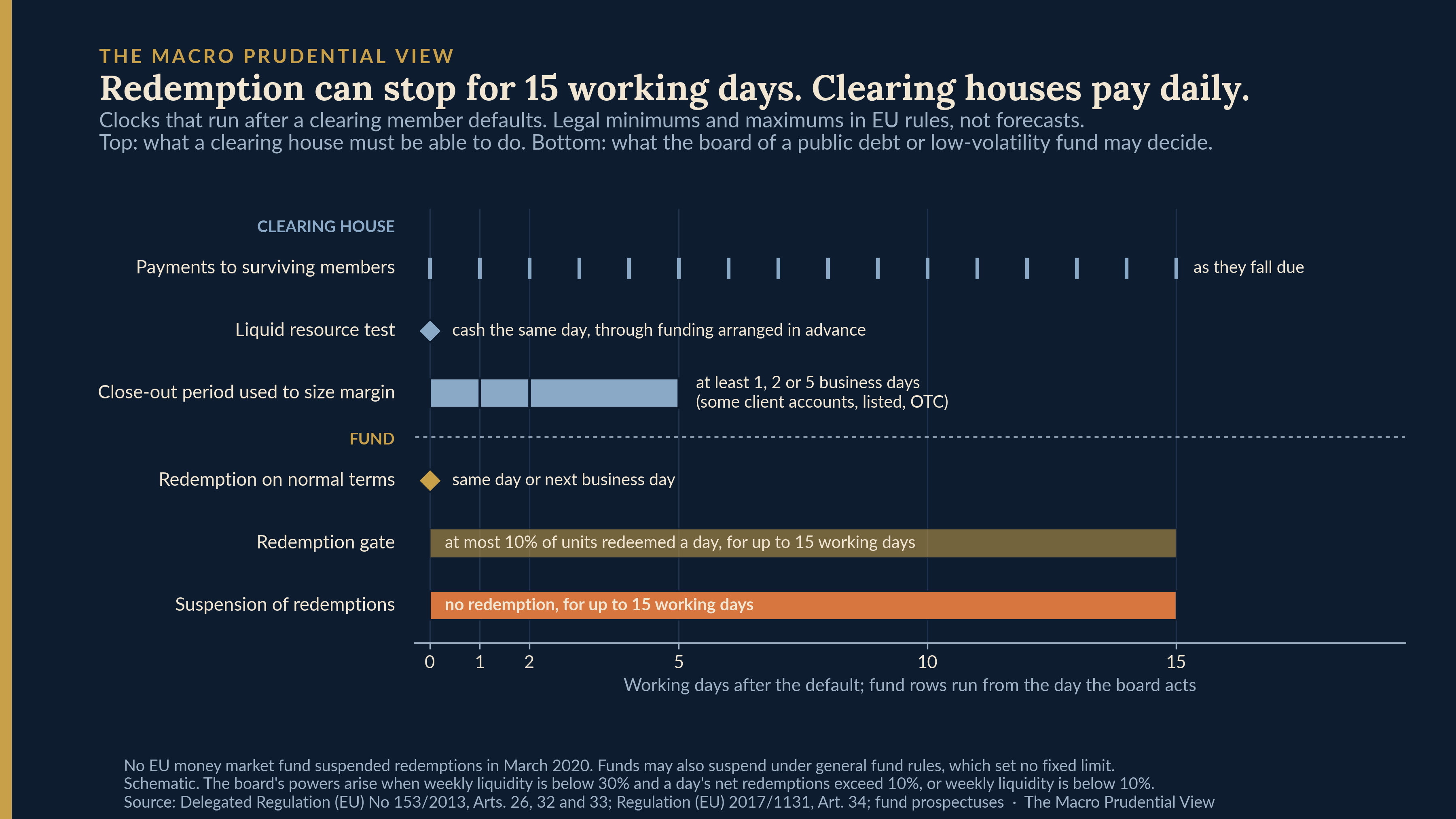
Set a money market fund unit against that. In normal times it is close to what the brief says. A public debt fund deals at a constant price, which the prospectuses do not guarantee, and BlackRock’s sends proceeds on the dealing day or the next business day. A unit that pays the next day would already need a facility behind it to count as a same-day resource. The difficulty is in the terms that apply when times are not normal. Under the Money Market Fund Regulation, if weekly liquidity falls below 30% of assets while a day’s net redemptions exceed 10%, the board of a public debt or low-volatility fund may impose a liquidity fee, a gate that limits redemptions to 10% of units a day, or a suspension, or decide to do nothing. If weekly liquidity falls below 10%, it must impose a fee or suspend. The gate and the suspension can each run for up to 15 working days. A fund can also suspend under general fund rules, which set no fixed limit.
A fee is a cost, and a haircut can be sized to cover it. A gate is a ration: with redemptions capped at 10% of the fund’s units a day, a holder may get part of its cash and wait for the rest. A suspension is a period of time: up to 15 working days, against payments that fall due every day and a close-out that the margin rules assume can take as little as one, two or five. I do not read it as a defect. The power exists to protect the holders who remain from a fire sale, and a clearing house holding pledged units would be one of them. It is a parameter that a clearing house’s liquidity plan would have to carry. At 1% of margin it is small against what Eurex Clearing reports: EUR 1.2 billion of the EUR 125 billion it holds, against EUR 43 billion of qualifying liquid resources. Those resources already stand behind other needs, so the comparison gives the scale and says nothing about spare capacity. The clocks bind if the units are themselves counted as liquid resources, or if the sleeve is large.
How close do these funds run to the thresholds? Not close, on average. The Commission’s review of the regulation in May reports that public debt funds held weekly liquid assets of 59% of net assets on average between 2020 and 2025, with the lower quartile at 41%; for low-volatility funds the figures are 50% and 43%. ESMA has stated that no EU money market fund suspended redemptions in March 2020, and that redemptions slowed once central banks acted. These are pooled figures and say nothing about a single fund on a single bad day, so I take them as context and not as a probability. Margin is held for bad days.
If redemption is stopped, the alternatives are transfer and sale. Here the fund documents are consistent. I read the prospectuses of five large liquidity fund ranges: BlackRock, HSBC, State Street, Goldman Sachs and Morgan Stanley. In each, a transferee has to be accepted by the fund, through an account-opening or application process, and the directors or the administrator may decline. HSBC’s and Goldman Sachs’s say in terms that no active secondary market in the shares is expected.
Two developments soften this a little. HSBC listed exchange-traded share classes of its euro and sterling liquidity funds last November, so there is now a unit with a quoted price. Its order book is thin: EUR 0.6 million of order-book turnover on Xetra in September, against EUR 394 million in the class. Trades away from the order book are not in that figure. The prospectus calls those shares “freely transferable” through the exchange and settlement systems, though the directors may still decline to register a transfer, and a buyer on the exchange cannot normally redeem with the fund. For that class the condition in question is the active market. And since August BlackRock has offered tokenised classes of six funds, its euro government fund among them. The tokens move between wallets at any hour. But only between wallets on the fund’s allow-list, which the directors may decline to extend to a holder; a transfer to any other address does not complete. Redemption means sending the token to the fund’s own redemption address, and the fund pays out in ordinary money. A suspension reaches the tokens too. BlackRock’s prospectus suspends transfers along with redemptions, and says that a token moved during a suspension does not transfer the share until the suspension ends. HSBC’s and Morgan Stanley’s suspension terms name issues and redemptions only. That is the settlement obstacle removed, as the brief hoped. The route to cash is where it was.
The fair comparison is with the bonds Eurex already holds. A bond can lose value, and its market can dry up. But a bond has no body with a legal power to suspend it or to refuse its buyer. A fund unit has a board.
What clearing houses elsewhere do
Four arrangements outside Europe show the range.
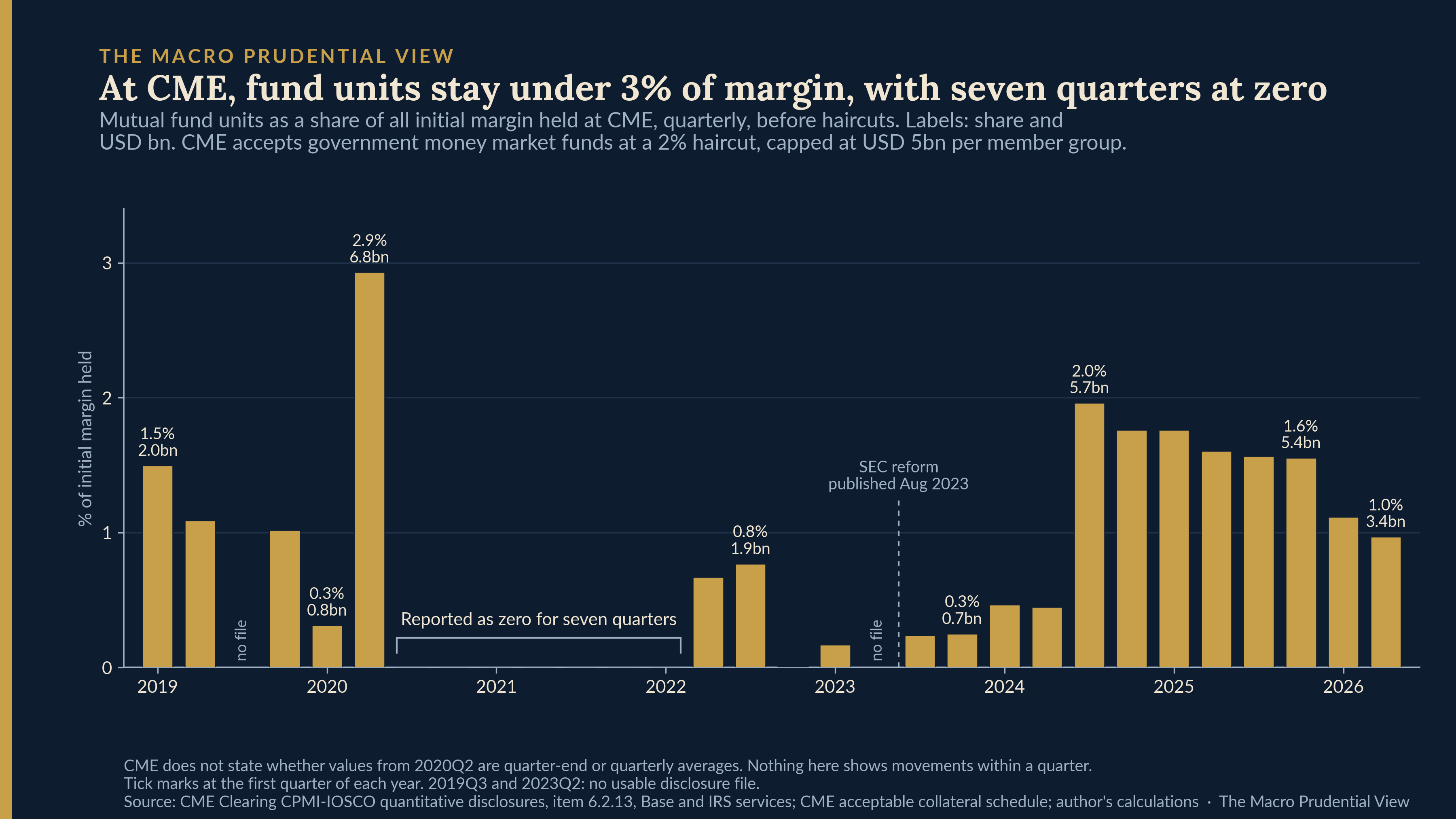
CME Clearing takes shares of 16 named US government money market funds. The haircut is 2%, against 0.5% for Treasury bills. Other things equal, that difference gives a member with bills to spare little reason to post fund shares. A member and its affiliates may post at most USD 5 billion. A member’s holding in any one fund is limited to the lesser of 5% of the fund or USD 1.5 billion, and all holdings through the programme to 10% of a fund. In its disclosure for the June quarter the shares came to USD 3.4 billion, 1.0% of the margin CME held. Use has been small and uneven, as C3 shows: never as much as 3% of margin, nothing for seven quarters after mid-2020, under 0.3% around the SEC’s reform in 2023 and between 1% and 2% since mid-2024. The series cannot say what moved it. Two things make the US product easier than the European one. Since the SEC’s 2023 reform, US government funds have no temporary gate at all and no liquidity fee unless they opt in. A US fund’s board may suspend redemptions on its own decision only once it has irrevocably decided to liquidate the fund; otherwise a suspension needs circumstances the statute specifies or an SEC order. And CME’s rulebook lets it pass members’ collateral to liquidity lenders to raise cash. Its public pages do not say how fund shares are realised on a default. I have found no public account of a clearing house realising fund units on a member’s default, there or anywhere else.
The Options Clearing Corporation shows that permission is not use: its rules allow money market funds, and its disclosure says none is currently accepted. Brazil’s B3 runs its own margin fund, which it reports inside government bonds.
India is the outlier. The securities regulator prescribes what clearing corporations may take, and classes units of liquid, overnight and government-securities schemes as cash equivalents, mostly at a 10% haircut against 2% for bills. At NSE Clearing those units were INR 1.5 trillion before haircuts at the end of June and INR 1.6 trillion in September, 15% of the margin held at both dates, up from 6% at the end of 2019. Almost all of it is client margin.
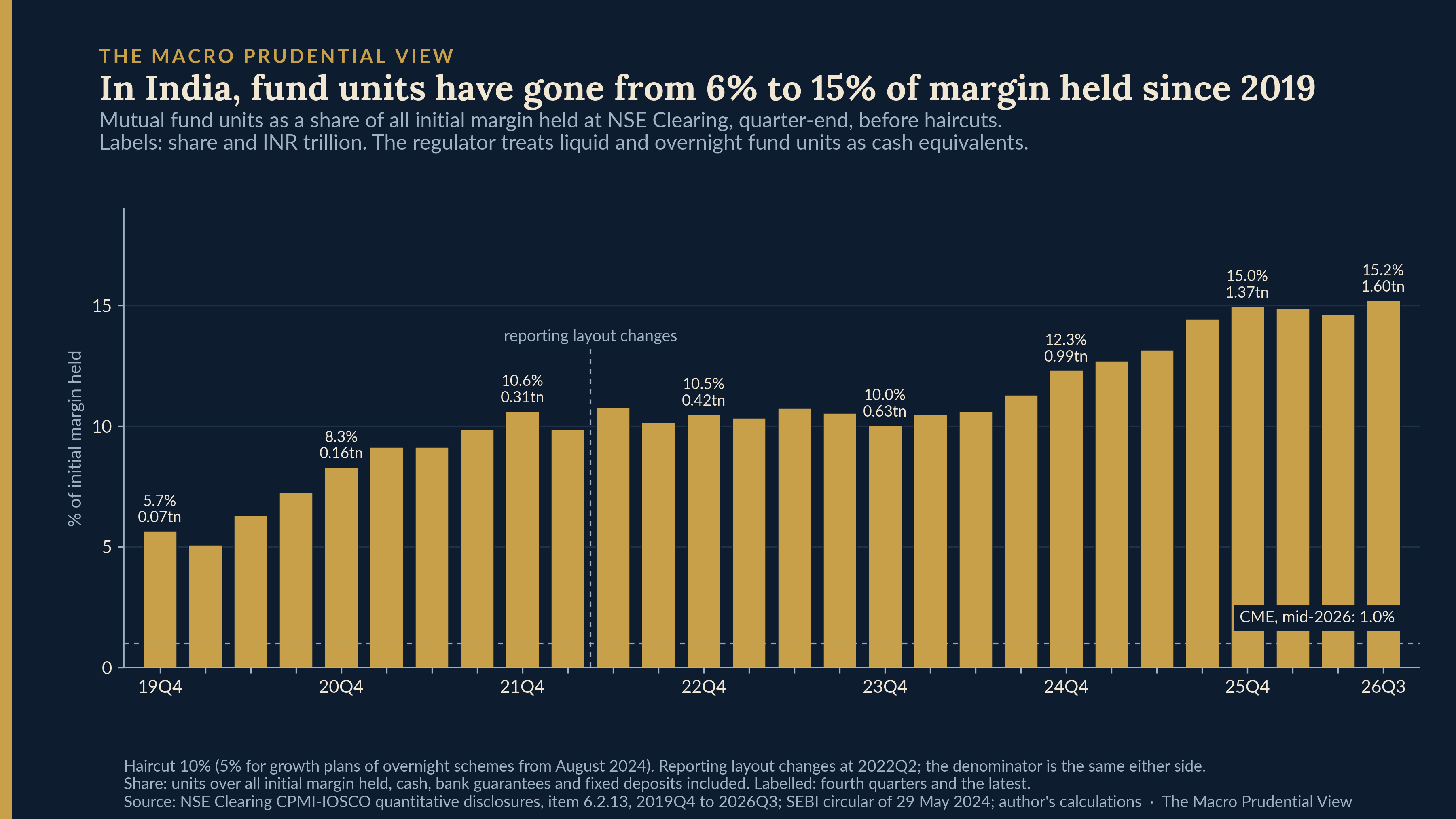
It would be easy to read India as proof that fund units work as margin at scale. I do not think the public record supports that. The one disclosed enforcement route, written for a broker calling on a client’s pledge, is redemption with the fund. The clearing corporation’s own procedure is not published. The one stress in the series, March 2020, came when the stock was a twenty-fifth of today’s, and quarter-end figures cannot show what happened inside the quarter. India shows a regulator choosing a design. It does not show the design tested.
At the end of June, after haircuts, CME held USD 3.3 billion of fund units and NSE Clearing INR 1.38 trillion, which is USD 14.6 billion at the Reserve Bank of India’s reference rate of 94.6 rupees to the dollar. Together that is about USD 18 billion of the roughly USD 19 billion of fund units in CCP Global’s aggregate of clearing-house disclosures for the same date. The two are different exposures: at CME the shares are members’ collateral, in India almost all clients’.
What a bounded programme would need
The strongest case for the brief can be put in one breath. No EU money market fund suspended redemptions in March 2020. Liquidity sits far above the thresholds. A sleeve of 1% of margin, capped by fund and by member, can sit behind cash and government bonds in the order of use. CME has run one for years without a public incident, though with a gap of seven quarters. I accept all of it. If the classes were opened, nothing above would rule such a programme out.
The evidence identifies the pieces such a programme would need in Europe, and where each stands.
Transferees accepted in advance. If the fund has already accepted the clearing house and its members as holders, a defaulter’s units can pass to them without a decision by the board on the day. None of the five prospectuses contains such a term. BlackRock’s allow-list for its tokenised classes is the nearest thing to one, and here the token does help. Being accepted is not the same as being willing, or funded, to take the units in a stress. Nor is a list of accepted holders the active market, with a diverse group of buyers and sellers, that the standard asks for. That condition would have to be met some other way or rewritten. And at BlackRock a suspension stops transfers as well, so acceptance in advance would not be enough there.
Limits by fund and by member group, so that the clearing house is not the redemption the fund’s liquidity rules did not plan for. CME has these. The EU standard already requires concentration limits by issuer, by type of asset and by member; the open point is how they would apply to a fund. They matter more in euro, where the product is small. Public debt funds are about 12% of an EU money market fund sector of nearly EUR 2 trillion, and almost all of that is in dollars and sterling. From the managers’ factsheets I can identify five euro public debt constant-NAV funds (BlackRock, Goldman Sachs, Morgan Stanley, HSBC and State Street), with about EUR 10 billion between them. One per cent of the margin held at Eurex Clearing alone is EUR 1.2 billion, about an eighth of that. Four of the five hold EUR 1.1 billion or less, so at any of them a redemption of EUR 110 million in a day would by itself pass the 10% test. Four have launched since January 2024, so supply is responding.
Funding behind the units for as long as a suspension can last. This is the piece the liquid-resource rule asks for, and the one I could find least about anywhere. Either the clearing house’s other liquid resources carry the units, or a lender agrees in advance to take them. The obvious lenders are banks that are also clearing members, and EMIR lets one member’s group provide no more than 25% of the credit lines a clearing house needs. A lender that takes the units as security meets the same suspension, so the commitment has to hold without relying on them. Two further conditions cannot be tested from public data. The same funds and lenders may stand behind several clearing houses, so each plan has to work when the others draw at once. And if cash still falls short, the clearing house has to finance the gap or sell at a discount. A loss from that, once the defaulter’s own margin and default fund contribution are used up, passes down EMIR’s waterfall to the clearing house’s own resources and then to the default fund, which the surviving members pay for, including those that posted no units. A suspension under general fund rules has no fixed limit, so 15 working days is not the longest case to plan for.
A haircut that covers a fee and, if the units have to be financed and not redeemed, the lender’s discount.
The Commission’s review treats the use of money market funds as a “collateral / margin liquidity vehicle” as a source of pro-cyclical redemptions, with the September 2022 gilt episode as its example. A clearing house that held units would redeem them when a member defaulted, which is when funds are likely to be under pressure already. Against that, a member able to post units need not redeem them to meet a call for initial margin, which is part of the channel the Commission describes. Variation margin is paid in cash, and that part is untouched. Public data do not say which effect is larger. I wrote about synchronised margin calls in Safe, Senior, and Synchronised; this bears on the same problem.
The questions this leaves
For a clearing house and its supervisor: would a fund unit count as a liquid resource, and if not, for how long would the liquidity plan carry it?
For fund supervisors: should a suspension bind a clearing house enforcing a pledge in the same way as any other holder, when an exemption would be paid for by the holders who remain, and do the liquidity expectations for these funds allow for a holder that redeems only on a default?
For ESMA and the Commission: the Bank of England has asked about fund units by name. The standard was reviewed this year and the classes were left as they were. Where in the EU does the question get taken up: an ESMA Q&A on whether fund units are admitted at all, the collateral standard, or the review of the Money Market Fund Regulation?
The Bank’s consultation closes on 12 February, ESMA’s on 15 January.
Paweł Fiedor - The Macro Prudential View
Positions described are as at 14 November 2026.
The author works at the Central Bank of Ireland and in the ESRB Secretariat. This piece is written in a personal capacity; views are the author’s own and should not be attributed to the Central Bank of Ireland, the ESRB, or the Eurosystem. It draws exclusively on publicly available sources and takes no position on whether the policy measures discussed should be adopted.
Sources: Bank of England, Consultation on supervisory expectations for central counterparties seeking to accept tokenised collateral, 29 October 2026; C. Borgogna, MMFs and collateralization: An opportunity financial markets should stop missing, SUERF Policy Brief No 1606, November 2026; ESMA, Call for evidence on CCP collateral tokenisation, ESMA91-1505572268-4934, 9 October 2026; ESMA, Final report on guarantees as CCP collateral and CCP investment policy, ESMA91-1505572268-4904, 19 October 2026; Deutsche Börse Group, response to ESMA consultation ESMA91-1505572268-4513, 2026; ESMA_QA_604, CCP collateral requirements, 12 October 2022; Commission Delegated Regulation (EU) No 153/2013, consolidated text of 7 March 2024, Articles 26, 32 and 33 and Annex I; Regulation (EU) No 648/2012, consolidated text of 17 January 2025, Articles 44 and 45; Directive 2014/65/EU, Article 4(1)(17) and (44) and Annex I Section C; Regulation (EU) 2017/1131, Article 34; Directive 2009/65/EC, Article 84; European Commission, Report on the adequacy of Regulation (EU) 2017/1131, COM(2026) 350, 11 May 2026; ESMA, Consultation report, EU Money Market Fund Regulation – legislative review, ESMA34-49-309, 26 March 2021; Eurex Clearing, Circular 035/2016, Admission of ETFs as collateral, 21 March 2016; Eurex Clearing, collateral support page; clearing houses’ CPMI-IOSCO public quantitative disclosures, items 6.2 and 7.1, 2015 to 2026Q3; CCP Global, PQD Quarterly Trends Report, 2026 Q2; prospectuses of Institutional Cash Series plc (BlackRock), 18 September 2026, HSBC Global Liquidity Funds plc, 31 March 2026, State Street Liquidity plc, 30 September 2025, Goldman Sachs Funds, plc, 29 May 2026 and Morgan Stanley Liquidity Funds, April 2026; BlackRock, Institutional Cash Series OnChain Shares brochure, 2026; Deutsche Börse, ETF & ETP statistics, September 2026; CME Clearing, summary of acceptable collateral and IEF2 money funds programme, read 14 November 2026; CME Rulebook, Chapter 8, Rule 817; SEC, Money Market Fund Reforms, 88 FR 51404, 3 August 2023; Investment Company Act of 1940, section 22(e) (15 U.S.C. 80a-22) and 17 CFR 270.22e-3; fund factsheets of the five euro government funds, read November 2026; OCC, PFMI disclosures; B3, clearinghouse risk management and quantitative disclosure; SEBI, Norms for acceptable collaterals and exposure of Clearing Corporations, SEBI/HO/MRD/MRD-PoD-3/P/CIR/2024/65, 29 May 2024; SEBI, Margin obligations to be given by way of pledge/re-pledge in the depository system, SEBI/HO/MIRSD/MIRSD-PoD/P/CIR/2025/82, 3 June 2025; NSE Clearing, PFMI and quantitative disclosures, 2019Q4 to 2026Q3; Reserve Bank of India, Handbook of Statistics on the Indian Economy, Table 223, reference rate for 30 June 2026; AMFI, monthly report, March 2020; ESRB, EU Non-bank Financial Intermediation Risk Monitor 2025, September 2025.