


On 26 October the People’s Bank of China announced a facility with an unwieldy Chinese name and a tidier English one, the Bond Market NBFI Swap Facility. It is meant for a specific scenario: asset managers facing collective liquidity risk while the bond market is under systemic stress. In that scenario, systemically influential bank wealth-management subsidiaries and public fund managers, or their parent banks and securities parents, can borrow central bank bills from the PBoC. They repo the bills for cash, use the cash to buy eligible bonds or units from public products of “本公司(或资管子公司)”, the firm itself or its asset-management subsidiary, that are facing redemptions, and pledge what they buy to the PBoC. The announcement is one paragraph, issued by the Open Market Operations Office, and it said nothing about price or recourse. The PBoC’s third-quarter monetary policy report, published on 11 November, filled in both: purchases are to be made at fair prices, and the borrower repays the PBoC in full and keeps the gains or losses. It still gives no haircut, fee, tenor or size, and the PBoC has announced no operation.
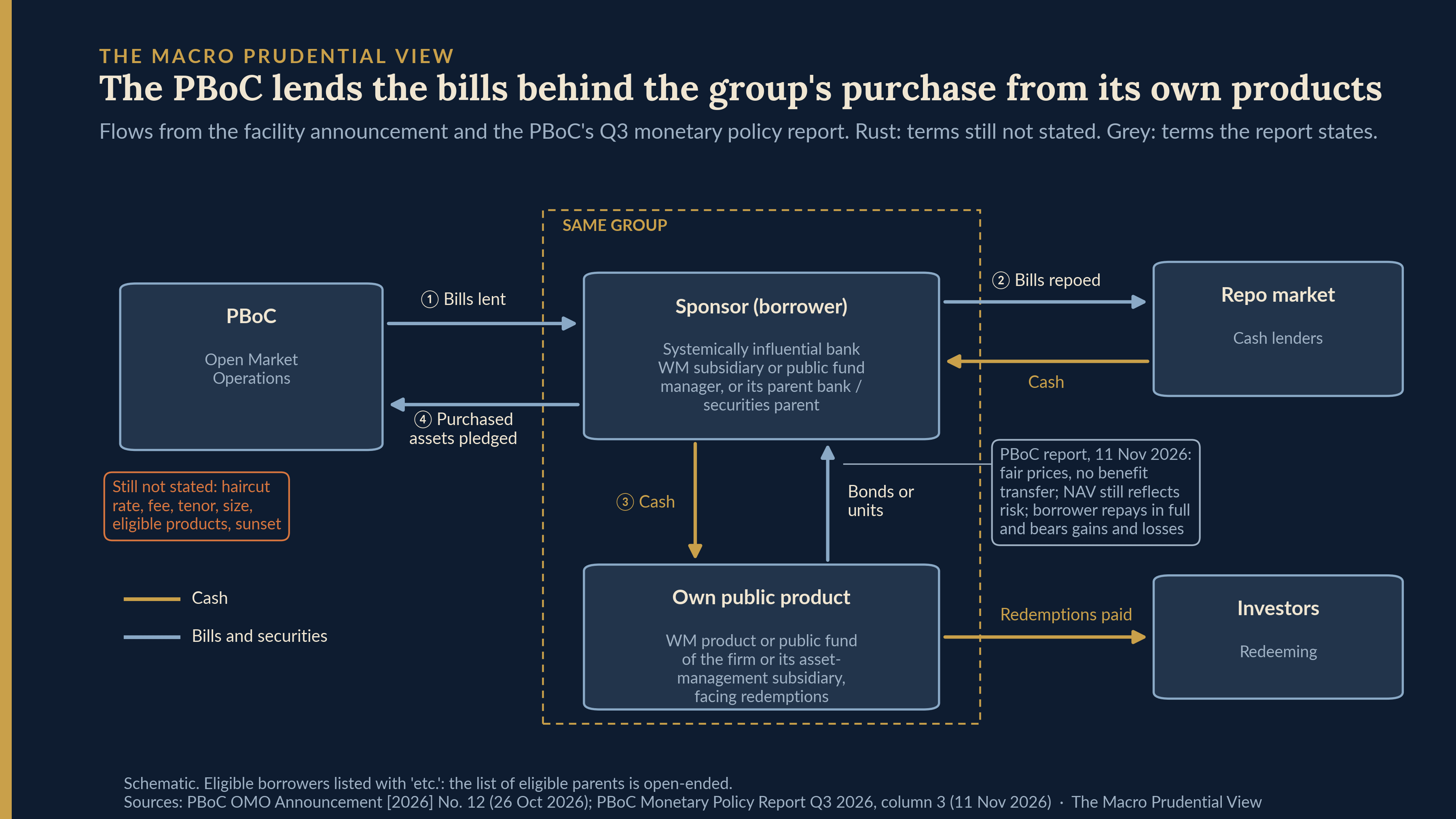
The design choice that interests me is the word “own”. The PBoC lends bills to a fund’s own group, and the group uses the proceeds to buy the fund out of a run. That casts the group as a sponsor of last resort, financed by the central bank, and it raises a question every sponsor-support regime has to answer somewhere: when the group buys from its own fund in a stress, may it support the fund, and if it does, who bears the loss?
The United States, in its standing rules for money market funds, makes the sponsor absorb the loss on such a purchase, and for other funds it does not allow the purchase without an exemption. The European Union prohibits sponsor support for money market funds. China’s answer depends on how the product is valued. Its money market fund rules put losses past a set point on the manager’s reserves or own capital, and later rules write the manager’s shareholders into liquidity plans, though how that sits with the 2018 ban on rigid redemption is not fully settled; its marked-to-market products may receive liquidity from the sponsor at the mark and nothing more. The BNSF finances the sponsor’s purchases. Its announcement did not say at what price; the PBoC’s report now says fair value, which puts the facility with the last of these answers, though it does not say which products qualify or what a fair price is in a run.
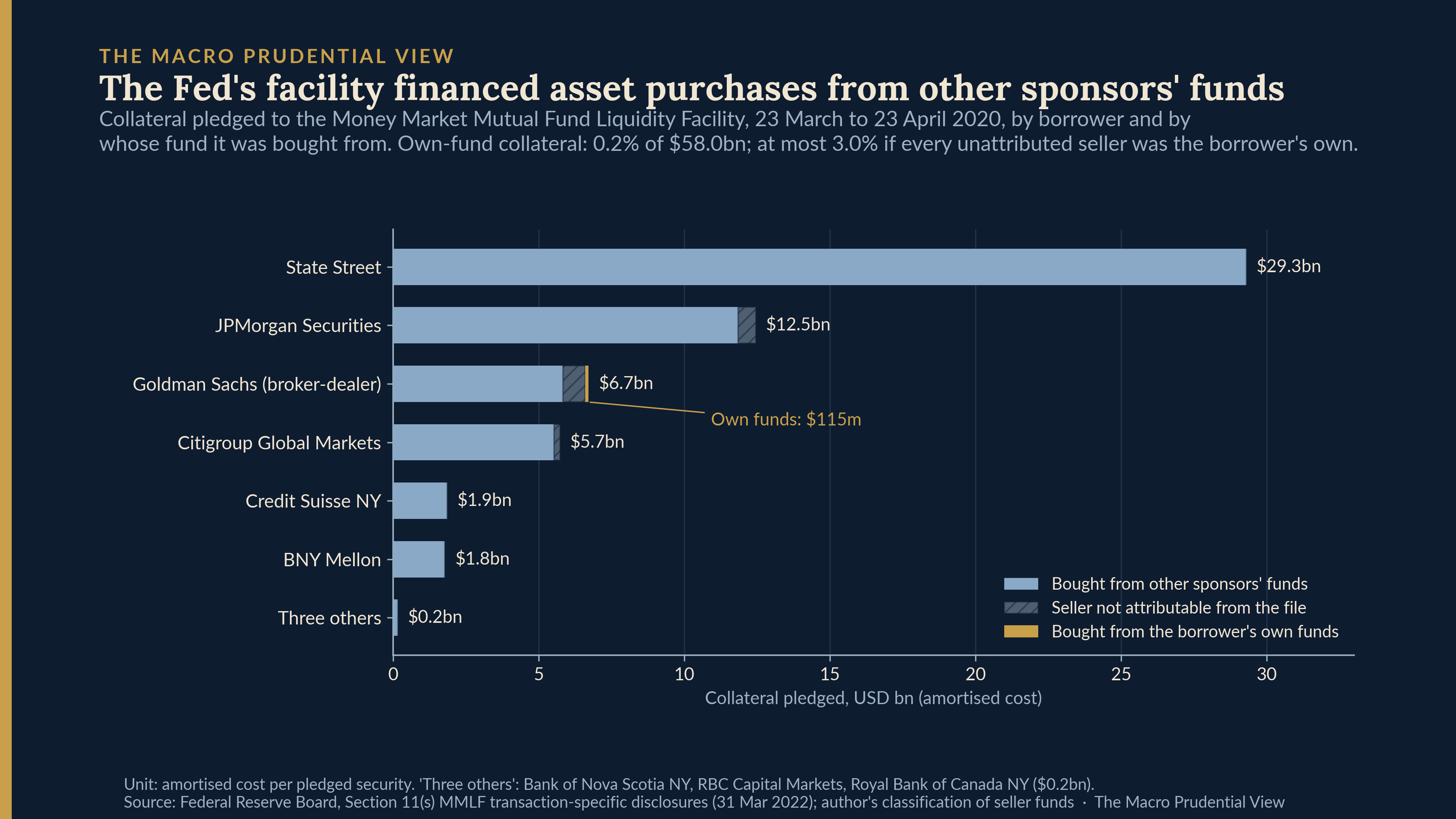
The facility’s restriction to the group’s own products concentrates the shock in the eligible groups and leaves products whose sponsor will not borrow outside the channel. The nearest comparison, the Federal Reserve’s money market facility of March 2020, which the PBoC’s report itself cites as a model, was open to own-fund purchases and was used almost entirely for purchases from other sponsors’ funds: 0.2% of its collateral came from the borrower’s own fund family, 3.0% at most.
What a sponsor purchase moves
I use three numbers throughout: the fund’s carrying value of the asset (B), its fair value (V) and the affiliate’s price (P). The price splits the gap B − V between the fund’s remaining investors, who book B − P, and the affiliate, who pays a premium of P − V.
For a fund that marks its assets to market, B and V coincide, and a sale at fair value moves no loss already incurred: investors already hold the marks. It does pass on the later price risk. The affiliate takes the later price risk on what it bought, and the investors who stay keep the risk on what is left. The gap is a feature of funds that carry assets at amortised cost, such as stable-NAV money market funds. Buying the fund’s units is a different transaction again. Units bought at a NAV that reflects fair value transfer no loss already incurred, though fair value at the scale of a run may be more than the fund could have realised by selling, so the sponsor still takes execution and liquidity risk off the fund; units bought at an amortised-cost NAV above the shadow value transfer the difference to whoever is paid out.
Three other things decide where losses end up. The first is any separate transfer from the sponsor group to the fund: a fair-value sale followed by a cash payment from the parent achieves the same result as a sale at book value, with a different paper trail. The second is what happens to the asset afterwards. The affiliate now holds it, and later losses or gains land wherever its own contracts put them; a parent that promises to reimburse its bank subsidiary keeps them inside the group. The third is the financing. A non-recourse central bank advance passes losses beyond the haircut to the central bank, and to the Treasury where there is a fiscal backstop. A recourse loan leaves the borrower contractually liable, and the central bank still loses if the borrower defaults and the collateral falls short, which is most likely in exactly the stress that activates the facility. The BNSF has two financing legs, a bill loan from the PBoC secured by the pledged assets and a market repo of the bills. The PBoC’s report says the borrower “到期足额偿还央行债权,承担工具运用的收益或损失”: it repays the central bank in full at maturity and bears the gains or losses. The claim is therefore a full-recourse loan to the borrower, secured on the pledged assets at a discount the report does not give. That discount caps what the PBoC lends against each asset, so any part of the purchase price above the PBoC’s valuation has to be financed outside the PBoC’s advance, from a source the PBoC does not specify. The price the fund receives is a separate matter, governed by the rules on related-party trades.
The second leg has its own economics. The group turns the bills into cash in the repo market, at whatever haircut and rate the market sets, so the cash it can raise depends on there being repo lenders willing to take PBoC bills in a bond-market stress. Reporting on the 2024 swap facility, which used the same structure, noted that it did not expand base money, and the PBoC says the BNSF borrows that structure, so the same should hold here: the cash comes from existing repo lenders rather than from new central bank reserves. The MMLF lent reserves directly. The BNSF’s capacity is therefore bounded by the PBoC’s valuation of the pledged assets and by the repo market’s appetite for the bills, and whatever the purchase costs beyond that is the group’s to fund.
The United States: the sponsor absorbs the loss by rule
Rule 17a-9 under the Investment Company Act is the exemption that lets an affiliate buy a security from its own money market fund at all. (For other funds there is no equivalent: section 17(a) of the Act makes it unlawful for an affiliate “knowingly to purchase from such registered company … any security”, absent an exemption from the SEC.) It requires a cash price equal to “the greater of the amortized cost of the security or its market price” and, for a security that is still eligible and has not defaulted, repayment to the fund of any gain on a later sale. When amortised cost exceeds market value, the price condition puts B − P at zero and the premium on the sponsor; when it does not, the price is market value, the fund books a gain over carrying value, and the sponsor pays no premium over what the asset is worth. The rule permits the purchase and obliges no one to make it.
When the affiliate is a bank, section 23A of the Federal Reserve Act gets in the way: the Board’s own letters recite its limits of 10% of capital stock and surplus for any one affiliate and 20% for all of them. On 17 March 2020 the Board issued exemption letters for purchases from affiliated money market funds, up to “200 percent of Bank’s capital stock and surplus” and only to cover net redemptions, in “investment grade” assets, at “fair market value as determined by a reliable third-party pricing service”, with the parent holding company bound to “reimburse Bank promptly for any losses”, both to stay well capitalised, for six months. On 19 March SEC staff said they would not object to affiliated purchases at that fair market value, where banking rules conflicted with 17a-9, provided each was reported on Form N-CR. The EDGAR form indexes for the first half of 2020 list sixteen N-CR filings, all in the first quarter, from four funds; four report only a NAV deviation, and the sponsor-support items come from two groups.
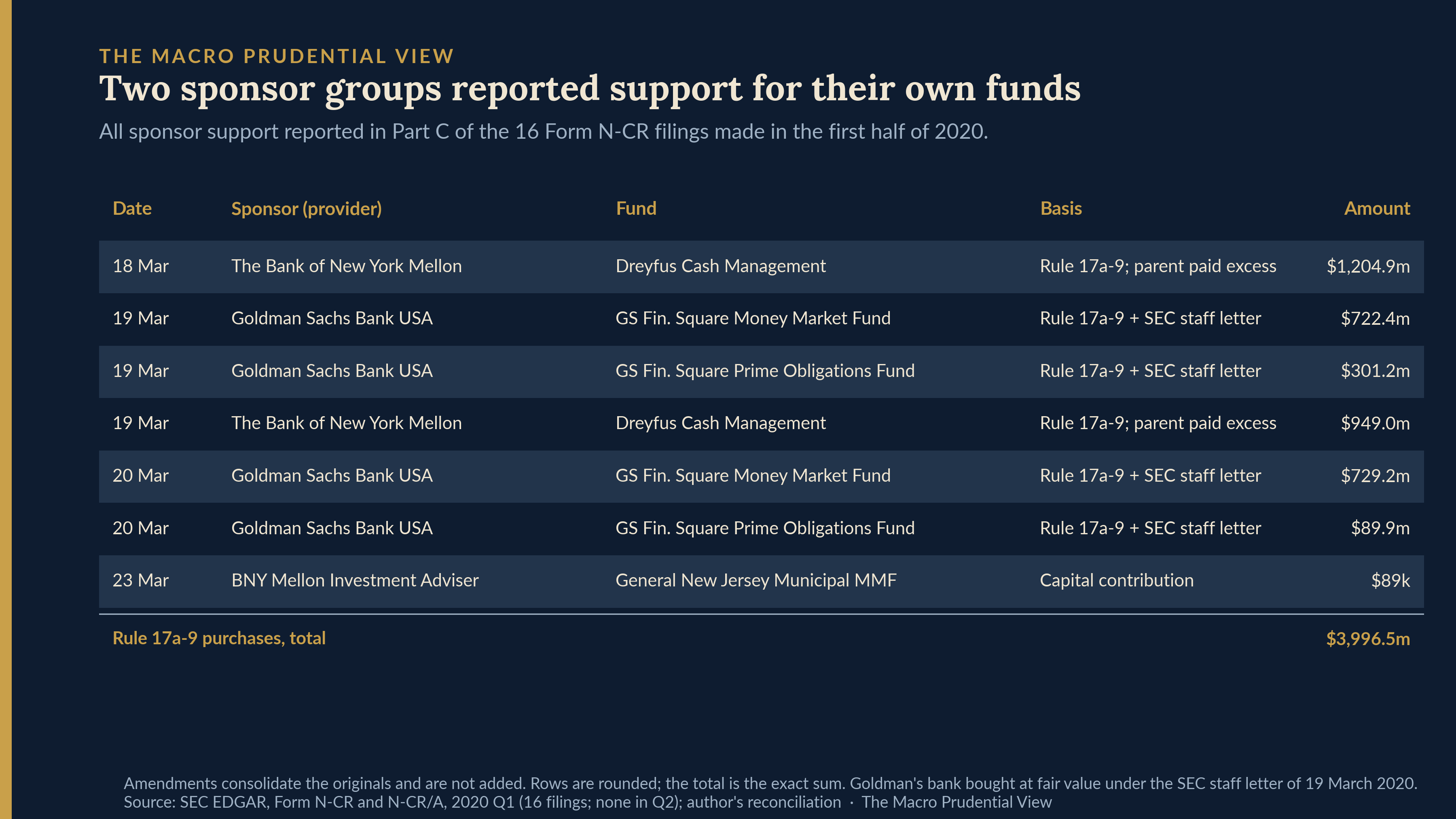
The two sponsors reached the 17a-9 result in different ways. BNY Mellon’s bank paid fair market value, as the Board’s letter required, and its filing states that “The Bank of New York Mellon Corporation paid the excess of amortized cost over fair market value to the Fund”. The fund received the 17a-9 price through a structure the staff letter made possible, and the group’s quarterly report puts a number on the cost: $2.2bn bought from affiliated funds “in order to provide liquidity support”, at a price “in excess of the fair value by $8 million”. Goldman’s bank bought $1.84bn at fair value, which “closely approximated their face values”, so there was little gap to allocate; its report adds that “Group Inc. has provided a guarantee to GS Bank USA in connection with these securities”, which places later losses with the parent and says nothing about funding.
The public facility shows a different pattern. The Money Market Mutual Fund Liquidity Facility, announced on 18 March and operated by the Federal Reserve Bank of Boston, lent non-recourse to banks against assets they bought from money market funds on or after 18 March, with $10bn of Treasury credit protection. Its FAQ B4 says a borrower that manages a qualifying fund “may fund the purchase of CP from [that fund] under this Facility”. The Fed’s section 11(s) disclosure has one row per pledged security, with its loan, the fund it was bought from and the purchase price; its loans run from 23 March to 23 April 2020. Of $58.0bn of collateral, $115m was bought from the borrower’s own fund family. That is 0.2%, or 0.23% of the $50.2bn pledged by the four borrowers whose groups ran money market funds. Some sellers appear only as abbreviations or generic master-fund names; counting all of them as the borrower’s own gives an outer bound of 3.0%. (I classified sellers by fund name against each borrower’s group; the classified file and the script are in the piece’s data folder at github.com/pafiedor/tmv-data.)
Timing is the obvious objection: the own-fund purchases came on 18–20 March and the facility opened on 23 March. Its rules weaken that explanation without replacing it. Commercial paper bought from 18 March could be pledged until 25 March, and by 10 April the FAQ treated a bank’s fair-value purchases under a 23A exemption as bought at amortised cost. But paper issued directly by a foreign entity was excluded, and CDs qualified only if bought from 23 March; BNY’s purchases were commercial paper of non-US banks and bank CDs, and the filings do not show which would have passed. BNY’s report is the one record of a choice: the facility financed $650m it bought from third-party funds, and nothing suggests its affiliate purchases were financed that way. One case is not a pattern.
Coverage is the second caution. Five Goldman securities pledged on 25 March appear in none of its N-CR filings, although the form counts any “purchase of a security from the fund in reliance on § 270.17a-9” as support, whatever the price, unless the fund’s board determines it was not intended as support. I cannot tell which applied, so T2 may be narrower than every affiliate purchase.
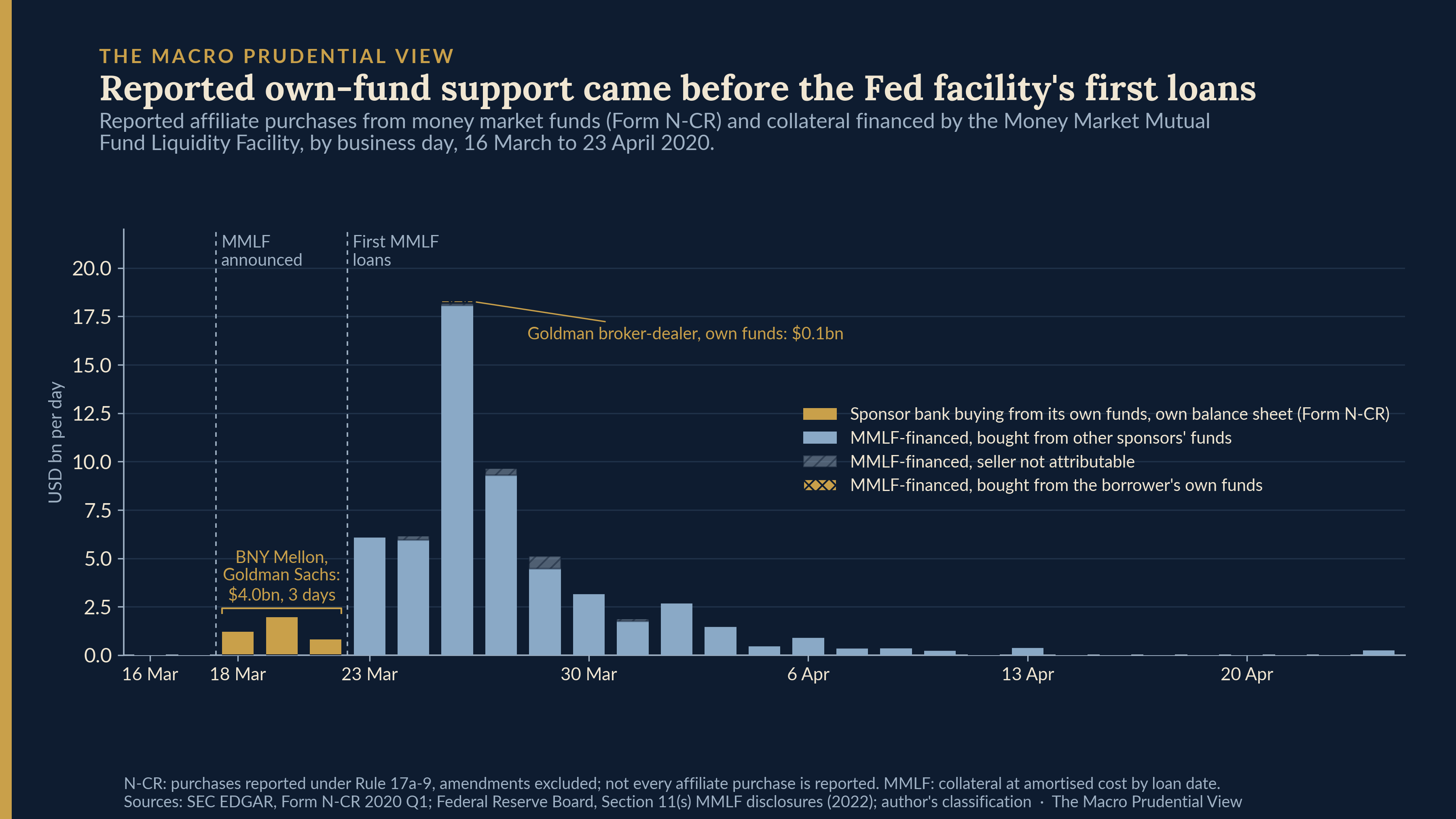
The record therefore supports two narrower statements. The own-fund support that was reported came before the first MMLF loans and reached the 17a-9 price inside the sponsors' groups, with the parent behind the bank in both cases. The facility, open to own-fund purchases by design, financed purchases from other sponsors' funds almost exclusively. That composition partly reflects sequence and rules as well as choice, since 17a-9 with 23A relief gave sponsors a private channel before the facility opened, and it does not show that every fund that needed a buyer found one.1
The European Union: support is prohibited for money market funds
Article 35 of the Money Market Funds Regulation starts with a sentence of seven words: “A MMF shall not receive external support.” External support is support from “a third party, including a sponsor of the MMF”, that would in effect guarantee the fund’s liquidity or stabilise its NAV, and the list includes cash injections, purchases of the fund’s assets “at an inflated price”, purchases of its units “in order to provide liquidity to the fund”, and any action whose objective is to maintain the fund’s liquidity profile and NAV. Recital 49 gives the reasoning: support of this kind increases contagion between funds and the rest of the financial sector, and because sponsors do not commit to it in advance, “the discretionary nature of sponsor support contributes to uncertainty among market participants about who will bear losses”.
Read against the table above, the BNY Mellon payment is the kind of transfer that list describes: cash from the sponsor’s parent to the fund, paid to hold it at amortised cost. ESMA’s statement of July 2020 sets out how the prohibition applies to dealings with affiliates. They are allowed “provided the requirements of Article 35 … are met”. A purchase executed at arm’s length is not a purchase “at an inflated price”, which settles one item on the list and no other. A third party that transacts “solely with the MMFs to which they are affiliated” gives an indication that its objective is to maintain the fund’s liquidity and NAV, which is the item at the end of the list.
Applied to the BNSF’s design, those tests would bite if the products were EU money market funds. The facility finances purchases from the purchaser’s own products only, and purchases of units as well as bonds, for the stated purpose of meeting redemptions. Unit purchases of that kind are on Article 35’s list as written, and an own-products-only programme of asset purchases fits ESMA’s indication even at arm’s-length prices. Rule 17a-9 does not require a sponsor to buy, but if it buys when amortised cost exceeds market value it must pay a price the EU rule would treat as inflated; the Chinese facility finances a pattern of dealing that ESMA reads as a sign of support.
Article 35 applies only to money market funds, though, and most of what the BNSF is aimed at would be a bond fund in Europe. EU bond UCITS and AIFs have no blanket external-support prohibition of the MMFR kind. Affiliate purchases from them are subject to the conflict-of-interest and best-interest duties in the UCITS and AIFM Directives (Articles 12 and 14 of each) and their implementing rules. The EU’s answer to a bond-fund run is a different instrument. Directive (EU) 2024/927, which Member States had to apply from 16 April 2026, requires managers of open-ended AIFs and UCITS to select at least two liquidity management tools from a prescribed list (money market funds may choose one), so that redemption pressure is handled first inside the fund. Its recitals present it as implementing the ESRB’s Recommendation of December 2017 on liquidity and leverage risks in investment funds. For public debt CNAV and LVNAV money market funds, Article 34 of the MMFR already provides liquidity fees, gates and suspensions. Central bank financing is a separate question, and the EU has nothing for bond funds there either.
On the financing side, the euro area has no dedicated facility that lends against assets bought from money market funds, in 2020 or since. I set out the broader gap, the absence of a euro-area liquidity facility for non-banks, in April.
China: the answer depends on how the product is valued
Since the 2018 guiding opinions on asset management, Chinese asset-management products must be managed on a net-value basis and measured at fair value. Article 18 allows amortised cost only for closed-end products that hold assets to maturity or hold assets with no reliable market price. A product facing redemptions is open-ended, so under that rule it is marked to market. Two product types are exceptions, each under its own rules, and they give different answers.
Public money market funds may use amortised cost under the 2016 measures issued by the CSRC and the PBoC, with shadow pricing against market values. Article 12 of those measures sets the triggers. At a negative deviation of 0.25% the manager must reduce it to within 0.25% inside five trading days. At 0.5% the manager “应当使用风险准备金或者固有资金弥补潜在资产损失”: it must use its risk reserve or its own capital to make good potential losses. Past 0.5% for two consecutive days, the fund must move to fair value or suspend redemptions and liquidate. For these funds the standing Chinese answer resembles the American one on its face: beyond a set point, the sponsor pays. The measures predate the 2018 opinions, which prohibit an institution from paying out a product’s investors with its own funds. The 2016 measures nonetheless outlived that ban. The CSRC and the PBoC’s 2023 provisional rules for important money market funds (CSRC Announcement No. 42) list “《货币市场基金监督管理办法》” among their legal bases in Article 1 and cite it again for enforcement in Article 18. They also add to it, though they deal in liquidity rather than losses. Article 14 requires the manager to draw up risk plans with its main shareholders and controllers that set out, for each degree of stress, “应对方式和资金来源”, how the fund will be handled and where the money will come from. They let the manager’s risk reserve, accrued from at least 20% of management and custody fees, be used “用于重要货币市场基金的流动性支持”, for the fund’s liquidity support, with CSRC approval (Article 16), and they require the manager to agree in advance with its main shareholders and custodian on short-term repo financing for the fund in a liquidity stress (Article 17). That is a privately arranged, within-group version of what the BNSF now does with central bank money, written five years after the rigid-redemption ban. I have found no official statement of how the 2016 top-up and the 2018 ban fit together, and no case in which the top-up was enforced, so the money market fund answer rests on rules the regulators still cite.
Cash-management wealth-management products may also use amortised cost, under a 2021 notice from the banking regulator and the PBoC that copies the deviation triggers. At 0.5% it requires the bank or wealth-management company to “采取相应措施”, take corresponding measures, without naming where the money comes from. The notice caps the amortised-cost products of any one company at 200 times its risk reserve.
Everything else the facility can reach, which includes the bond wealth-management products and bond funds that a bond-market stress would hit first, is marked to market. For these products the relevant Chinese rules govern the price of a related-party trade, and they leave little room for support. Where a bank wealth-management subsidiary uses its own money, the 2018 measures for those subsidiaries (an order of the then banking and insurance regulator, the CBIRC) cap in Article 33 its holdings of its own products at 20% of its own funds and 10% of any product’s net assets, and add that “其自有资产与发行的理财产品之间不得进行利益输送”: there may be no transfer of benefit between its own assets and its products. Where a product trades with the subsidiary’s shareholders and related parties, which covers a parent bank, Article 42 requires terms “不优于对非关联方同类交易的条件”, no better than those offered to unrelated parties, with full disclosure, and approval and a report to the regulator for major transactions. The Article 33 caps may bind before any question of price arises: a subsidiary near them cannot buy its own products’ units with its own money, and whether purchases under the facility are exempt is not stated. An exemption would expand what the group could buy; whether those purchases then move losses still depends on the price. The 2021 liquidity measures for wealth-management companies require fair dealing and fair pricing in trades between products and the company or its affiliates. For public funds, Article 73 of the Securities Investment Fund Law requires major related-party transactions to put holders’ interests first and be disclosed, and the CSRC’s 2022 measures for fund managers bar improper related-party dealing with fund assets. Over all of it sits Article 19 of the 2018 opinions, which treats an institution that “自行筹集资金偿付或者委托其他机构代为偿付”, that pays a struggling product’s investors with funds it raises itself or through another institution, as providing the rigid redemption the opinions prohibit.
On these rules, the sponsor of last resort for a marked-to-market product looks like a buyer at the mark. That is a reading of related-party and benefit-transfer provisions written for other purposes: they appear to constrain preferential transfers, but no single rule governs purchases in a run, and the valuation benchmark in a stressed market is unresolved. The sponsor supplies cash so the product does not have to sell into a falling market; investors bear the valuation loss up to the sale, the sponsor takes the later price risk on what it bought, and the investors who stay keep the risk on the rest. The weak point is the mark itself. The facility is triggered by systemic stress in the bond market, which is when market prices are least reliable, and a valuation chosen generously is a transfer of benefit that is hard to catch after the fact.
China has run something like this loop before, informally. In November 2022 a bond-market selloff pushed thousands of wealth-management products below par (4,932 of the 28,038 that reported a NAV on 9 December, on 中国理财网 data cited by the China Securities Journal) and set off redemptions. In December, Bloomberg reported that regulators had given some of the largest banks window guidance to buy bonds through their proprietary desks, to absorb the selling caused by withdrawals from those same banks’ wealth-management products. The report does not say the banks bought from their own products, only that their buying was meant to offset their own products’ selling. That is close to own-group support, arranged by guidance, priced by the banks and financed on their own balance sheets. The BNSF puts central bank financing behind the same loop and writes it down, and the PBoC now says the price is fair value.
The BNSF announcement mentioned none of these rules. The PBoC’s monetary policy report of 11 November addresses them. Purchases of a product’s assets or units “坚持公允定价、风险隔离,杜绝不公平交易、利益输送等行为”: fair prices and risk isolation, with no unfair dealing or transfer of benefit. And “产品净值仍会真实反映投资风险,不属于刚性兑付”: the products’ NAVs still reflect the investment risk, so this is not rigid redemption. That confirms the reading above for marked-to-market products and places the facility, in the PBoC’s own description, on the right side of the 2018 ban. For money market funds it means the facility does not finance a top-up directly. What it does not say is how a fair price is set in the stress that triggers the facility.
The report followed what Governor Pan Gongsheng had said on 19 October, previewing the tool at the Financial Street Forum. As Xinhua reported it, the PBoC would set it up “会同金融监管总局、中国证监会”, together with the National Financial Regulatory Administration and the CSRC, and operations with the central bank “必须满足宏观审慎要求、提供高等级抵押品,防止金融市场定价扭曲、形成兜底幻觉,维护市场纪律”: they must meet macroprudential requirements and be backed by high-grade collateral, so as to avoid distorting market prices or creating an illusion of a backstop, and to preserve market discipline. The report puts that in writing: the facility “更不会兜底个别机构的信用风险”, will not backstop the credit risk of individual institutions, and “工具运用是救市场而不是救机构”, it rescues the market, not institutions. The same column calls the products “接受救助的产品”, products receiving rescue, so the line between supporting the market and supporting particular products is less clean in the text than in the slogan.
The rest of the terms will probably come with an operation. The report says the BNSF’s mechanics are borrowed from the PBoC’s Securities, Funds and Insurance Companies Swap Facility, announced on 10 October 2024 with an initial size of RMB 500bn. Its fee and term arrived with its first operation, on 21 October: RMB 50bn to 20 institutions, at a fee set by tender (20bp), for one year. If the BNSF follows that template, its haircut, fee and size will be set when it is first used. No operation and no joint notice with the NFRA or the CSRC had been published by 12 November.
Who is the sponsor of last resort?
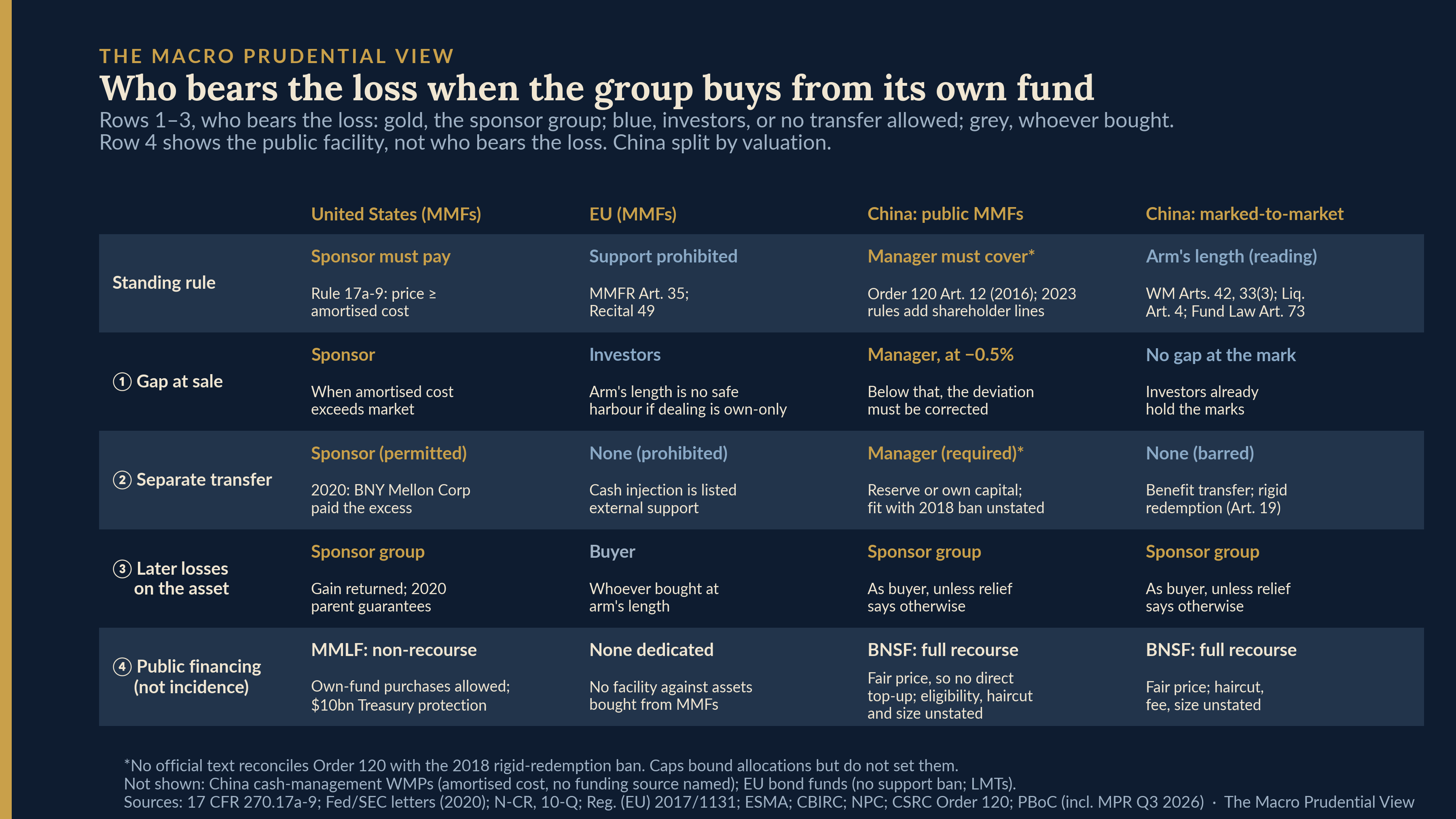
Because the PBoC requires fair prices, the BNSF does not pay for a money market fund top-up directly; but money is fungible, and a group whose purchases the PBoC finances has more of its own resources left for a separate payment.
There is another way to read the facility. Take away the purchase and the BNSF is lender-of-last-resort credit: collateralised central bank lending to large banks, securities firms and asset managers, on terms the governor says must preserve market discipline, with a condition on what the money may be used for. The PBoC’s report names its models: the Fed’s AMLF of 2008 and MMLF of 2020, and the Bank of England’s contingent repo facility for non-banks from 2024. The MMLF was built differently. It lent central bank money, non-recourse, with $10bn of Treasury protection; the BNSF lends central bank bills, and the cash comes from the repo market, so the PBoC’s exposure is to the bill borrower and its collateral, with no fiscal backstop. Where purchased units are pledged, the PBoC’s collateral is a claim on the very product facing redemptions. The larger difference is the condition. The MMLF let any eligible bank buy from any fund, and banks bought almost entirely from other sponsors’ funds. The BNSF lets a group buy only from its own products, which ties the central bank’s credit to the borrower’s own fund business and sends the liquidity through the relationship that sponsor-support rules exist to police.
Buying from its own products lets a group stop a fire sale before it starts. It also leaves the same group funding the purchases and bearing any later losses. If that group is a bank or securities firm under pressure of its own, as it may be in a systemic bond-market stress, the shock comes back to it through its own bond book and funding; if it is strong, concentrating the shock there is the intended effect, and why parents are eligible. The PBoC says as much: eligible groups have “资本实力更为雄厚,有更强的风险承担能力”, more solid capital and a greater capacity to bear risk. The haircut limits what the PBoC lends, and with its claim on full recourse it moves no risk off the group. And because only purchases from a borrower’s own products qualify, products whose sponsor cannot or will not borrow get no direct purchase support through this channel, though their own sales still set the marks everyone else uses. The MMLF did not impose that condition. Whether the BNSF’s design leaves the system safer, on net, depends on whether the eligible groups stay as strong as the PBoC expects in the stress that triggers it. On either reading of the facility, the initial split of the loss is decided where the group buys, and the PBoC has now said that split is at fair value; later losses depend on whether the borrower stays sound, since the PBoC’s claim on it is full.
The 11 November report settles two of the four things the implementing documents had to settle. Purchases are at fair value, and the PBoC’s claim on the borrower is full. On the reading set out above, that makes the BNSF a liquidity facility for the group, with the PBoC exposed to the borrower’s default and to the collateral. Two remain open. The report names the eligible institutions but not the eligible products, so whether money market funds are in is unknown. And it does not say whether separate support from the sponsor is permitted alongside the purchases; it “鼓励行业机构与投资人合理共担风险”, encourages institutions and investors to share the risk reasonably, which could be read either way. Allowing purchases from other groups’ products would remove the own-group restriction, though on its own it would not make the BNSF the MMLF.
The haircut, the size and the eligible products will come with the first operation. What counts as a fair price in the run that triggers it will show whether the sponsor of last resort is a buyer at the mark or something more.
Paweł Fiedor - The Macro Prudential View
Positions described are as at 12 November 2026.
The author works at the Central Bank of Ireland and in the ESRB Secretariat. This piece is written in a personal capacity; views are the author’s own and should not be attributed to the Central Bank of Ireland, the ESRB, or the Eurosystem. It draws exclusively on publicly available sources and takes no position on whether the policy measures discussed should be adopted.
Data and code for the US figures (the MMLF classification and the Form N-CR reconciliation) are in tmv-data on GitHub.
Sources: People’s Bank of China, Open Market Operations Announcement No. 12 (2026), 26 October 2026; People’s Bank of China, 2026年第三季度中国货币政策执行报告 (Monetary Policy Report Q3 2026), column 3, 11 November 2026; 17 CFR 270.17a-9 (75 FR 10117, 4 March 2010); Federal Reserve Board, section 23A exemption letter (template), 17 March 2020; Federal Reserve Board, H.2 release, week ending 21 March 2020; SEC Division of Investment Management, staff letter to the Investment Company Institute, 19 March 2020; SEC EDGAR, Form N-CR and N-CR/A filings, 2020 Q1; SEC EDGAR form index, 2020 Q2 (no N-CR filings); The Bank of New York Mellon Corporation, Form 10-Q, Q1 2020; The Goldman Sachs Group, Inc., Form 10-Q, Q1 2020; Federal Reserve Board, MMLF press release, 18 March 2020; Federal Reserve, MMLF frequently asked questions (B4); weekly MMLF balances, H.4.1 (FRED series H41RESPPALDBNWW); Federal Reserve Board, MMLF transaction-specific disclosures under section 11(s), 31 March 2022; Regulation (EU) 2017/1131, Article 35 and Recital 49 (consolidated text); ESMA, Public Statement ESMA34-39-1096, 9 July 2020; 商业银行理财子公司管理办法(中国银行保险监督管理委员会令2018年第7号), CBIRC, text hosted by NFRA; 理财公司理财产品流动性风险管理办法(2021), NFRA, docId 1024321 (published 10 December 2021); 中华人民共和国证券投资基金法(2015年修正), National Database of Laws and Regulations; 公开募集证券投资基金管理人监督管理办法(CSRC, 2022; amended 2025 by CSRC Order No. 227); 关于规范金融机构资产管理业务的指导意见(2018), Articles 18 and 19; Bloomberg, ‘China Asks Banks to Buy Bonds Via Prop Desks After Market Slump’, 14 December 2022; 中国证券报, report on wealth-management product NAVs citing 中国理财网 data as at 9 December 2022, 10 December 2022; Xinhua, report of Governor Pan Gongsheng’s remarks at the 2026 Financial Street Forum, 19 October 2026; 货币市场基金监督管理办法(中国证监会、中国人民银行令第120号, 2016), Arts. 11–12; 关于规范现金管理类理财产品管理有关事项的通知(中国银保监会、中国人民银行, June 2021), section 6; Directive 2009/65/EC (UCITS), Arts. 12 and 14; Directive 2011/61/EU (AIFMD), Arts. 12 and 14; Federal Reserve Board, AMLF press release, 19 September 2008; SEC, Money Market Fund Reform, Release No. IC-29132 (2010), 75 FR 10060; Directive (EU) 2024/927 of 13 March 2024 amending Directives 2011/61/EU and 2009/65/EC, recital 30 and the transposition article; 重要货币市场基金监管暂行规定(中国证监会、中国人民银行公告〔2023〕42号, 17 February 2023, effective 16 May 2023), Arts. 1, 13, 14, 16, 17, 18; 15 U.S.C. 80a-17(a) (Investment Company Act, section 17(a)); PBoC Securities, Funds and Insurance Companies Swap Facility, establishment, 10 October 2024, as reported by 每日经济新闻; the same facility’s first operation, 21 October 2024, as reported by China Daily.
March 2020 is not the only American episode. Sponsor support was widespread in 2007–08 (SEC, Money Market Fund Reform, Release IC-29132, 2010), and the Asset-Backed Commercial Paper Money Market Mutual Fund Liquidity Facility, from 19 September 2008, financed bank purchases of ABCP from money market funds on terms very similar to the MMLF. I use 2020 because its section 11(s) file names the selling fund behind every pledged security, which is what an own-versus-other split needs.
The question you end on, what counts as a fair price in the run that triggers the facility, seems to me where much of the practical difficulty sits.
From the servicing side, the fair value a fund books for a bond that has not traded is typically an evaluated price from a pricing vendor, built from observable inputs such as benchmark yields, reported trades, dealer quotations, and comparable securities. The Fed’s 2020 relief relied on exactly that concept: a “reliable third-party pricing service.”
The challenge is that those inputs become less informative when they are needed most. Bid-ask spreads widen, comparable trades become scarce, and the evaluator’s assumptions begin to matter more than they do in normal conditions. The fair-value requirement answers the pricing question in principle, but in the stress that activates the facility, much of the judgment sits in the mark itself.